
Humans have poured in innovation and ingenuity into developing communication modes and media. Today of course the world revolves around ‘social media’ but some of the older modes are quirky and beautiful. Here is a look at two of them:
Singing Telegrams: Popular in the 1930s in the US, these were telegrams sung out to the recipient. It began in 1933 when a fan sent a birthday greeting to Rudy Vallee, a popular singing star of the times. George Oslin, the Public Relations Officer of Western Union–the company which handled telegrams–was a man who thought differently. He had long been concerned with the ‘gloom and doom’ image of telegrams, which usually arrived to announce a disaster (those old enough will recall churning stomachs when a telegram arrived—usually to announce a seriously ill relative or the demise of a loved one). He took the occasion of this birthday greeting to add a fun element to telegrams and try to change their image. So he got a lady-operator to sing the telegram out on the telephone. And so a new medium of communication was born!
But those were days when few homes even in the US had telephones. So the postal department used to actually sent someone to ring the bell of the addressee and sing out the words! Of course, this was not something that went ‘viral’ but people did use if for a lark. It continued on till 1974 when the company suspended this service. Now, in the US and even in India it seems, there are some private companies which will perform this service. They come dressed in fancy clothes to fit the occasion, and put up a full-fleged performance at the doorstep of the addresee.
Speeding Birds: Pigeons as carriers of messages have been the mainstay of armies, spies, princesses imprisoned in towers and everyone else that the romantic imagination can conjure up. But the interesting thing is that the Odisha Police had a functional pigeon messenger system till as recently as 2008! They were used in times of disasters or during military or police action when all other means of communication like wireless, telegraph, telephone and despatch riders were disrupted or failed. The pigeons were also used for inter police station communications. Flying at a speed of about 55 kmph, carrying messages written on light-weight onion paper which were inserted into a metal capsule and tied to the bird’s leg, this mode of communication was considered no-fail. These Belgian Homer pigeons were highly trained, and considered very intelligent by their handlers!
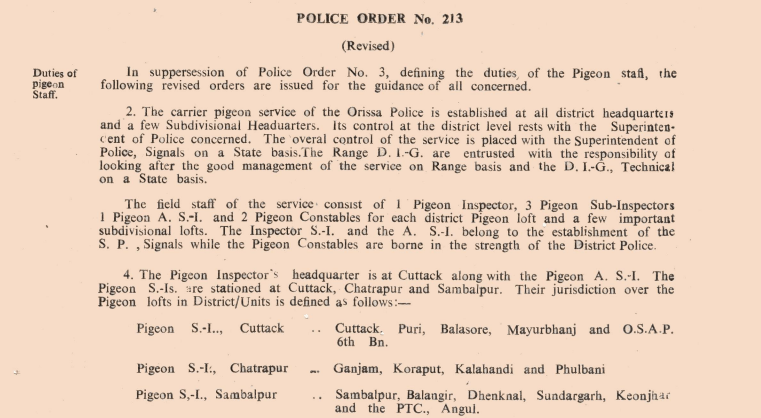
There is a very interesting story about Orissa Police Pigeon messengers. Apparently, in 1948, when Pandit Nehru, the then-PM visited the state soon after Independence, he first went to Sambalpur. The same day, he was to address a public meeting in Cuttack, which is about 260 km away. He wanted to send an urgent message to the police in Cuttack to ensure that the arrangements were such that they did not create too much of a barrier between the public and the dais. When he asked how the message would reach Cuttack in time, the police officials there showed him the carrier-pigeon which would be doing the needful. Nehru was sceptical. But the pigeon departed Sambalpur at 6 am and was in Cuttack by 11.20 am. And when the PM reached, his instructions had been carried out! He was amazed.
Even today, though not in regular use, Orissa Police still maintains a carrier pigeon service of about 150 birds, utilizing them for communication during disasters and for ceremonial purposes.
–Meena
Visual from: https://odishapolice.gov.in/sites/default/files/PDF/PO-213_0.pdf

 Millennial Matriarchs