
Queasy stomachs have plagued humanity since ancient times. Many have been the remedies, each with its own followers and detractors. For instanc, in India, ginger, omam (ajwain), jeera, curd are all popular.
Somewhere in ancient times, probably in Egypt, wine infused with herbs became a popular remedy for uneasy stomachs. The popularity of such infusions, called bitters, was high till even a hundred years ago.
Bitters are ‘liquid aromatic alcohol-based infusions of bittering botanicals and flavoring agents’. They are extracts of seeds, herbs, roots, bark, leaves, flowers, and fruit liquid from various plants. While they started out as medicines, soon another use was found for bitters.
Today, we have two types of bitters: Digestive bitters and Cocktail bitters. Digestive bitters aid in the digestion of food and are usually sipped straight, on the rocks, after a meal and are popular in Europe. Cocktail bitters are made from a tincture of water and alcohol, containing spices and plant-based components. They are too strong to be had neat, and are added to cocktails to elevate the taste and add a dash of sophistication.
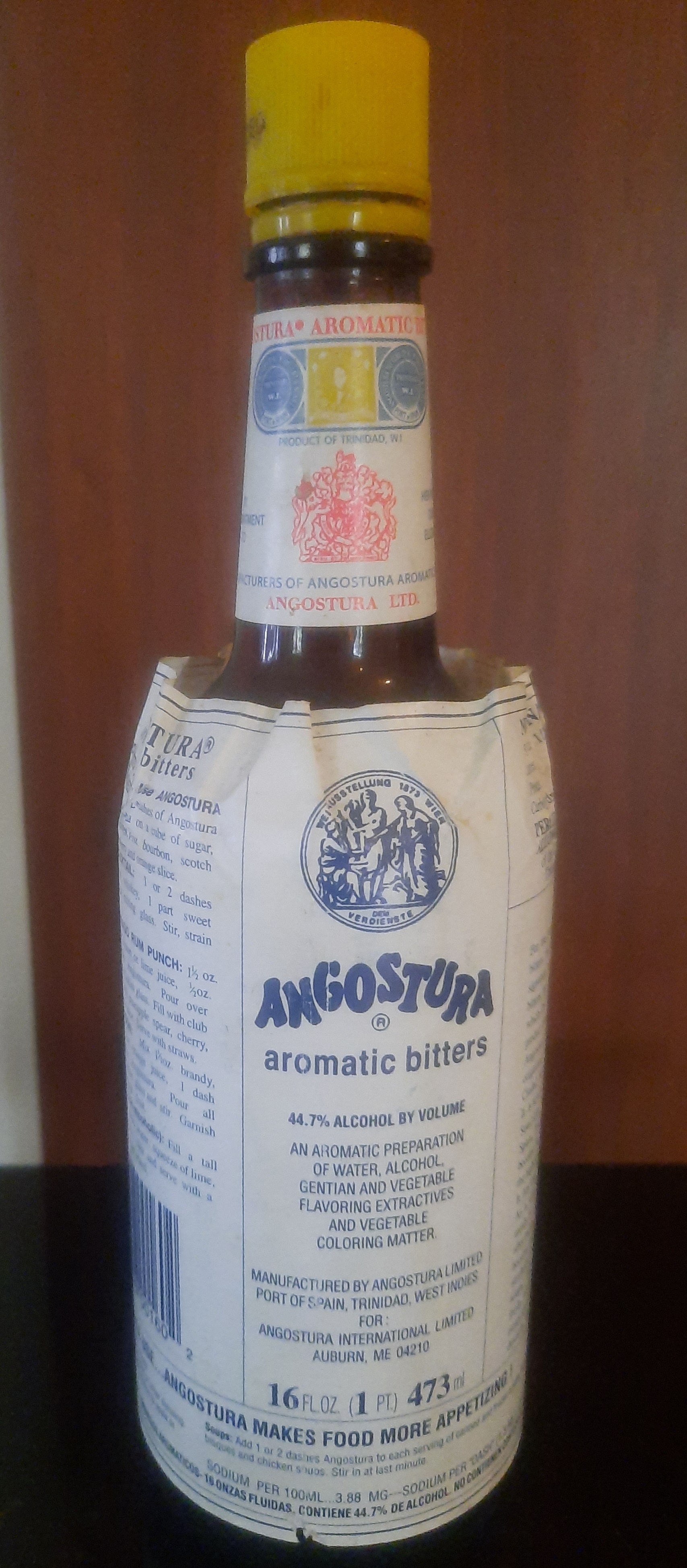
Of all the bitters, Angostura Bitters are probably the best known, and are a staple for every bartender and cocktail-mixer, and are used in classic cocktails like the Old Fashioned and Manhattan. More than that, they are in every kitchen cupboard in Trinidad and Tobago where they are made, as a home remedy for stomach problems. They are also an important ingredient in many local dishes.
Angostura is a tree native to South America, but strangely, the famous bitters are not made from the bark of this tree. Rather, they get their name from the town of Angostura in Venezuela, where they were invented. (The name of the town was changed subsequently, and it is now known as Ciduad Bolivar).
They were first concocted in 1824 as a medicine for the army of Simon Bolivar by a German army surgeon called Johann Siegert in the town of Angostura. He called it ‘Amargo Aromatico’. Dr. Siegert started exporting this to Europe, USA and the Caribbean. Apart from its use as a medicine, this product caught the fancy of bartenders at a time when cocktails were just becoming popular. Demand boomed.
The Siegert family migrated to Trinidad in the mid-19th century and started manufacturing the tincture in Port of Spain, the capital. And the company flourished.
Angostura Bitters were something one had vaguely read about. It definitely did not loom large in our lives. Till we visited family in Trinidad. Then we realized how big a thing it was!
A tour of the Bitters factory was of course on the essential itinerary. It was an overwhelming experience, especially to the nose! The pervasive smell of alcohol and herbs and tinctures almost made one dizzy.
All the processes of making the Bitters were on display. But the critical part is a secret—the mix and proportions of the herbs which go into making the product! It is apparently one of the world’s longest-held culinary mysteries, and no one has been able to replicate it exactly! Apparently only five people are privy to the secret.
Another part of the myth and legend of Angostura Bitters is the over-sized labels on the bottles. Apparently, in the late 1800s, Siegert’s sons decided to re-brand the product. As a part of a competition, one brother designed the new bottle, while another designed the new label. But they did not discuss their designs with each till it was too late. So the labels that had been printed were too big for the bottles they made! Though the Siegerts lost the competition, one savvy judge advised them to keep the design as it was. He said that this would help the packaging stand out among the competition. And that is exactly what has happened! The oversize labels area distinctive feature even today.
I remembered my bottle of Angostura Bitters from our trip to Port of Spain trip when I recently had a stomach upset. Whether thanks to this or some of the other home remedies I tried, I was better soon!
–Meena

 Millennial Matriarchs