
In this week of Republic Day, the tune of our national anthem and other patriotic songs are all around us. Without them, the mood cannot be built. Singing the national anthem together with neighbours, community, colleagues, fellow-students—there is nothing more symbolic of our oneness.
Anthems in general are rallying cries, rousing or uplifting songs identified with a country, section, cause etc. A national anthem is a solemn patriotic song officially adopted by a country as an expression of national identity.
These songs are our identity. But just as in so much else, should they change as contexts and realities change?
Well, five countries have taken the bold step of changing their anthems in recent years.
Australia: On Jan 1, 2021, Australia’s national anthem, “Advance Australia Fair,” underwent a significant change. The phrase “For we are young and free” in the second line was changed to “For we are one and free.” This is an effort to respect the Aboriginal and Torres Strait Islander peoples, recognizing that Australia’s history precedes European settlers tens of thousands of years. It is a symbol of Australia’s commitment to unity and reconciliation with Indigenous population.
Austria: Austria’s national anthem is “Land der Berge, Land am Strome” (Land of Mountains, Land by the River). The language was reviewed and modified to promote gender inclusivity in 2021 . The original lyrics which referred to “great sons,” was changed to “great daughters and sons.”
Canada: In 2018, Canada made a significant and widely-welcomed change to its national anthem “O Canada” in 2018. The line “in all thy sons command” was changed to “in all of us command.” was changed to “in all of us command”, again an effort for gender-inclusivity.
South Africa: Like the nation itself, South Africa’s national anthem is unique. It combines lines from several different languages and songs, including the hymn “Nkosi Sikelel’ iAfrika” and the former anthem “Die Stem van Suid-Afrika.” In recent times, small changes have been made to the anthem with the purpose to ensure proper pronunciation and inclusion of all languages and honour the linguistic heritage of all its people.
New Zealand: In 1977, the Government announced that New Zealand would have two national anthems — the traditional anthem ‘God Save The Queen’ and the poem ‘God Defend New Zealand’. Since then, both the anthems have had equal status. Following the accession of King Charles III to the throne in 2022, the words of the first anthem changed to ‘God Save the King’.
The latest change in a national anthem is not for a change of words but of the tune. In January 2025, Saudi Arabia has asked Hans Zimmer (Oscar-winning composer of the Lion King, Dune etc.) to create a new version of its national anthem, Aash Al Malik (Long live the King)!
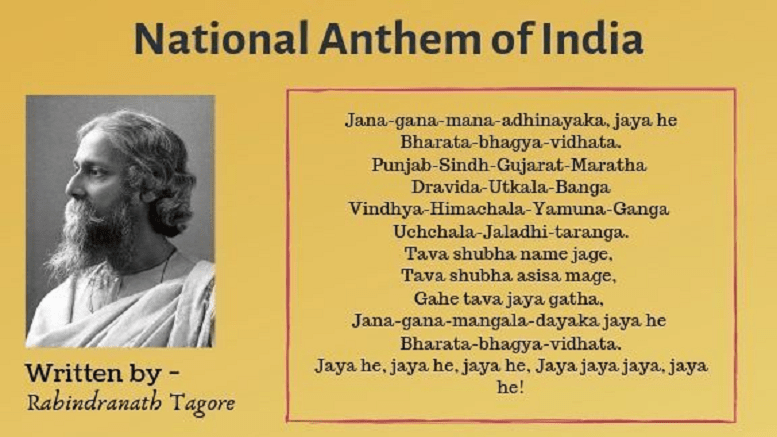
Our anthem Jana Gana Mana (‘[Ruler of] the minds of the people’) was composed as “Bharato Bhagya Bidhata” in Bengali by Rabindranath Tagore on 11 December 1911. The first stanza of the song was adopted by the Constituent Assembly of India as the National Anthem on 24 January 1950, the same day as the Indian Constitution was signed. (Mamata has dwelt on this at length in post last week).
There have been a few proposals to change/add/delete words and phrases. For instance, to add the name ‘Kamrup’ to make the anthem inclusive of the Northeast; or remove the name ‘Sind’ because it is no longer in India. The word “Adhinayak” has also been controversial, because it was used to praise King George V in 1911. In 2019, there was a bill moved in the Rajya Sabha, to modify the third line to ‘Punjab Sindh Uttarpurv Gujarat Maratha’, to bring in the Northeast. However, the Supreme Court has struck down all of these.
While tampering with sacred traditions is always fraught, there does seem to be sense in these suggestions, and maybe we need a debate on this. After all, the essence of democracy is debate, and this seems a worthwhile one!
Happy Republic Day!
–Meena
Thanks: http://www.vanguardngr.com

 Millennial Matriarchs