
I was recently on a nostalgia trip to Ahmedabad, visiting/re-visiting haunts of yore. One of these was Ambadvad ni Gufa (Hussain-Doshi Gufa for old-timers like me). This is an underground art gallery where both the structure and ‘contents’ are works of art
Born of a collaboration between the renowned architect Balkrishna Doshi and MF Hussain, it exhibits works of MF (Maqbool Fida) Husain, in a unique structure designed by Doshi. It is and unusual juxtaposition of architecture and art—a situation where a work of art contains works of art.
Hussain and Doshi both belonged to and loved Gujarat, and hence the decision to create a permanent structure in Ahmedabad which could showcase both their work.
The underground gufa (cave) has a roof made of multiple interconnected domes which are covered with a mosaic of tiles. As one descends a not-so-obvious staircase, the inside opens up. It has irregular and inclined tree-like columns supporting the domes. The roof and walls are painted by Hussain. Light enters the cave though snouts, creating spots of light on the floor. The lighting is thus very different at different times of the day, and creates a mystique of its own. The cave spans across 1000 square metres.
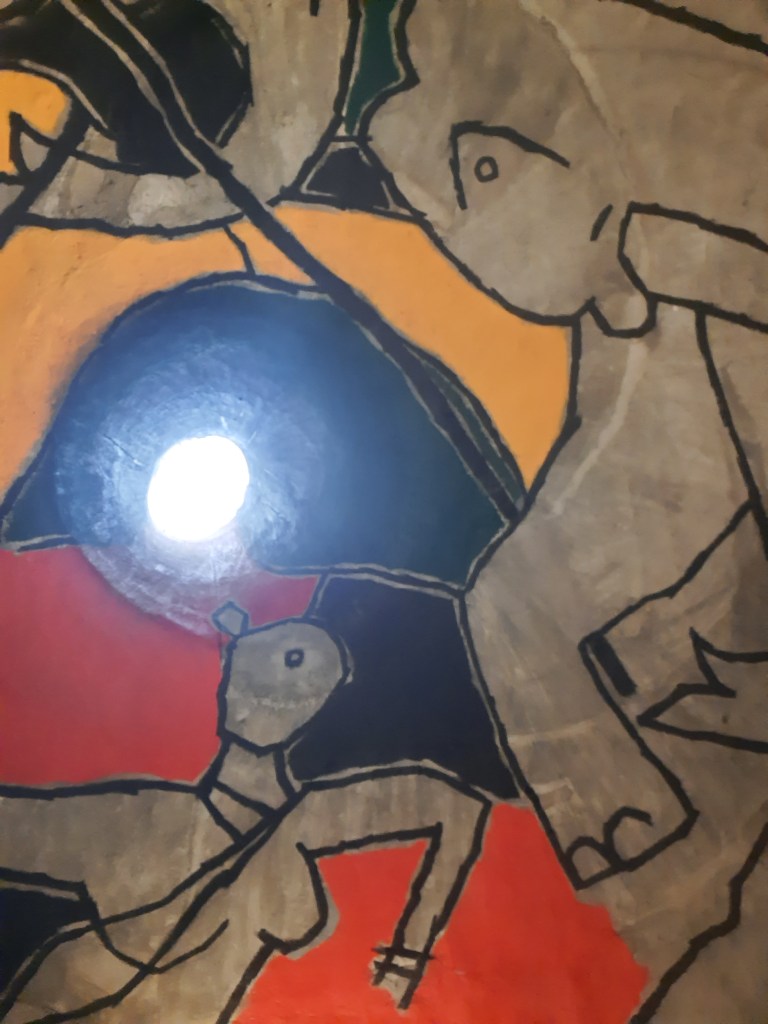
The inside walls serve as a canvas, on which Hussain painted with bold strokes and in bright colours. There are depictions of human figures and animals, including of course, his iconic horses. The idea was to recreate ancient cave-type paintings in a modern environment. A few metal sculptures of human figures are also placed in the niches between the columns.
However, the largest artwork is on the mosaic outside surface of the gufa. This is a depiction of the Sheshnag (divine serpent), winding across the surface over a length of 100 feet, and is visible at eye-level as one walks past the structure.
The Gufa is considered a milestone in collaborations across disciplines. When Hussain visited Ahmedadab once, he asked Doshi, who was a close friend, to design a permanent art gallery for his works. Doshi said he would design something unique but Hussain would need to rise to his structure in his artwork! The planning was a process of interplay of ideas.
The objective was to develop something contemporary, but based on ancient design ideas, and in sync with the natural environment.
Given Ahmedabad’s high temperatures, it was designed as an underground structure. The white porcelain mosaic tiles covering the outside reflect sunlight and reducing the heat reaching the inside of the structure. The Buddhist caves of Ajanta and Ellora inspired Doshi to design the interior in the form of circles and ellipses. The domes are inspired by tortoise shells (kurma avatar) . The mosaic tiles on the roof are similar to those on the roofs of Jain temples at Girnar. Hussain’s wall paintings are inspired by Palaeolithic cave art, and serpent by the Seshnag of Hindu mythology. The interior columns resemble columns at Stonehenge.
The Gufa has been attacked and vandalized several times—ironic for something designed as a syncretic work. In the very first attack on October 11, 1996, Bajrang Dal activists damaged 23 tapestry items and 28 paintings which were on display. The excuse for the attack was Hussain’s depiction of Hindu goddesses.
What is nice today is that there is a lively café around it, and young people throng the place. The Gufa is a part of a cherished hangout. They look on to the mosaic domes and the Sheshnag as they munch on their snacks and sip on their iced tea. And hopefully, through the process, imbibe an appreciation of the art so close to them, and moved to cherish both the art and the spirit behind the work.
–Meena

 Millennial Matriarchs
