
The walking stick may be one of the most ancient tools ever invented (or should we say ‘discovered’??!!). I can imagine my ancient-ancestress in Africa, 300,000 years ago, stopping to cut a branch and smoothen it, to help her trek and clamber over hills and rocks.
Walking sticks obviously began as mobility aids, in that they help with balance and mobility issues; reduce the risk of falling; help those recovering from injuries and those who experience pain in their hips or knees. But of course, they were also used for self-defence. Having a two-in-one is always great–my ancient grandmother would have used hers to shoo away wolves or hyenas.
What began as a very functional item would soon have become a thing of beauty and pride– my ancestress-grandmother may have spent the evenings chipping at her stick and carving wonderful designs on it.
Down the ages, these sticks became a symbol of power, authority and status. Ancient images show kings, religious leaders and authority figures holding them.
But walking sticks really came into their own in the 17th and 18th centuries, when they became an essential part of the wardrobe of fashionable men in Europe. The cult is thought to have started with Louis XIV. This royal king was conscious of his height—he was 5’4”, and so used heels (red and high). And to help him balance, he used a walking stick. Heels and walking sticks became the rage in the French court, and then spread to the rest of Europe and to England. They became prized possessions and an oft-exchanged gift between kings and courts.
And of course, befitting the importance given to these objects, they began to be made of precious material and extravagantly decorated. The knobs or handles were carved individually, made of gold, silver, ivory, tortoise shell, or painted porcelain, and studded with precious stones or inlaid with mother of pearl. Shapes ranged from lions to dogs to rams to fantastical creatures. Louis XIV had a stick whose eagle knob was set with twenty-four diamonds!
And no one who could afford it was content to have just one. Voltaire, the French philosopher-writer owned eighty sticks, though he considered himself a man who did not follow fashion. Count Brühl of Dresden, owned three hundred canes to match his three hundred suits, and had a snuff-box to match each cane! Queen Victoria had a room full of canes, gifted to her from across the world, though she used only one–one of great historic value which had been presented to King Charles II. The head was made of “An idol which graced the temple of an ill-fated Indian prince… an exquisitely wrought affair in ivory… The eyes and forehead are jewelled and on the tongue is the rarest of rubies.”
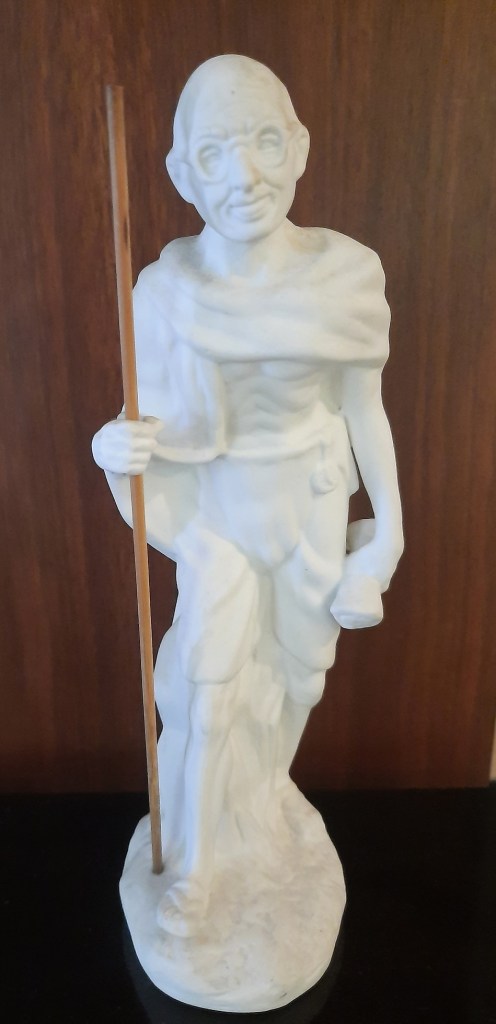
But if walking sticks were a symbol of worldly power, they were also the symbol of spirituality. They were among the few possessions of monks–Hindu, Jain and Buddhist. A staff is part of our image of Swami Vivekananda. And of course Gandhiji! It was with the help of his lathi that Gandhi strode across the country, and walked 241 miles in 24 days to protest the British monopoly on salt in India.
There is a very interesting story about Gandhiji and his lathi. In the 1920s and 30s, Ghorghat village in Bihar made and supplied lathis all across north India, and these were essentially used by the British forces on protesting unarmed Indians. When Gandhiji visited Ghorghat in 1934, the villagers wanted to gift him a lathi. He agreed but put a condition—that they would not sell them to the British anymore. It is a symbol of those times and of Gandhiji’s influence that the villagers readily agreed to give up a means of their livelihood. Gandhi accepted their gift. Ever since, the village celebrates ‘lathi mahotsav’ to commemorate the gifting of a lathi to the Mahatma.
Walking sticks started losing their image as a fashion-accessory around the middle of the last century, but great are the advancements of walking sticks as mobility aids. So now it is about function and not art!
Well, we, especially men, may have lost a fashion accessory. But with better and more functional walking sticks on the market, senior-life is surely better!
–Meena

 Millennial Matriarchs