
Agatha Mary Clarissa Miller was born on 15 September 1890. 135 years later she continues to be popular around the world as Agatha Christie, the Queen of Murder Mystery. Even as the very English settings of most of her stories and the lifestyle of the characters in her books have seen a century of change, what makes these stories endure is her deft portrayal of human character, with all its foibles, frailties, and hidden depths.
While much has been written about Agatha Christie’s life (including her autobiography), a lot of it describes her life as a writer. From the first short story she wrote (to stave off boredom when she was in bed with the flu) to early days of exploring the ‘murder-mystery’ genre (a detective novel written after a bet with her sister), to creating the memorable detective Hercule Poirot (while she was working as a nurse and hospital dispensary assistant during World War I).
Along the way Agatha became engaged, but then met and married someone else, and became Mrs Agatha Christie. At some point writing became a necessary means of income, rather than an exciting and creative vocation. There were periods when she wished for anonymity, and a yearning to get away from the pressure and spotlight. As her wartime marriage with Archie Christie was falling apart, Agatha began to make brief forays towards breaking free; impulsively travelling alone on the Orient Express to Baghdad 1928. As she wrote in her autobiography …one must do things by oneself, mustn’t one? …I thought ‘it’s now or never. Either I cling to everything that’s safe and that I know, or else I develop more initiative, do things on my own’. And so it was that five days later I started for Baghdad.
From Damascus she travelled overland to Baghdad, and from there on to an archaeological excavation at the ancient site of Ur, where she met eminent archaeologist Leonard Woolley and his wife Katherine who became good friends. At their invitation, she returned to Ur in 1930 where an archaeologist-in-training Max Mallowan escorted her around the historic sites, the two often travelling ‘rough’ over difficult terrains and situations. The bond between Agatha (already a well-known author) and the much-younger Max grew, and ended in marriage in 1930. Agatha Christie Mallowan discovered the world of archaeology.
Agatha began to accompany Max on some of his excavation sites, and spend the digging season from October to March with him and his team. Here she pitched in, helping to clean, catalogue and photograph the finds. Agatha slept in a tent like the other members of the team, but there was a room set aside for her to write, when she was not engaged in archaeological tasks. This was the only time and place where she was not to be disturbed.
An archaeological dig is like a mystery novel. While the slow and painstaking process of carefully uncovering centuries of accumulated earth in the hope of discovering fragments of past history is far from being a ‘page turner’, the actual discovery of even a fragment of shard is when the mystery really begins. It is from these tiny clues that an entire jigsaw begins to be meticulously pieced together. Where did this piece come from? What was it a part of? Who used this and for what purpose? A single object may lead to the remains of a dwelling, which in turn could have been part of a settlement. And thus the ambit widens. The different clues may provide answers to the key questions of a whodunit: What, where, why, how?
So while Agatha spent much of her time helping the team discover and decipher these tiny clues, she spent some of her time also putting together a different set of clues and characters who would make up a murder mystery novel. Some of these novels were set in the region where she herself was based for part of the year.
Simultaneously she was also noting her observations about the people and their culture, the landscape and its wildlife, the architecture and the archaeological discoveries. These remained notes and memories until the Second World War when Max had been posted to Egypt and Agatha Christie was alone in London, where she worked part time as a volunteer in a hospital dispensary (as she had done in World War I).
In the years when she used to accompany Max on his excavations, Agatha had often been asked by her friends what it was like on an archaeological site. She had started writing about this before the War, but had put it aside. Now missing her husband and nostalgic about their days on the ‘digs’ she returned to those notes and began to chronicle her time there. Drawing upon these and her memories and experiences she wrote about life on an archaeological dig, the different personalities that made up the team (a combination of nationalities, temperaments and dispositions), and the everyday doings and happening that resulted from their interactions. These vignettes, recounted with humour and detail, vividly brought to life the human side of the enterprise. She put these in the context of the political situation in the Middle East in the 1930s.
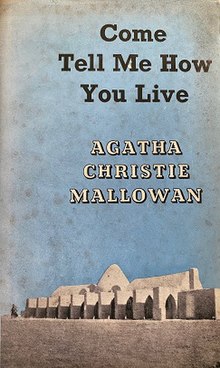
Agatha Christie finished the book in June 1945, soon after she was reunited with her husband. It was published in 1946 under the title Come, Tell Me How You Live.
For the enthusiasts of detective fiction, who eagerly awaited the new exploits of Hercule Poirot and Jane Marple, the new Christie was a bit of a shock. Where was the plot, the suspense, the investigation and the unmasking of the villain? And yet, in their own way, all these elements were indeed present, this time not as fiction but as facts. The subtitle of the book An Archaeological Memoir, was the first clue to the difference.
But the best-selling author did not intend to ‘cheat’ her faithful readers. The book was published under her married name Agatha Christie Mallowan. It was her tribute to a geographical region and field of study that had given her a lot of happiness. As she wrote in the Epilogue to the book: “Writing this simple record has not been a task, but a labour of love. Not an escape to something that was, but bringing into the hard work and sorrow of today of something imperishable that one not only had, but has”.
–Mamata

 Millennial Matriarchs