
National Librarian’s Day is observed on August 12 every year to commemorate the birthday of Padma Shri Dr S. R. Ranganathan (1892-1972), who is considered not only as the father of library science in India, but who has made immense contributions with worldwide impacts to the development of the discipline.
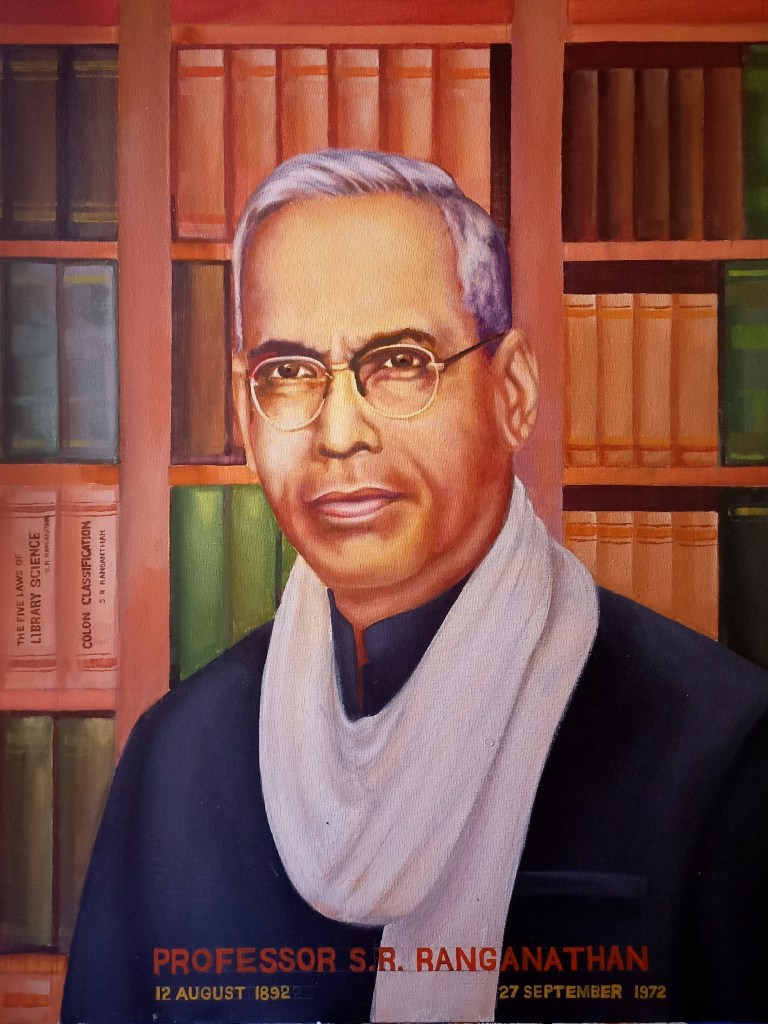
Dr Ranganathan’s academic journey did not indicate that he would end up as the country’s most significant librarian. He did his B.A. and M.A. in mathematics at the Madras Christian College. He was a brilliant student, and aspired to teach mathematics. He therefore went on to take a degree from the Teachers’ College Saidapet. He started his career at Government College Mangalore in 1917. From there on, he went on to teach at Government College Coimbatore and Presidency College, Madras.
In 1924, he was appointed the first librarian of the University of Madras. He was a reluctant librarian who at first hated to be cooped up in a room with just books and a few staff members. He missed the interactions with students and his colleagues and pleaded to come back to teaching. But other people saw something in him and knew he would do a great job. He was selected to go to the UK to be trained in library science. His principal Mr Duncan assured him that if he still wanted to give up librarianship after his UK visit, he could go back to teaching.
The experiences in the UK transformed Dr Ranganathan’s view of this profession. When he saw the difference that libraries could make in the lives of people, and how they could serve different sections of the community, he discovered a social mission for libraries, and for himself.
Dr Ranganathan served as Librarian and Professor of Library Science for over three decades, at some the largest and most prestigious universities of India. In 1962, he founded the Documentation Research and Training Centre in Bangalore, and was associated with it through his life.
His major technical contribution to the world of librarianship was the Colon Classification system, which is even now one of the major classifications used in libraries across the world.
But as a lay-person and user of libraries, what deeply fascinates me is the ‘Five Laws of Library Science’, which he first proposed in 1924, and after several iterations, finally published in 1931. These sum up the foundational philosophy on which libraries must be run.
These laws are:
1. Books Are For Use: We have all experienced how some librarians are more concerned that their books not be ‘spoilt’, dog-eared or lost, rather than that they be read. The first law addresses this concern—the primary purpose of a library is not to store and preserve books, but rather to ensure that they are used. With this Law, Dr. Ranganathan refocused the attention on access-related issues, such as the library’s location, loan policies, hours and days of operation; and as importantly, the quality of staffing. Practical matters like library furniture, temperature control, and lighting too fall in this purview.
2. Every Reader His/Her Book: The Second Law recognizes that readers have different interests, and stresses that every reader has the right to read what he or she wants. They have equal rights to be able to access material of their interest. It fixes the responsibilities of the state, the library authority, the library staff, and the readers, and clarifies that a library must serve all users, irrespective of age, social background, or economic status.
3. Every Book Its Reader: Related to the previous Law, the practical implication of the third Law is that there should be a variety of books and that the library needs to figure out ways to ensure that each item finds its appropriate reader. This points to making the collection accessible, including open shelving. Importantly, it means that even if there are few readers for a book, each book has its place in the library.
4. Save The Time Of The Reader: This law is a recognition that library services must meet the needs of library users efficiently. One requirement for this is that the library staff must have strong reference skills, as well as strong technical skills in cataloguing, cross-referencing, ordering, accessioning, and the circulation of materials.
5. The Library Is A Growing Organism: A library is a social institution and will keep growing in terms of documents, readers, and staff. Even when a library seems to have reached its capacity, the growth would be in terms of replacing old books by new books and new users will continuously replace old users. So a library needs to be a continually changing institution, never static in its outlook.
At a time when the reading habit seems to be on the decline, and many libraries are floundering to re-define themselves, it would be a good idea to revisit Dr Ranganathan’s vision of libraries and his Five Laws. They will help us find a new direction in this rapidly changing landscape.
–Meena

 Millennial Matriarchs