
Who hasn’t, at some time or the other, had a song or piece of music stuck in their heads, which just won’t go away! You get up in the morning, and suddenly you find yourself humming a tune. It follows you around the house, to the office, on the drive back home. It serenades you inside your head through dinner. And sometimes it is still there when you wake up in the morning!
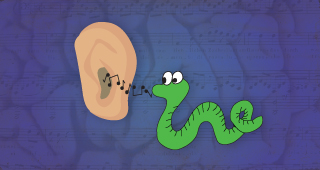
This is what is called an earworm. Extremely irritating, but nothing to worry about. It happens to most of us at some time in life. A recent study of American college students found that 97% had experienced an earworm in the past month. Other studies have found similar results.
And don’t worry how long an earworm troubles you. Though the typical length is 10 to 30 minutes, research shows that for about 20% folks, the earworm lasts an hour or more. And some unlucky folks have been stuck with one for a year or even longer!
The term earworm comes from the German “ohrwurm,” which is defined as a “cognitive itch” or “the inability to dislodge a song and prevent it from repeating itself in one’s head”. Several terms have been coined for this, including stuck song syndrome, sticky music, musical imagery repetition, intrusive musical imagery etc. The semi-official term is ‘involuntary musical imagery’, or INMI.
It has been a serious area of study since 1885, and scientists hope to get insights into the functioning of the brain. Several major universities have been undertaking studies into the phenomenon.
Sufferers try various ways to get rid of an earworm– by thinking of another song, singing the earworm song all the way through to its end, or taking up other tasks that require focussed concentration. But trying to get rid of an earworm may be counter-productive. One study has found that the harder people fight to quiet an earworm, the longer it tends to harass them!
Something that is not irritating to you, but may be to others if you sing, is a mondegreen. A mondegreen is a word or phrase in a song or poem that you get wrong–the result of mishearing something recited or sung. Incorrectly heard lyrics are called mondegreens.
The origin of the word itself is from an instance of such mishearing. In a column by journalist Sylvia Wright in the 1950s, she wrote about a Scottish folksong The Bonny Earl of Morray that she had listened to. Wright misheard the lyric “Oh, they have slain the Earl o’ Morray and laid him on the green” as “Oh, they have slain the Earl o’ Morray and Lady Mondegreen.” And ever since, such mishearings have been referred to as mondegreens!
The scientific explanation goes as follows: Hearing is a two-step process. First sound waves make their way through the ear and into the auditory cortex of the brain. On receiving the signal, the brain tries to make sense of the noise. Mondegreens occur when, somewhere between the sound and the sense-making, communication breaks down. You hear the same sound as another person, but your brain doesn’t interpret it the same way.
Sometimes we may just mishear something because it is noisy, the phone signal is weak, or there are other extraneous factors. Or it may be because the speaker is speaking in an unfamiliar accent or is mumbling. So the sound becomes ambiguous and our brain tries its best to resolve the ambiguity—and gets it wrong.
Another common cause of mondegreens is the oronym–word strings in which the sounds can be logically divided in different ways. This is similar to what we call sandhi vichhed in Sanskrit—the process of analysing and separating compound words into their component parts. Oronyms result in a wrong parsing of sounds when context or prior knowledge is missing.
Yet another reason could be letters and letter combinations which sound alike, and without a context, we can go wrong, and one sound can be mistaken for the other. An example often given to illustrate this is, :“There’s a bathroom on the right” being heard as “there’s a bad moon on the rise”.
When we hear a sound, a number of related words are activated all at once in our heads. These words could be those that sound the same, or have component parts that are the same. Our brain then chooses the one that makes the most sense. In this choosing, we are more likely to select a word or phrase that we’re more familiar with. An oft cited example is that if you’re a member of a boat crew, you’re far more likely to select “row” instead of “roe” from an ambiguous sentence. If you’re a chef, the opposite is likely.
Some mondegreens become the word! For instance, the word orange was such a widespread mispronunciation of “a naranj” (from Persian and Sanskrit), that it became the official name of the fruit! One can think of any number of place-names which the English mangled, for instance!
Bollywood songs of course have their share of mondegreens. Though not systematically documented, some common ones identified include:
From the song Hawa Hawai (Mr. India): ‘Bijli girane mai hoon aayi’ being heard as ‘Bijli ki rani mai hoon aayi’; and from the song Banno (Tanu weds Mannu) ‘Banno tera swagger laage sexy’ being heard as ‘Banno tera sweater laage sexy’.
Raghu has these examples from his childhood (which he attributes to the poor sound quality of radio transmissions of those times):
Hearing ‘Yeh manzar dekh kar jaana’ (from the film Around the World) as ‘Yeh mandir dekh ke kar jaana’ (could be a jingle for a recent event!); and ‘Ahsan tera hoga mujh par’ (from the film Junglee) as ‘Ahsan tera ho gaa mujh par’!
The only request: If you have a mondegreen, don’t sing the song aloud. You may give someone a more than usually horrible earworm!
–Meena

 Millennial Matriarchs