
This month games have been in the news. From cricket dominating the headlines, to Meena’s pieces on the importance of play for the all-round development of children. Toys are perhaps the first objects that children interact with as they learn how to ‘play’. Beginning with supporting the development of psycho-motor skills, toys also encourage imagination and creativity. As the child explores and discovers, in its own way, the toy becomes way more than what it was formally designed for. Toys can become the central characters in a gamut of games and make-belief adventures. The child’s interactions with toys also begin to lay the foundation of the sense of ownership (“my doll, my truck”), which also lends itself to possessiveness when the same toy is ‘snatched’ ‘begged’ or ‘coveted’ by another child.
It is at this early stage then, that the field of games introduces other instincts such as ownership and competiveness, often leading to conflict. This is where the concepts of ‘sportsmanship’ are also planted (or not planted), well before the child graduates from toys and imaginary play to more formal games, and then on to sports.
A game is described as a physical or mental recreational activity involving one or more players, defined by a goal that the players try to reach, and some set of rules to play it.
A sport is a physical activity carried out under an agreed set of rules, with a recreational purpose: for competition or self-enjoyment, or a combination of these.
The two terms have also spawned two related terms—sportsmanship and gamesmanship.
Gamesmanship refers to the strategic manipulation of the rules and the spirit of the game to gain an advantage over opponents. While not necessarily breaking the rules, players who engage in gamesmanship employ tactics that push the boundaries of fairness. This may include exploiting loopholes, distracting opponents, engaging in unsportsmanlike conduct, or using psychological tactics to gain an edge. While gamesmanship may be within the confines of the rules, it can undermine the principles of fair play and the spirit of the game.
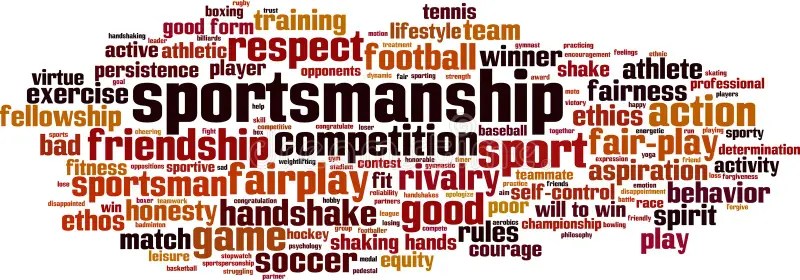
Sportsmanship refers to the values and behaviours exhibited by the players that uphold the spirit of fairness, self-control, respect for rules, opponents and authority, and integrity. Sportsmanship fosters positive relationships among players, promotes teamwork and healthy competition, encourages accepting victories and defeats with grace, and thereby enhances the sports experience.
Poor sportsmanship, while not exactly using manipulative tactics, includes unethical behaviour such as intentionally injuring opponents, taunting or insulting players, or disrespecting officials and fans.
We teach children the importance of sports, but sadly do not pay enough attention to also inculcating the values of sportsmanship from an early age. We send them to coaching classes to hone their skills in a sport—from tennis to football to hockey. Large academies are set up that identify budding players and rigorously mould them to become “champions.” These instil in the young minds the yen to be winners always, to be the best, the fastest, and the strongest at all times. They also laden them with highest of expectations. The aspiring champions carry on their young shoulders the burden to always meet these expectations, at any cost, including personal burn-out and breakdowns.
This expectation balloons manifold in the eyes of spectators of team games. It manifests itself in the fanatic fandom of a favourite team. This is what buoys the playing teams and fuels the culture, and indeed, the enormous business of spectator sports. Support and encouragement of one’s favoured team is necessary, even desirable in sports. But when this balloon bursts, leading to a mass wave of intense negative feeling, it is certainly not sportsmanship. What we have forgotten in our love for ‘our team’ is that it is more than one team that makes a sport a sport, that that it calls for dignity and grace to acknowledge that we cannot always be the winner.
Participation in sports develops important skills, but this needs to be combined with developing the values and behaviour of sportsmanship. Even as we coach our young minds and bodies to excel in sports, it is important to remember that they also need coaching in sportsmanship. This involves engaging also with their hearts and emotions. It means emphasising respect for the opposing team in every circumstance—win, lose or draw, on or off the field. It means extending goodwill not only to one’s own team mates and coaches, as well as the others who support the players in many ways, including the spectators.
While healthy competition is an important ingredient of a competitive sport, unsportsmanlike conduct cannot justify the end—winning at any cost. Competing with honour and fairness need not be a dampener to the skills and excellence of players. Rather a game well played to the best abilities of both teams enhances not only the quality of the game, but the ambience within which it is played.
As the curtains fall on the mega spectacle of World Cup cricket, let us remind our children (and indeed ourselves) that the true spirit of sportsmanship means that it doesn’t matter what the outcome of the game is, it is not just about winning or losing; it is also about empathy, about the person or people you are competing against; they deserve to be shown the same respect you would show them outside of sport. Sportsmanship centres on three vital life-skill components of Respect, Losing with Dignity, and Winning with Humility. Let this principle be the guiding factor in the long game of life, as in the many games that we play in many fields.
Be a sport! May the best one win!
–Mamata

 Millennial Matriarchs