
A few weeks ago, when we were in the Western Ghats, the resort manager kindly set up a telescope in the evening. It was for the kids who were our co-guests, but ultimately it was the adults who hogged the eyepiece! It was amazing to see the craters on the moon; Mars and Venus; and sundry stars. And we were reminded once again of the fascination that the sky has always held for humans.
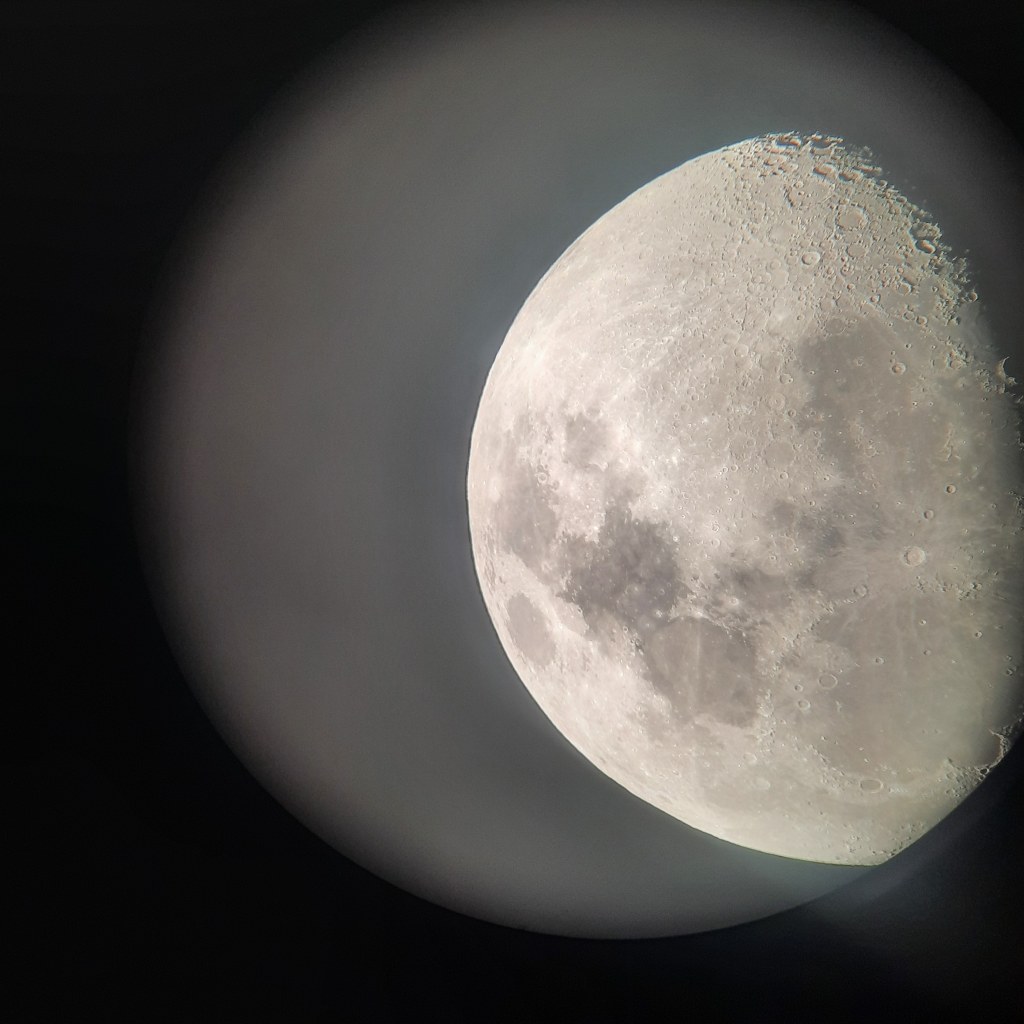
The conversation obviously took a turn towards raking up memories about telescopes. Techy-types among the group reminded us that the magnification power of a telescope essentially indicated the size of an object observed inside the eyepiece relative to the size of that object when observed with the naked eye. For example, when looking at Mars at 50x magnification, the red planet will appear 50 times larger than if one looked at it with one’s eyes. Factors like light pollution, atmospheric turbulence, temperature, wind, and much more affect the viewing experience. When viewing conditions are bad, the view will be blurry, fuzzy, shaky and unstable. That is generally why telescopes are set up in high altitudes: the atmosphere is thinner at higher levels, and makes for better viewing. Air quality is important for good observations because any particles in the air will reflect light–so higher altitudes work better in this aspect too. Also, telescopes need to be located as high above the clouds as possible. And of course remote areas have less pollution.
Humans have been gazing through telescopes since the 17th century. The earliest existing record of such an instrument is a 1608 patent submitted to the Dutch government by a spectacle-maker called Hans Lipperhey. While the actual inventor of the refracting telescope is not known, Lipperhey was the one to file the patent. Scientists all over Europe were fascinated by the invention and many started their own attempts to come up with one. Galileo built his own version a few years afterwards, and started making his telescopic observations of celestial objects. The word telescope itself was coined in 1611 by the Greek mathematician Giovanni Demisiani for one of Galileo Galilee’s instruments, and translates roughly into ‘far-seeing.’
To most of us, the word ‘telescope’ probably brings to mind the Hubble, launched by NASA in April 1990 and still in operation today. What we refer to as the Hubble Telescope is in fact a large, space-based observatory. It has been in operation for over 31 years, and in fact, its observation abilities have grown with time because new, cutting-edge scientific instruments have been added to the telescope over the course of the years through five astronaut servicing missions. It has made over 1.5 million observations over the course of its lifetime including seeing the collision of a comet with Jupiter, and has discovered moons around Pluto. It is truly one of the instruments which is shaping our understanding of the world.
Indians of course have always been fascinated with the skies, and down history have built different kinds of instruments to study the stars and other celestial objects. The observatories built by Maharaja Sawai Jai Singh of Jaipur between 1724 and 1734–the Jantar Mantars in Jaipur, Delhi, Ujjain, Varanasi, and Mathura being among the recent ones.
India’s focus on space observations has continued into the modern era, with ISRO launching our first dedicated Space Astronomy Observatory—Astrosat–in September 2015. India’s biggest telescope currently is the 3.6m Devasthal Optical Telescope, a custom-built instrument of great complexity. Built in collaboration with Belgium and Canada, this telescope has the distinction of being largest telescope in India for the study of celestial objects at optical wavelengths. Devasthal is a district of Nainital, at a height of about 2,450 mt.
Women have had their share in these explorations. The ancient scholar Gargi (somewhere between 800-500 BC), engaged in questions about astronomy. In a dialogue with Yajnavalkya, she asks ‘what is that which pervades above the heavens, below the earth and in between the two (heaven and earth)’.
In the present day too, we have our share of astronomical stars (pun intended). G. C. Anupama, the former Dean and Senior Professor (retired), Indian Institute of Astrophysics (IIA) is a world renowned astronomer. She has served as president of the Astronomical Society of India (ASI), the first woman to head this association of professional astronomers. She is a member of the Indian core team which is part of the international effort to establish the thirty meter telescope (TMT) in Hawaii, USA, as also the principal investigator of the project which led to the establishment of the 0.7m wide field telescope at Hanle near Leh in Ladakh, the world’s ninth highest site for optical, infrared and gamma-ray telescopes in the world.
Exploring the skies is fundamental to the human quest for understanding ourselves. And it can set children on a course to study the world around us scientifically. If you don’t want to invest in a telescope which may cost in the tens of thousands, if not in the lakhs, do check out DIY telescope kits, available for as little as Rs. 1000 (one such option available at https://scienceshop.vascsc.org/). Who knows, you could be starting some kid out to a journey to ISRO or NASA—if not the stars!
–Meena

 Millennial Matriarchs