
This week Meena wrote about Bungaree the first Aboriginal man to circumvent the continent of Australia. His feat was amazing not only because he was the first to undertake the journey but also because he was from an indigenous tribe, in an era when sailors and adventurers were white men. Bungaree broke the mold in more ways than one, but always remained in the footnotes of the history of sailing.
There is another group that has been in a similar position in this context—women sailors. According to traditional sailing superstition, it was believed that having women on board ships could anger the Gods and lead to misfortune such as storms and shipwrecks. It was also felt that the presence of women on board would be a distraction to sailors and lead to fights and disruptions. In fact seafaring professions were officially barred to women until the 20th century. But maritime history has its own set of tales about spunky women who rode the waves over the earlier centuries, in many cases disguised as men, but also openly and boldly. The most fascinating of these are some of the women pirates who defied every established norm of the day.
Zheng Yi Sao: Queen of the South China Seas
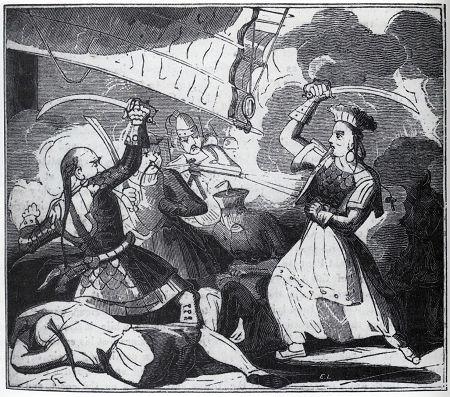
Zheng Yi Sao is described as the most successful female pirate in history. Born in 1775 into humble circumstances, she married the notorious pirate captain Zheng Yi, but on her own terms. She demanded equal partnership in his pirate fleet—an unprecedented and audacious demand. Zheng Yi was agreeable, and she took on the name Zheng Yi Sao (wife of Zheng Yi).
After her husband died when she was 32, Sao took control of his pirate fleet and transformed it into an unstoppable force in the South China Sea. She knew the coastline better than any imperial admiral, using hidden inlets and storm-lashed coves to evade capture. Sao was not just a skilled seafarer, she was a brilliant and brutal administrator. Her fleet was governed by a strict code of conduct:
Loot was divided fairly, with captains receiving a smaller share than their crew to ensure widespread loyalty. Female captives were to be treated with respect, and could only be taken as wives with mutual consent. Rape was punishable by immediate execution. All plundered goods had to be presented for group inspection, all captured goods were registered, and the punishment for disobedience was often beheading. Perhaps her most revolutionary approach was for other women within her fleet. The wives and widows of pirates were encouraged to take on leadership roles, creating an unprecedented situation where women held genuine authority in a violent, male-dominated world.
Zheng Yi Sao reigned supreme with an armada of over 300 ships and a crew of 20,000 to 40,000 pirates. Her fleet successfully defeated the navy of the ruling Qing dynasty, and even the ruling government could not destroy her power. Zheng Yi Sao’s power stemmed not just from ruthlessness and brute force, she was equally a strategic planner and shrewd negotiator. Recognizing that prolonged conflict would eventually erode her power she negotiated a surrender with the government, once again, on her own terms. She secured full amnesty for herself and almost all her crew, the right to keep her accumulated wealth; military positions for many of her top commanders.
Zheng Yi Sao eventually retired with all her loot, and continued to lead a civilian life for the next several decades. However she has gone down in the annals as the most successful pirate of all times.
Sayyida al Hurra: Pirate Queen of the Mediterranean
Sayyida al Hurra was not just a pirate; she was a queen, a refugee, a warrior and a power broker of the 16th century Mediterranean. She was born in 1485 in a family of Andalusian nobles, but forced to flee to Morocco. While in exile there Sayyida rose to become Governor of a vital port city on the North African coast. Once in power, she decided to avenge Spain and Portugal, not through politics or war, but through piracy. She forged a strategic alliance with Barbarossa an Ottoman admiral and pirate, and together they controlled the seas, he in the east and she in the west.
Sayyida was more than a pirate commander; she was also a skilled diplomat and ruler. She negotiated directly with European monarchs, wielding influence usually denied to women of her era. She even married the Sultan of Morocco and insisted the wedding take place in her city, making her the only woman in Islamic history to have married a reigning monarch without leaving her seat of power. Thus Sayyida established rule over both land and sea, a rarity in history.
Laskarina Bouboulina: The Pirate Admiral of Greek Independence
Laskarina Bouboulina was born defiant. Her father was a naval captain and rebel who had been imprisoned by the Ottomans. Laskarina was born in a prison cell in Constantinople in 1771, where her mother had gone to visit her imprisoned husband. After her father’s death Laskarina and her mother moved to the island of Spetses. This was no idyllic Mediterranean village, but a haven for smugglers, sailors and rebels who had fled conventional authority. The young Laskarina grew up among pirates and ship’s captains, learning about the language of the sea and sailing ships even before she could read.
By the time she was 40, Laskarina was married and widowed twice, to powerful ship owners, and inherited their fleets and fortunes. She used these resources not just for commerce but to fight the Ottoman Empire. She became a member of Filiki Eteria a secret organisation plotting to overthrow Ottoman control over Greece. Her main role was to smuggle food, weapons and ammunition into Spetses. She used her wealth to commission the construction of Agammennon, her personal warship, considered to be one of the largest and fastest Greek warships of the revolution. She commanded the rest of her fleet from this warship. Spetses was the first island to revolt against the Ottoman Empire in 1821. Laskarina then led her fleet to begin a naval blockade of the fortified city of Nafpoli, followed by the siege of other cities.
Throughout the battle against the Ottomans, Laskarina conducted her spirited resistance with a mix of strategy, ruthless power and charisma. She was fierce, but an inspiring leader who commanded the respect of the men who willingly joined her battle. Ironically, she was killed in a family feud.
These swashbuckling buccaneers ruled the waves, broke every rule written for women, and rewrote history at sea.
–Mamata
 Millennial Matriarchs