
Pulses Rule!

They are at the heart of every meal; they come in many colours, shapes and sizes; they can be used in a large range of permutations and combinations. They are the pulses that are an integral part of all cuisines in India. In a country with such immense diversity in culinary traditions, food habits, and meals, pulses are the one common as well as essential element. Our daily meal is incomplete with a dish made from a pulse, and many of our favourite snacks would not be what they are without pulses. Yet there is much that we have never stopped to really think about.

Technically pulses are the edible seeds obtained from the cultivation of leguminous plants for both food and feed. India has an immense diversity of pulses at the genetic and species level, as well as their uses at the culinary level. What makes pulses the original ‘wonder food’?

These seeds are a rich source of nutrients, mainly proteins, that are crucial for a healthy and balanced diet. It is estimated that 100 grams of dry lentils contain about 25 grams of protein. Thus pulses can become a backbone of a vegan diet.

They are naturally low in fat and contain no cholesterol, reducing the risk of cardiovascular diseases. They are also low in sodium chloride or salt which is a contributor to hypertension. They are high in potassium which plays an important role for digestive and muscular functions.

Pulses are a good source of iron and a great answer to address iron deficiency. The iron in pulses is best absorbed in the body by combining them with foods containing vitamin C. They are an excellent source of folate, a B-vitamin essential for nervous system function. They have a low glycaemic index, which makes them suitable for people with diabetes. They are naturally gluten-free, making them an ideal option for those who are gluten intolerant.

They can be stored for a long time and can be used even when fresh seasonal fruits and vegetables are not available. Their long shelf-life prevents food loss and wastage.

Pulses are incredibly versatile and can be used in an endless variety of cuisines and dishes in numerous forms. 

That is so far as human health goes, and most people are, at some level, aware of these attributes of pulses (a lot of which is passed down through generations by family recipes and ‘granny’s words of wisdom’). But there is not as much awareness about the fact that pulses are as important for environmental health as they are for human health.

Pulses play a vital role in soil health by providing essential nutrients, maintaining soil biodiversity, and enhancing soil structure. They improve soil health by hosting helpful bacteria, called rhizobia, in their roots. These bacteria convert nitrogen from the air into fertilizers in the soil. Additionally, other bacteria and fungi help release phosphorus in the soil, providing essential nutrients for plants and promoting soil diversity. The fertilizers produced by pulses benefit not only the pulses, but also other crops grown alongside them, reducing the need for chemical fertilizers. This makes pulses ideal for sustainable farming practices like intercropping or crop rotation. Additionally, pulses and their by-products are utilized as animal feed.

The benefits are not limited to soil alone. Pulses also perform other ecosystem services. Many pulse species are drought tolerant and resilient to adverse climate, such as drought and heat. Their cultivation optimizes fertilizer use, thus reducing greenhouse gas emissions.

Pulse crops have a lower carbon footprint than most foods because they require a small amount of fertilizer to grow. They also have a low water footprint as they are adapted to semi-arid conditions and can tolerate drought stress.

Despite their immense value for human and environmental health, pulses are not generally ‘stars’; they are often undervalued and under-recognized. In an effort to highlight the importance, as well as potential, of pulses as a global food the United Nations declared 2016 to be the International Year of Pulses. As the then UN Secretary General Mr Ban-ki-Moon said: “The International Year can help overcome this lack of knowledge. Much work needs to be done to end hunger and provide food security and nutrition for all. One concrete, promising opportunity lies with pulses. Let us join forces to raise awareness of the benefits of pulses”.

As the world was embarking on efforts to achieve the newly-adopted Sustainable Development Goals it was hoped that this International Year would help raise awareness of the benefits of pulses globally. The year-long celebration was implemented by the Food and Agriculture Organization (FAO), a specialized agency of the United Nations. The year was a success, and recognizing the potential of pulses in further achieving the Sustainable Development Goals, since 2019 the United Nations General Assembly has designated 10 February as World Pulses Day to be celebrated every year.  

This celebration is a recognition of the decisive role that pulses can play in achieving the comprehensive, far-reaching and people-centred set of universal and transformative goals and targets of the United Nations’ 2030 Agenda for Sustainable Development.

The World Pulses Day celebrations are an opportunity to raise public awareness about pulses and the fundamental role they play in the transformation to more efficient, inclusive, resilient and sustainable agrifood systems for better production, better nutrition, a better environment, and a better life, leaving no one behind.

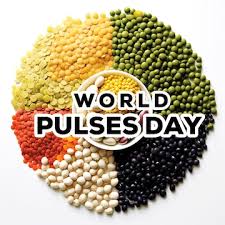
This is a good day to look more closely at our own meal! What is the original colour of the pulse on your plate? Green, yellow, red, brown, orange, black, white…

In what form are you eating your pulses? As a Dal (sweet Gujarati or Punjabi tadka?) Rajma-chaval or chana puri? As a part of your idli-sambar? As the partner to rice in khichadi? As the coating on your pakodas? As the sweet moong dal halva or payasam? Each platter will have a different version of pulses!

Whatever the form and whatever the taste, pulses rule our plates and palates!

–Mamata
Celebrating Pulses

They are an intrinsic part of every Indian’s meal. They are eaten as a staple or as a snack; they are part of something sweet and something savoury; they come in many forms, colours and flavours. They are pulses–the most sustainable, affordable, and versatile food items since time immemorial.

While we do not consciously think about them, we are making decisions regarding their use every day, for every meal—soak or saute, grind or roast, pressure cook or slow simmer, what spices go best with each one, and what accompaniments will make it a perfect meal?

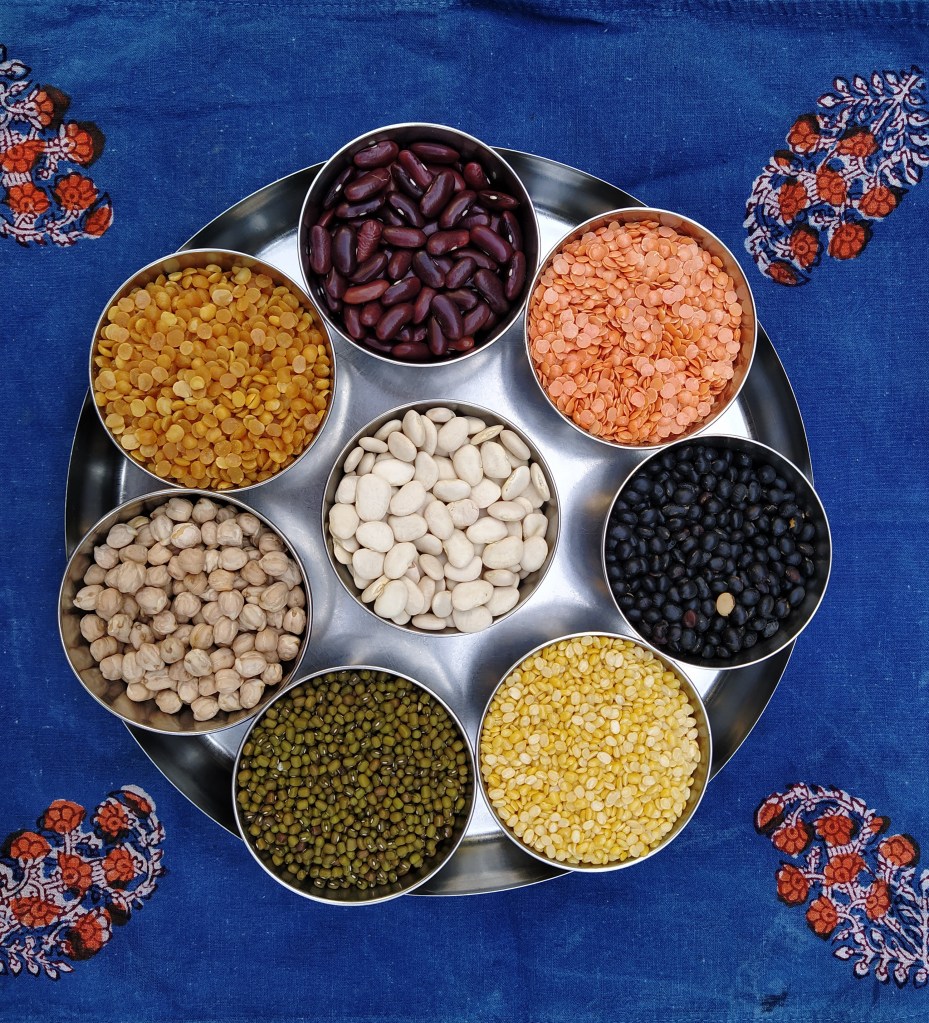
Every Indian kitchen has a variety of pulses that go under the umbrella term of “dal”. Technically, pulses, also known as legumes, are the edible seeds of leguminous plants cultivated for food. Dried beans, lentils and peas are the most commonly known and consumed types of pulses.

Interestingly pulses do not include crops that are harvested green (e.g. green peas, green beans)—these are classified as vegetable crops. Also excluded are those crops used mainly for oil extraction (e.g. soybean and groundnuts), and leguminous crops that are used exclusively for sowing purposes (e.g. seeds of clover and alfalfa).

Pulses have formed an essential part of diets in many parts of the world for thousands of years and thus humans have cultivated this ancient food crop for centuries. Scientific studies of archaeological remains have suggested that people from modern-day Turkey grew chickpeas and lentils in 7000-8000 B.C. Evidence of lentil production has also been discovered from Egyptian pyramids, and dry peas were found in a Swiss village—dating back to the Stone Age. Experts have hypothesized that chickpeas production started to spread from the ancient Mediterranean region between Morocco in the west and the Himalayas in the east before 3000 BC. There are even mentions of certain pulses in the Vedas, which are widely believed to be at least 4000 years old.

From the Yajurveda onwards, Sanskrit literature has mention of the three Ms—mudga (green gram or mung), masura (pink gram or masoor) and masha (black gram or urad). The Buddha is said to have endorsed all three Ms for regular use. The three pulses continue to be widely used in all parts of India in different dishes and forms. It is believed that when Iranian scholar Abu Rayhan al-Biruni came to India 1,000 years ago, he discovered the daily meal of the average Indian, the porridge-like khichdi, a mixture of rice and lentils. Traditionally, the definition of a balanced meal in most parts of India always consisted of pulses, along with cereals, vegetables, fruits, and milk products.

Pulses are indeed what we call “superfoods”. The tiny seeds are loaded with nutrients, fibre, vitamins, and minerals. They are gluten-free and have high protein content, making them an ideal source of protein particularly in regions where meat and dairy are not culturally or economically accessible. Pulses are low in fat and rich in soluble fibre, which can lower cholesterol and help in the control of blood sugar. They are a great source of vitamins and minerals such as iron, zinc and magnesium.

Pulses are a rich source of fermentable fibre, which feeds intestinal bacteria and promotes the assimilation of nutrients, thus facilitating proper immune system functioning. Because of these qualities they are recommended by health organizations for the management of non-communicable diseases like diabetes and heart conditions. Pulses have also been shown to help combat obesity.

Pulses are important not just for human consumption, but also for the farmers who cultivate these. They are an important crop because they can both sell them and consume them, which helps farming families maintain food security. They provide economic stability as compared with perishable crops as they can be dried and stored for a long time.

 Pulses are farmer-friendly as well as friends of the environment. The nitrogen-fixing properties of pulses improve soil fertility, which increases and extends the productivity of the farmland. Using pulses for intercropping and cover crops can promote field biodiversity and improve soil microbiome, while keeping harmful pests and diseases at bay.

Pulses are highly drought and frost-resistant, which makes them suitable for a wide range of climatic conditions and environments. Pulses are also known to be climate-smart, which means they can easily adapt themselves to weather fluctuations. They have a low water footprint. As compared to others, pulses only require one-tenth of the amount of water to grow and therefore can be easily grown in semi-arid conditions.

Pulse crops have a lower carbon footprint than most foods because they require a small amount of fertilizer to grow, and they help to naturally introduce nitrogen in the soil. One of the advantages of biological nitrogen fixation is that it provides a natural slow-release form of crop nitrogen supply that matches crop needs. By reducing dependence on synthetic fertilizers which release greenhouse gases during both their manufacture and use, pulses contribute to climate change mitigation.

While pulses have always been integral to our daily diets, they are usually not seen from these other perspectives. Recognising their multi-dimensional value the United Nations proclaimed 2016 as the International Year of Pulses (IYP). The celebration of the year, led by the Food and Agriculture Organization of the United Nations (FAO), was aimed to increase the public awareness of the nutritional and environmental benefits of pulses as part of sustainable food production.

In December 2018, the United Nations General Assembly designated February 10th to be marked as World Pulses Day every year, to recognise, and remind of, the important link of pulses to the United Nations’ 2030 Agenda for Sustainable Development.

Today, as the world celebrates World Pulses Day, let’s take a look at our own meals and list the numerous forms of pulses on our menu for the day. And as we relish our dal baati-churma, sambar-idli, rajma-chaaval, cholar dal-luchi, or even the simple khichdi, let’s put our hands together for the pulses!

–Mamata