
Continuing Meena’s celebration of women in unconventional professions. While forensic scientists do a lot of their work in labs, there is a band of sleuths that follow clues on the ground. These are the women detectives. Crime fiction through the ages has had its share of popular female detectives. From Jane Marple, the gentle (but canny) epitome of an old English aunt, to Mma Ramotswe, the generously proportioned Botswana detective, these fictional detectives have a dedicated band of followers. Not many readers may even stop to wonder if such sleuths exist in real life. Indeed, they do! And the real lady detectives probably date back as far back as the fictional ones.
In Victorian England several stories of female detectives appeared in newspapers in the 1850s and 1860s. These ladies donned disguises to pursue thieves, and spy on adulterous husbands. Most of these ladies were initially part of male-led detective agencies, but by the 1880s women were beginning to set up their own agencies. Maud West was one of the most popular and well-known private detectives of her time in England. She was famous for her disguises. In 1905 she set up her own private detective agency. Over the next century such lady detectives were in demand especially as they were discreet, ingenious, and smart at surveillance.
But it took until the early twentieth century for a woman to join Scotland Yard as a detective. On December 27, 1922, Lilian Wyles became the first woman in the history of the Metropolitan Police to join the Criminal Investigation Department (C.I.D.) as an inspector. She was promoted to Woman Detective Inspector First Class on February 18, 1935.
Meanwhile across the Atlantic, women were also entering what was considered to be a male domain. In 1856 a self-possessed young woman walked into the Chicago office of Pinkerton Detective Agency looking for a job, but not a job as a secretary. Kate Warne was hired, becoming the first female detective in the United States of America. She proved herself to be fearless, and adept at digging out valuable information. In one investigation she posed as a fortune teller to entice secrets from a suspect; in another she made friends with the murderer’s wife. The most defining case of her career was to foil an attempt to assassinate President Abraham Lincoln while on a train trip. She infiltrated the plotters by cultivating their wives and daughters. Her exploits encouraged other women to explore this field. Kate Warne rose to become the superintendent of the female bureau of the Chicago office of Pinkerton Detective Agency.
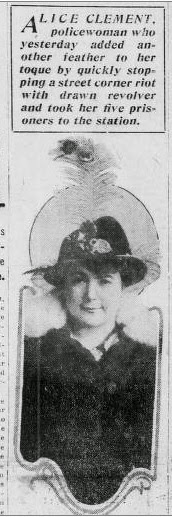
While Kate was into private investigation, the official law and order agencies still had to engage women. In 1913, Alice Clement was the only woman in the class of almost 100 new police officers in Chicago’s police force. And Alice made no attempt to colorlessly blend in with the uniforms. She flaunted fashionable dresses, ropes of pearls, and a sophisticated haircut, even as she brandished a submachine gun, and practiced martial arts. She was passionate about her chosen profession, famous for her undercover work, and solving difficult murder cases. The Queen of Dramatic Arrest as she was called, was feared by even the most hardened criminals of the day. Alice Clement was a major advocate for women’s rights including the right to vote. She also travelled across the United States making a case for police departments to include policewomen, leading to several cities opening up this career for women. The substantial presence of women officers in the police dramas that we see on TV today, are not just reel characters but reflections of the real women who are integral to investigation of crime.
It took almost a hundred years after these pioneering PIs, for India’s first female detective to make her presence felt. Rajani Pandit the daughter of a CID officer, did some instinctive sleuthing while in college. She tried to find out why one of her classmates was behaving out of character, unraveled the mystery; and informed the parents who were grateful. Rajani was now bitten by the bug, and began to pursue investigative work, more as a passion than profession. Her father was not too happy with his daughter’s choice of work. But news of Rajani’s successful investigations spread through word of mouth, followed by some media publicity. Cases started pouring in, and in 1986 she set up her own detective agency–Rajani Investigative Bureau. From a time when the idea of a female detective was met with disdain, Rajani and her bureau have solved 75000 cases. These cover a range, from extramarital affairs to corporate espionage, missing persons to murder.
Today more women are making a foray in this field. Perhaps the youngest female detective to set up her own agency is Tanya Puri. Still in her 20s she runs Lady Detectives India. The agency has half-a-dozen female investigators. They call themselves the Girl Squad, and usually work in pairs when out late on Delhi’s streets.
Female detectives nowadays carry out undercover operations, conduct surveillance, take charge of high-stakes investigations, cases of corporate espionage, and sensitive matrimonial investigations. Women in India can legally lead investigations.
What makes women excellent investigators? As a veteran male detective observed: They are highly perceptive, they know how to get access locations and discussions that men can’t, and they’re very organized. Women communicate empathy which engenders trust.
Mma Ramotswe summed this up neatly: Women are the ones who know what’s going on. They are the ones with eyes.
On this Women’s Day celebrating the spunk in every woman—past, present and future!
–Mamata

 Millennial Matriarchs