
For every one of us, there are about 2.5 million of them. Yes, that’s how much ants out-number us. They inhabit every corner of the world other than Antarctica, Greenland, Iceland, and some islands.
We humans swing between appreciation of these insects for their qualities of team work and hard work, and irritation when they invade our homes or kitchens. The ants probably swing between the same two emotions—appreciation of the humans who feed them, and disapproval of clumsy or mean humans who step on them or kill them.
Beyond human approval or disapproval, ants have a huge role in the ecosystem. They serve as seed dispersers for plants, hosts for a wide range of associate organisms, and act as both predator and prey. The role of ants in nutrient decomposition and soil turnover is enormous–they are estimated to excavate up to 13 tons of soil per hectare annually and increase local nutrient availability by a significant order. Moreover, they create and maintain of microhabitats for a variety of other organisms.
The subject of today’s piece is their homes. They make their homes in a variety of places, and these structures are made with an enormous amount of labour by thousands of the creatures working together.
Most species of ants are soil-nesters. Soil meets their needs for food, moisture and protection. Since these ants move a lot of soil in the process of building their nests, they provide a valuable service to the soil-based ecosystem they occupy by their tunnelling and de-compacting of the soil. Some soil nesting ants construct a simple nest with one vertical tunnel, which has branches on either side for ant food, eggs and larvae. But other ground nesting ants build elaborate below-ground galleries going several metres below ground, with a network of interlocking interconnecting tunnels.
Wood-nesting ants are the next category. Carpenter ants are the best examples of these. They nest in wood that is rotting, dead, dying, or with a high moisture content. The ants bore into the wood and make elaborate nests. They do not eat the wood but deposit the wood they bore outside the nest. While they usually build outdoors in trees, it is not unknown for them to build in wooden structural elements in our houses.
There is category of ants which are called opportunistic nesters. These will nest almost anywhere, including under rocks, concrete slabs, air conditioners, inside holes in walls etc.
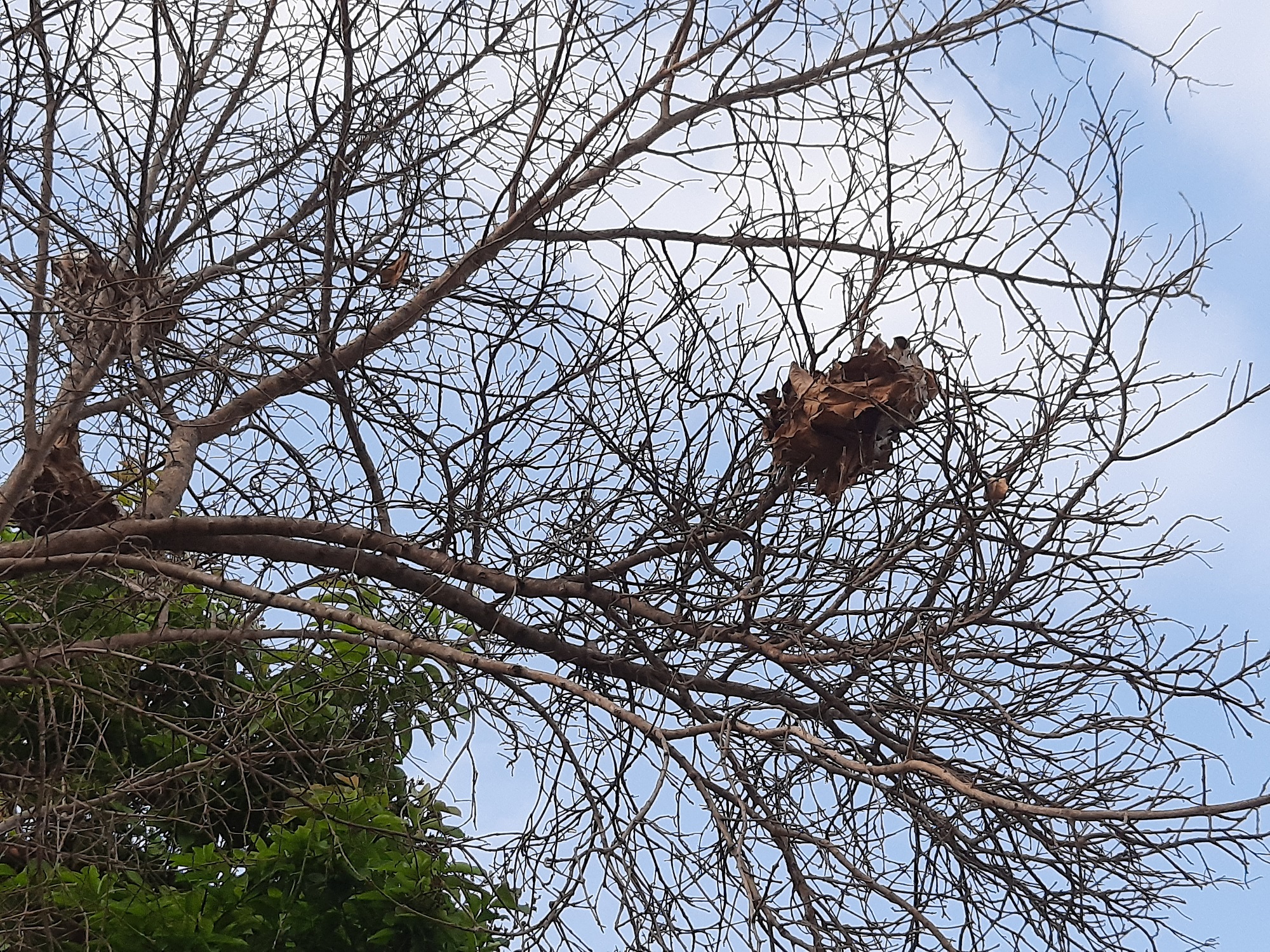
A fourth category, which are most visible to us at the moment are arboreal ants which construct nests on trees using leaves. These light red ants Oecophylla smaragdina, popularly known as weaver ants, stitch together individual leaves using larval silk to form nesting cavities. The nests are round-oval and use leaves of different sizes ranging from 8-32cm. About twenty leaves are used to make each nest. These ants are aggressive in defending their territories, and a colony may take over an entire tree with nests distributed throughout. Incidentally, these ants, called “Rukkung” in Arunachal Pradesh, are consumed in various forms in some of the North-eastern states..
I see these every evening on my walks—the falling leaves in this season leave the trees bare, which make the nests very visible. And marvel at the intricacy of the nests and the hard work that goes into each of them. What wonders there are around us, if only we take a minute to look!
–Meena
 Millennial Matriarchs