
It sounds like something out of an imaginary futuristic scenario. Entire countries with no young people, no babies being born, and the old dying out until finally there are entire countries without a human population. Incredibly, this is happening here and now. Many countries in Eastern Europe, Southern Europe and East Asia are facing drastic declines in new births, even as the elderly population declines due to deaths. News reports say that the number of babies born in Japan in 2024 was the lowest since records began in 1899. The prospect of population extinction is becoming a reality in South Korea, which has been moving towards a childless society. Of the already dwindling population, young people are abandoning their rural homes and migrating to cities in search of work, leaving no workforce for agriculture and fishing. What will these abandoned villages look like?
There is a village in Japan which is an ironically graphic example of such a scenario. This is Nagoro, an isolated valley town on the Japanese island of Shikoku, the smallest and least visited of Japan’s four main islands. Originally populated by around 300 people, a few years ago only about two dozen old people remained. One of these old people was a father whose daughter moved back to the village to be with him. Tsukimi Ayano who had spent most of her life in Osaka moved back to the island in 2002.
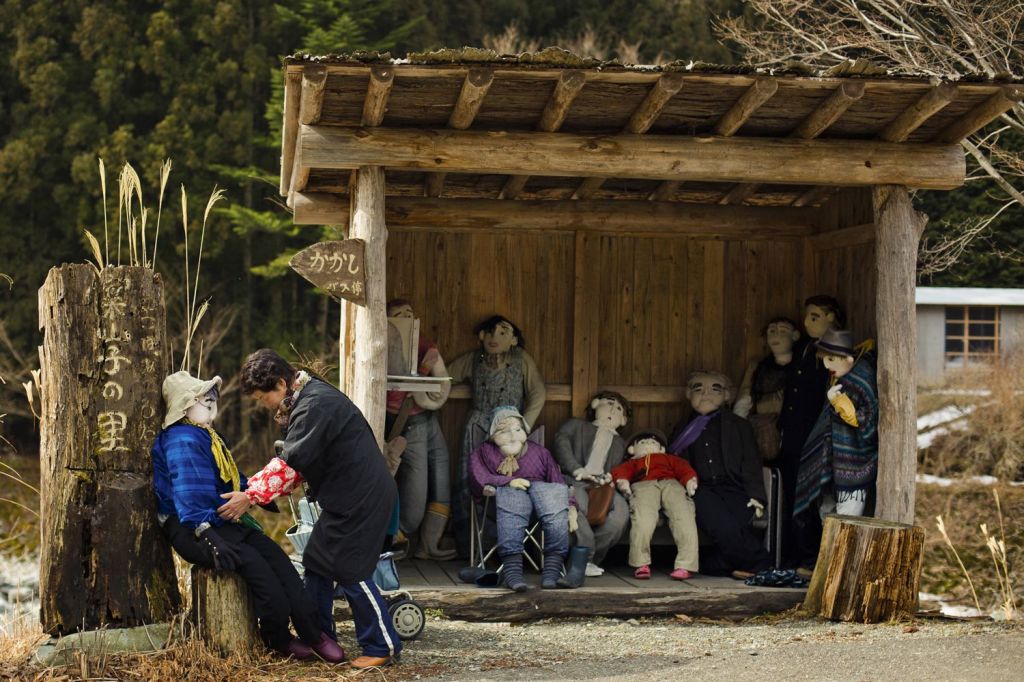
One of the things that Ayano did when she came back was to make a scarecrow (called kakashi in Japanese) that resembled her father to scare away the birds that were raiding the seeds that she planted on the family plot. In addition to keeping the birds away, Ayano liked that the scarecrow added a dash of something different in the deserted landscape. Having the time, and the skills, Ayano continued making these life-sized and life-like scarecrows for other people’s fields also. From scarecrows, Ayano moved on to making other figures. It became her hobby, and her pleasurable pastime. Initially she made the scarecrows for the fields; then she started making figures that resembled old neighbours who had passed away, or people who had moved away. Ayano felt that these gave her a sense of having some company. It was also a way of commemorating the erstwhile residents of the village, while infusing some spirit in their rapidly vanishing village.
These figures (she calls them ‘dolls’) soon began to populate different parts of the village. They were placed in people’s gardens, at bus stops, in village meeting places—depicted as being engaged in everyday tasks. Walking around the village one could see figures of construction workers installing a road sign, a fisherman on his porch with his daughter, a couple sitting on a river bank, all looking real and ‘ready for action’. After the village school closed down as there were no students, Ayano recreated a classroom with students and teachers, with two of the dolls wearing the same clothes as the last two students who had attended the school.
As she said “I just wanted people to enjoy looking at the dolls and I want to enjoy making them.” Ayano makes all the dolls herself using wooden slabs for the base, cotton clumps for the head and rolled newspapers for the ‘skeleton’ as well as straw and fabric. The dolls come to life with the unique facial expressions she gives each one, shaping the nose and the mouth, choosing the buttons for the eyes, and meticulously crafting the ears. Ayano wants to make sure that her kakashi can hear well! She dresses them in clothes that, in many cases, belonged to the real characters, or are donated. It takes Ayano about three days to make a doll. Each doll has a life of two to three years as the natural materials weather quickly. Ayano tries to recycle as much of the material as she can, as she makes new dolls to replace the old ones.
Ayano’s village of dolls Nagoro remained undiscovered and unknown until 2014 when a German filmmaker made a short documentary titled Valley of Dolls. This attracted global attention, and led to an influx of curious tourists to this remote island. Ayano personally felt that the film was dark and sad, whereas for her the process of creating the dolls is a joyous one, and the village itself is a now a curiously vibrant and animated place. Ayano’s acknowledgement of the filmmaker is his replica doll as a figure at a bus stop!
For Ayano these dolls are a celebration of life, not weird reminders of the past. In her mid-seventies now, Ayano continues to live in the village with its population that she has created and continues to nurture.
–Mamata
 Millennial Matriarchs