
Doomsday Book

No, not a book with dire predictions for 2025 aka Nostradamus, Baba Yaga etc.

The Domesday (or Doomsday) book is the 1200+ year survey record! Covering most of England and parts of Wales, it was commissioned by William the Conqueror. The survey started on Christmas of 1085 (exactly 939 years ago!) and was completed in1086. It is the oldest government record held in The National Archives of the UK.

It is an amazing piece of work, in that it surveyed almost every property in England and Wales. Using a fixed format, the survey tried to elicit who owned which property, who lived there, the livestock, how much the land was worth etc. It traced the history of the property—who had owned it before the time of William the Conqueror and who owned it now.

The whole purpose was to ensure that the King had a record of how much land was owned by whom, and therefore how much tax could be charged! It provides definitive proof of land rights and tax obligations, making it a crucial legal document even today. It covered over 13,000 places. Not only was it a foundational document for land rights, it also the socio-economic landscape of 11th-century England.

But why on earth was it called the Doomsday Book? This evolved from its association with the Last Judgment (or Doomsday). The book was the last word–once recorded, its contents could not be contested! It was the source of evidence of land titles, and hence served as a legal reference for resolving disputes over land ownership. It was the final arbiter!

Data collection for the Book was monumental for its time. Royal Commissioners travelled across the kingdom, collecting information from local juries composed of nobility and citizens convened for the purpose. These people swore in court to give correct and accurate information to the Commissioners.  They answered several questions including:

  • Who owned the land.
    • How much land there was.
    • The value of the land.
    • The number of tenants and their obligations.
    • Livestock counts.
    • How many plough teams.
    • How much wood, meadow and pasture.
    • How many mills and fisheries.

The responses gathered by the juries were meticulously recorded in Latin by one set of scribes, and checked by a second set. The data was probably cross-verified with other records and follow-up inquiries.

The information was recorded in two books—The Great Domesday, and the Little Domesday (covering different geographies). Each is arranged by county, and within each county, by landholder. Each landholder is given a number, which is written in red in roman numerals as the heading of their entry. There is a table of contents at the beginning of each county, which lists the landholders with their numbers.
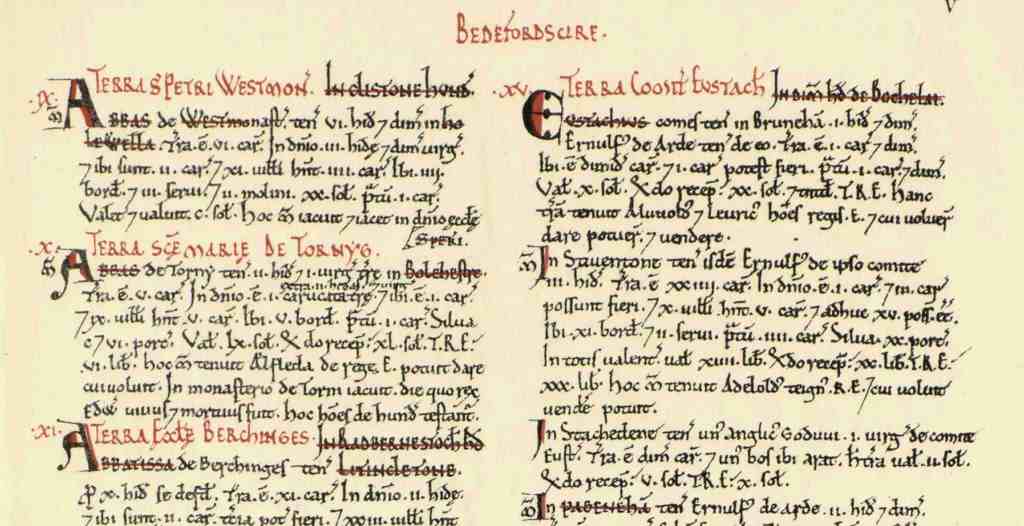
The Doomsday Book is not a census of the population, but has influenced surveys and censuses down history. The Indian census is considered a model for gathering reliable data across a large country (not of course land ownership—that is a problem yet to be cracked).  The Doomsday Book has probably also influenced our census indirectly.  Hopefully, we will have our long-delayed census in the coming year—aided by smart phones, tabs and the like. Let us hope the information collected is as authentic as the Doomsday Book managed.

In 1789 Benjamin Franklin said, ” In this world, nothing can be said to be certain, except death and taxes.” The Doomsday Book was indeed proof of that!

So here is to a Happy 2025, even though we will still have to pay our taxes!

–Meena

nationalarchives.gov.uk

Pic: Historic UK
A ‘Strictly Personal’ Common Experience

Recently I was reading ‘Strictly Personal’ an account of the lives of Dr. Manmohan Singh and Mrs. Gurcharan Singh, by their daughter Daman Singh.

The-then Mr. Manmohan Singh went to Oxford in the early ‘60s. He was joined in a few months by his wife and daughter. He was there for about 2 years. He was there to do his Ph.D

My father went to London in the early ‘60s, He was joined in a few months by his wife and children. He was there for about 2 years. He was deputed there by the Defence Research and Development Organization to train at the Royal Marsden Hospital, towards helping in the operationalization of the Institute of Nuclear Medicine and Allied Sciences (INMAS), which was to be involved in nuclear medicine research, and response to nuclear accidents and explosions.

What amazed me was the commonality between the experience that the book talks about, and the stories which are a part of my family history.

First and foremost, the travails of living on a very limited budget. It was literally hand-to-mouth! My mother recalls that at times, there were not enough pennies to put into the home-heater, and we all spent the day huddled in our woollies. The free milk that my brother and I were eligible for as children was a major saviour. It was not that the pay and allowances were so bad (they were not generous, but adequate). It was that they simply did not come for the first 3 months, till the bureaucratic wheels started moving. And even after, the money came in by fits and starts. One incident which was etched deep into my parents’ memories was a visit to Veerasway, UK’s oldest Indian restaurant. Yearning for other-than-home Indian food, they, with the two of us in tow, ventured in one day. Only to beat a hasty retreat on learning that the cover charge was £ 1 per head!

The book quotes Mrs, Singh as saying ‘We were quite hard up. I don’t know how many pounds a week we got. We had to survive within that. It was not a great, handsome scholarship.’

To the question ‘did you wear Western clothes?’ Mrs. Singh responds ‘No, no, no, never.’ But at least she may have worn salwar kameez. My poor mother stuck to saries through the freezing windy days, walking through hail and snow to the shops or to drop or pick up my brother from the school bus. I fully attribute her getting arthritis by the age of 35 to this exposure to the terrible cold and wet.

Food may have been a bigger problem for my strictly vegetarian family. My mother, on one of her initial trips to the super market, brought home margarine, which an English friend had suggested as a cheaper substitute for butter. It was only after her return home that she read the packaging and realized it was made from pork fat. The trauma stayed with her for life!

The Singhs lived in Oxford. Apart from one trip to London and one to Stratford-upon-Avon, they saw nothing of England. Maybe to that extent we were luckier. Living in London, we at least got to see the sights there—the few family pics taken with my father’s precious camera bought there show us at Trafalgar Square, outside the Buckingham Palace, the Tower, Westminster Abbey etc. The penguin show and the Chimpanzees’ Tea Party (discontinued in the ‘70s) were the highlights of the zoo visit.

The SInghs did not have a TV, and went to a neighbour’s to watch. We did have a television and the show that my parents talked about, which still sticks in my memory is ‘Saturday Night at the London Palladium’, a long-running variety show.

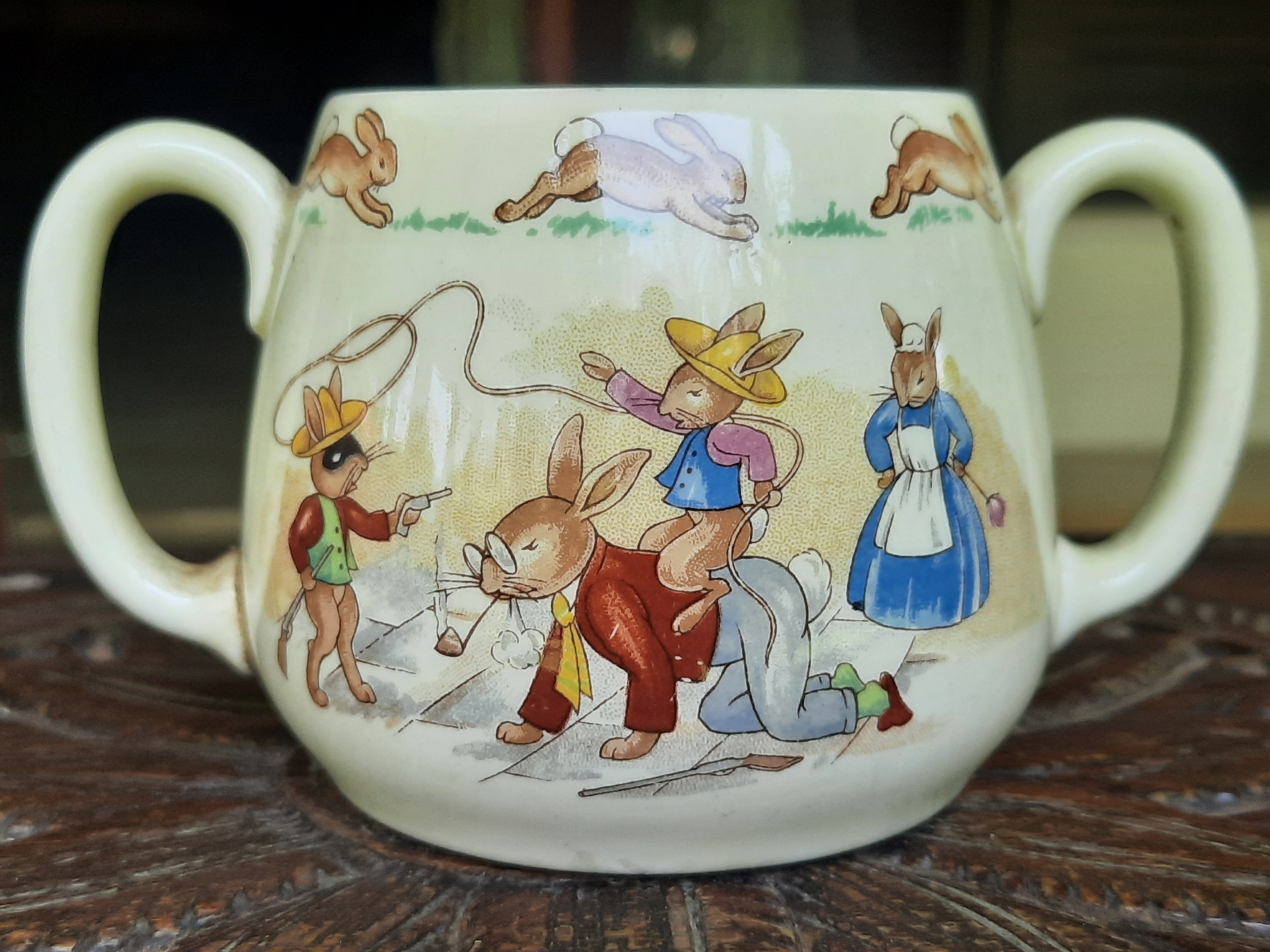
Peter Rabbit Milk Mug
My Peter Rabbit Milk Mug: A Precious Relic

Equally, the things they chose to buy and bring back. Both Mrs. Singh and my mother brought back Baby Belling ovens—a part of British history. The Belling company was established in 1912 and manufactured electric heaters. The first complete domestic electric cooker was made in 1919 and the first Baby Belling oven was manufactured in 1929. The company still exists but is not the gold standard for ovens that it obviously was in mid twentieth century. The other significant item to accompany the Singhs back were three saucepans. In my parents’ case, it was a mixie—a Braun Liquidizer, if I recall. This was my mother’s most precious possession. In fact, when a mischievous visiting child was on the verge of pushing it over, she caught the machine, and her hand was badly slashed, requiring stiches! Mrs. Singh’s oven served her for 3 decades, as did my mother’s mixie!

I think this would be the story of all professionals who went to the UK in those days. But interesting to see that a PM’s family and mine were in the same straits! (We were in other similar ‘straits’, more about which next week.)

In today’s world, all this sounds so strange! Life is so international today, our exposure is great, that nothing really comes as a surprise even when we go to the farthest part of the world. Purchasing power is not a problem, except maybe when there are threats of taxing international credit card payments. Not only are we more international in our eating, Indian food of every variety is available everywhere.

But how did they handle it back then—landing in a country familiar only through books, with few support systems or networks, with little money, inadequate warm clothes, unfamiliar food. They were certainly adventurous, maybe much more than we are today!

–Meena