
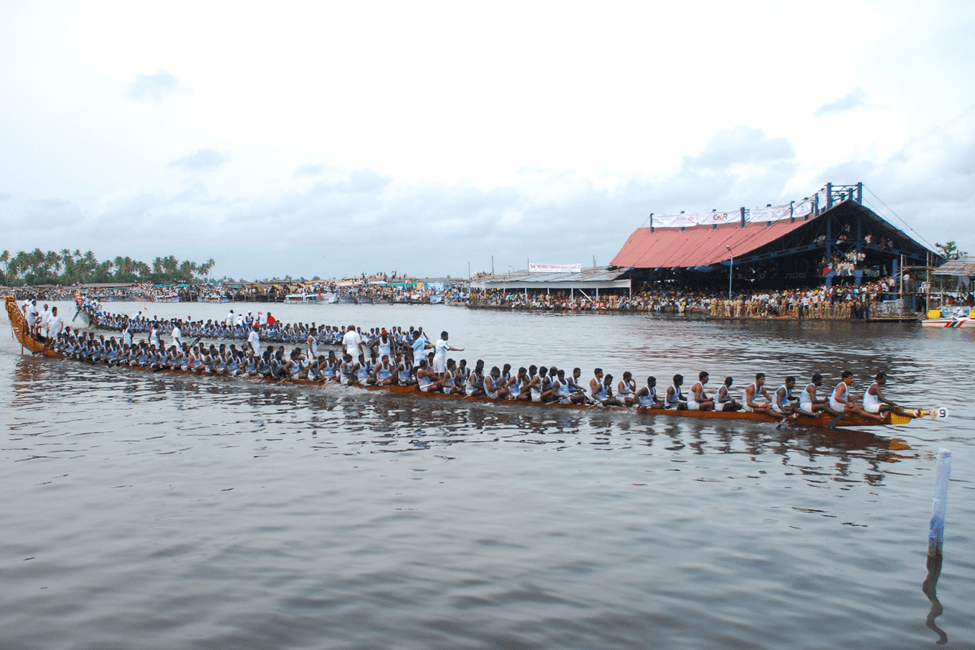
Come August, the air begins to buzz with anticipation in Kerala. The boat race season is here! Known locally as vallamkali (literally, boat play), the sight of dozens of snake boats slicing through the waters, powered by hundreds of synchronized oarsmen, is one of Kerala’s most spectacular traditions. Shiny black boats stretching almost 100 feet, with rowers swaying to the rhythm of a vanchipattu (boat song).
The most famous of the boat races is the Nehru Trophy Boat Race, inaugurated in 1952 when Jawaharlal Nehru, then Prime Minister, was so captivated by the spectacle that he donated a silver trophy. Today, the Nehru Trophy on the Punnamada Lake in Alappuzha attracts international attention and has been featured on tourism campaigns worldwide. But across the state, from Aranmula to Champakulam, local communities host their own races, each with its own traditions and lore.
Innovation on the Water
One of the most interesting aspects of the boat races today is how technology has crept in—not to diminish tradition, but to amplify it. While the boats themselves are still crafted the old way, using Anjili wood and painstaking carpentry handed down through generations, innovations have entered the training and organization.
Rowers now undergo scientific fitness regimes, with physiotherapists, nutritionists, and even sports psychologists guiding teams. GPS trackers and drone footage help coaches analyze synchronization and speed—things once left only to the naked eye and instinct. Live-streaming and 4K broadcasts take the drama of the races across the world, making it a truly global event. And traditional boat songs as well as new ones are now available on Spotify playlists.
Women at the Oars
But what about women? For long, the snake boat races were a male preserve, embodying sheer physicality. Yet, in recent years, there has been a quiet but important shift. Kerala has begun hosting all-women boat races—a recognition that strength and stamina are not male monopolies. In 2022, the first Vallamkali exclusively for women was held, with teams of fisherwomen taking to the waters.
Even in mixed-community celebrations, women’s teams are increasingly visible, particularly in the Kettu Vallam (smaller decorated boats) races. It is still early days, but the image of women rowing with fierce determination underlines how traditions evolve without losing their essence.
More than a Race
Preparing a snake boat involves dozens of families. Training the oarsmen requires food, lodging, and encouragement from entire villages. On race day, the banks are filled with people singing, cheering, and celebrating. Divisions of caste, class, and creed dissolve.
There is also a spiritual dimension. The Aranmula boat race, for instance, is tied to temple rituals, where the boats are offered as homage to Lord Parthasarathy. Here, winning or losing is less important than participation.
The Kerala boat races are not just about the boats—they’re about the teams, each carrying the pride of their village or community. In recent years, the competition has become so professional that many villages now run their own “boat clubs,” with dedicated squads training year-round. It’s a bit like football clubs elsewhere—loyalty runs deep, rivalries are fierce, and victories are celebrated across the community! A few of the most celebrated teams are:United Boat Club (UBC), Kainakary, Police Boat Club, Kollam, Jawahar Boat Club (JBC), Kollam, St. Pius Boat Club, Alappuzha, Karichal Chundan (Alappuzha), Champakulam Chundan, Veppu Vallams of Aranmula.
Congratulations to the winner of this year’s 71st Nehru Boat race held last week, the boat Veeyapuram Chundan of Village Boat Club Kainakary. The winning team which was one among 75 competitors, touched the finishing line in 4.21.084 minutes.
And Happy Onam to all!
–Meena
Pic: nehrutrophy.nic.in/
 Millennial Matriarchs