Some memories come back vividly when there is a trigger. Sadly, the trigger for this memory was a newspaper item reporting an accident involving a Sepak Takraw team.
But the memory itself is joyful. A trip to Burma, about fifteen years ago. It was a warm afternoon in Yangon. The tea stalls were buzzing, the pagodas gleamed in the sun, and somewhere between wandering and people-watching, I found myself drawn to a small patch of open ground near a quiet lane.
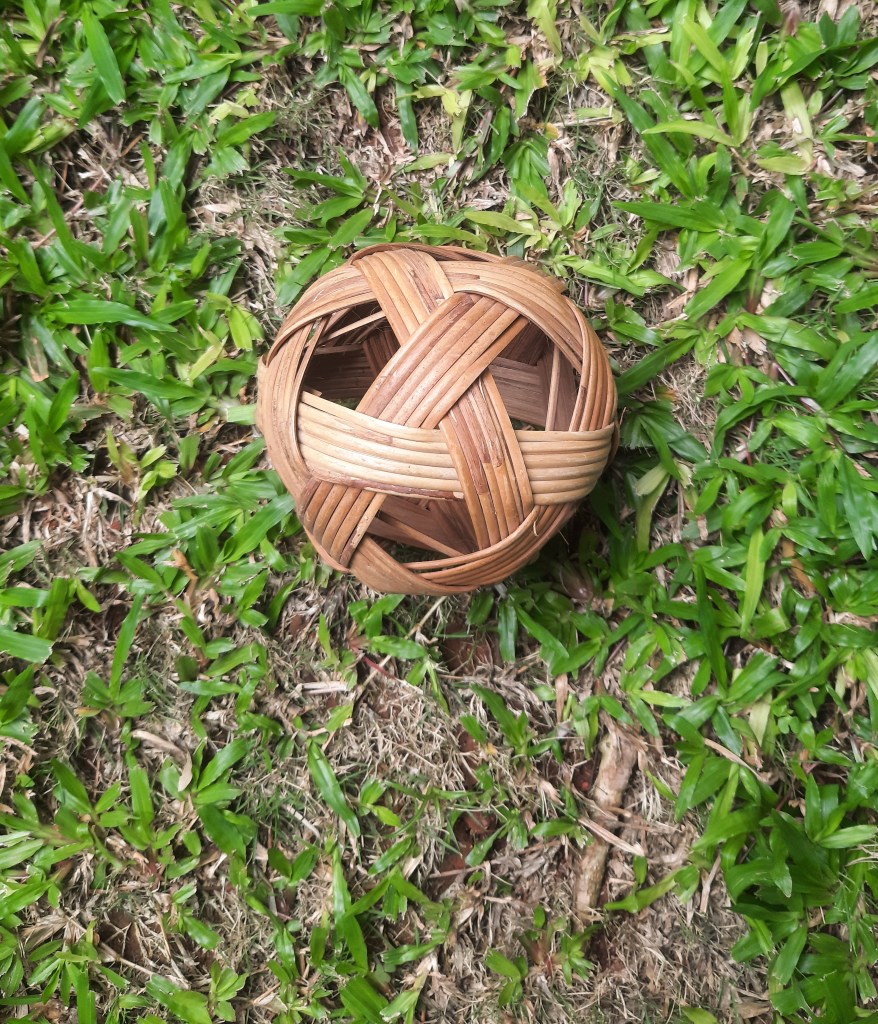
A group of young boys were playing a game I had never seen before. A boy leapt into the air, spun like a dancer mid-flight, and kicked a small rattan ball clean. I stood completely still, mesmerized. It was my first encounter with Sepak Takraw. We stood and watched for quite a while—the grace, the athleticism, the sheer joy of the players—was something amazing to watch. Fortunately on the way out, I found a Sepak Takraw at the airport and bought it.
All these years later, that moment still shines brightly in memory. Because Sepak Takraw is not a sport you easily forget.
For many of us in our generation, our playground sports were familiar—gully cricket, kho-kho, maybe a weekly volleyball session if your school had both a net and enough motivation to set it up. But Sepak Takraw feels like someone took volleyball, infused it with martial arts, added the grace of classical dance, and sprinkled it with sheer joy.
In the lanes of Myanmar, Malaysia, Thailand, and Indonesia, this sport has lived for centuries. Its early form, sepak raga, simply meant “kick the rattan ball.” Communities played in circles, keeping the woven ball aloft with feet, knees, heads—much like our own childhood attempts to keep a rubber ball bouncing on our legs, but infinitely more skillful.
Over time, the game evolved. Nets were added, rules refined, teams formed. What remained unchanged was the heart of the sport—rhythm, teamwork, and an almost balletic coordination.
What struck me in that first encounter in Burma was the joy. There was no crowd, no scoreboard, just a group of boys pushing the limits of their bodies, laughing, teasing, showing off impossible kicks.
Since then, as videos of Sepak Takraw swirl across the internet, the world has begun to share in that delight. Watching professionals play is like watching physics bend slightly. The killer kick—a full somersault that sends the ball crashing down at an angle—feels like something from a choreographed stage performance. The teamwork is intuitive, almost telepathic.
Interestingly, Sepak Takraw has been creeping into India’s sporting landscape too, especially in the Northeast. Manipur in particular has embraced it with enthusiasm, with players who train tirelessly and compete internationally. Perhaps some Indian traveller today will see a game in Imphal or Aizawl and feel the same quiet awe I felt in Yangon all those years ago.
Today the game is played at international level, and has entered the AsianGames. Efforts are on to get it into the Olympic list.
But for me, it is the memory of that afternoon in Burma—the dusty field, the laughter of boys, the swift arc of a rattan ball against the sky. It is a reminder of how sport, in its purest form, connects us across borders and time.
–Meena
 Millennial Matriarchs