
A survey in America in 2003 asked people which of the following inventions would be the hardest to live without: the automobile, the personal computer, the cell phone, the microwave, and the toothbrush. The more recent inventions trailed the list; the century-old automobile came in second, and the five-century-old toothbrush came in first!
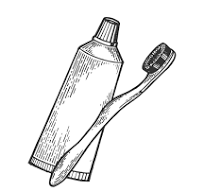
This week Meena took a walk through the history of walking sticks. Continuing a look at things that aid, and starting at the head rather than the legs, here’s looking back at the object that we start and end our day with—the toothbrush!
But cleaning teeth did not wait till the discovery of the toothbrush. From the earliest times, people used to chew on a piece of twig until it softened and became frayed. This process helped to not only reach crevices where particles hid, but also released juices in the mouth which performed the task that toothpastes do now (not to mention the regular work out for the jaws!) Twigs from aromatic shrubs or trees were also built-in mouth freshening! Even today neem and babool twigs continue to be used by many. While one end of the twig was frayed by chewing, the other end could be niftily carved into a toothpick to pick at the more stubborn bits wedged between the teeth.
Such tooth cleaning tools date back to 3500-3000 BC, to early Babylonians and Egyptians. Toothsticks these have been discovered as part of burial artifacts in Egyptian tombs, to enable the departed persons tooth cleaning routine even in the afterlife.
Different cultures had other cleaning techniques. Some used a rag dipped in sulfur oil or a saline solution to wipe teeth. Another practice was to just rub baking soda (sodium bicarbonate is still an ingredient in toothpastes) directly onto the teeth.
The transition from a ‘make your own bristles by chewing’ implement to the toothbrush in its early form as we know it is believed to be the invention of the Chinese in the 15th century. Using a piece of bone or bamboo, they attached, at right angles to this, stiff coarse bristles from the back of a hog’s neck, and voila! You could reach the difficult to reach crevices in the mouth, and also actually brush your teeth rather than chew with them.
News of this nifty device reached Europe via commercial travellers during the middle ages. But it was difficult to replicate because the Siberian hog’s hair which was ideally stiff and coarse was not available; and the horsehair used as a substitute was not stiff enough.
The story goes that an Englishman named William Addis who was jailed for inciting a riot spent his time in prison experimenting with alternatives to cleaning teeth by the prevalent method of rubbing them with a rag covered in soot and salt. Addis carved a handle out of a small bone, drilled holes into it, and inserted tufts of boar bristles which were held in place by glue. He had found his replacement for the soot and rag!
After his release Addis began importing coarse boar bristles from the cold climates of Siberia and northern China. His design and the combination proved so successful that, in 1780 he founded a company called Addis to mass produce these brushes, and became a very wealthy man. The company continues to be in the brush business till today.
The expanding market gave rise to innovations in design and material. The single or double row of bristles gave way to a three-row brush with serrated bristles, and Meyer Rhein patented this design in 1844. The Chinese civil war in the latter 1800s, and later the Japanese invasion of China made it increasingly difficult to procure the boar bristles. The invention of a nylon, new synthetic material in the mid-1930s provided a timely alternative to natural bristles. This invention began a new phase in the history of the toothbrush with Dr West’s Miracle Tuft Toothbrush in 1938, the first such toothbrush with nylon bristles. And the rest, as they say is history.
While the material of the handle and the bristles continues to be plastic and nylon, today toothbrushes come in a mouth-boggling range of shapes and sizes. Handles that are straight, angled, and contoured with a variety of grips; and bristles ranging from hard to extra-soft offer something to fit every tooth. While the fundamentals of their design have not changed since the time of the Egyptians and Babylonians, today toothbrushes, like all products are marketed with labels such as ‘ergonomically designed’ to ‘dentist endorsed’.
Even more heavily dentist-endorsed are the mouth-watering choices in toothpastes. We have come a long way from sooty rags as mouth-cleaning agents. It is believed that mouth cleaning and freshening agents were in use even before the invention of toothbrushes. Ancient Egyptians, Greeks, Romans, as well as people in China and India used a variety of ingredients to keep teeth and gums clean, as well as for whitening teeth and freshening breath. These included powdered charcoal and bark, as well as a powder of ox hooves, ashes and burnt eggshells which added abrasiveness. The Chinese added mouth-freshening components such as ginseng, herbs, mints and salt.
Before the 1850s these mouth cleaners were in powder form. Early versions of these in paste form contained soap, and in the 1850s chalk was included in the composition. During the 1850s, a new toothpaste in a jar called a Crème Dentifrice was developed; in 1873 Colgate started the mass production of toothpaste in jars. The late 1880s saw another breakthrough in toothpaste manufacturing with the invention of toothpaste tubes; making it easier to carry, and to use. Colgate introduced its toothpaste in a tube similar to modern-day toothpaste tubes in the 1890s. Today toothpaste is always associated with the tube.
The formula of toothpaste underwent changes over time. Soap, which was initially used in toothpaste, was later replaced by other ingredients like sodium lauryl sulphate (which continues to be an ingredient in most toothpastes). This transition led to gentler toothpaste options and a wider variety of flavours.
In the second half of the twentieth century modern toothpastes were developed to help prevent or treat specific diseases and conditions such as tooth sensitivity. Fluoride toothpastes to help prevent decay were introduced in 1914. Toothpastes with very low abrasiveness were also developed, and helped prevent the problems caused by overzealous brushing. Each of these is heavily advertised and endorsed by professional ‘oral health specialists’. The new trend in toothpastes is the return to natural organic ingredients to replace the chemical components. Perhaps a return to its origins, albeit in ‘brand’-new avatars!
–Mamata
 Millennial Matriarchs