
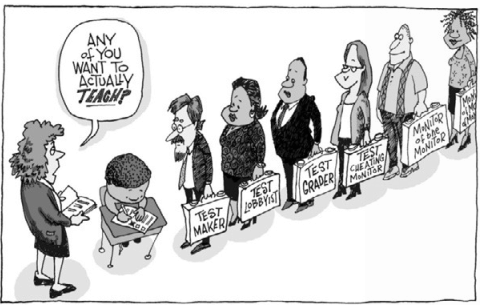
In the run up to Teacher’s Day which is celebrated in India on 5 September every year, there will be numerous pieces about outstanding teachers, teachers who have changed the lives of students, and other inspiring stories.
Sadly, even as we felicitate and celebrate teachers such as these, there are also disturbing reports about teachers who, perhaps, could leave life-long scars on the children that they have the opportunity to mould and nurture. These belong to the mass of average teachers who are “teachers” in name but not in deed. What do they make of their job, which is really speaking a means of livelihood, and even that, which is insecure?
Take this piece, titled Confessions of a Teacher.
I am a teacher. I saw an article entitled ‘Teacher’s Confessions’ and thought, why not pen down my own confessions?
I have been in teaching for years now. As a requirement to becoming a teacher, I had at that time, to study the science and principles of education. I have not learnt much more, since then.
I go to public libraries but rarely touch teaching related journals. A glance at the librarian’s issue book will show several books against my name, but none related to education.
I am certainly in the habit of reading. In the early years I was busy studying the textbooks and related material. But the textbooks don’t change often. I now need only to glance at the books. My reading list now includes dailies and monthlies and some assorted fiction.
After school hours I rarely discuss education-related topics. My discussion includes topics such as someone’s dismissal or promotion, forms and examinations, higher authorities or fellow teachers, booksellers, and so on.
During recess time, my colleagues gather for a cup of tea. We talk of many things. But never do we talk about how to teach, teaching aids, or students.
The school timings are fixed. The curriculum is set. The school bell heralds the passage of time, and students are prepared for the examinations. The systems are in place. I go to school. Teach the lessons for the day. I carry out my tasks and keep the order – partly by force, partly by wit, partly through my image, and largely through the set disciplinary systems of the school.
I don’t get into the depths of any subject. There is no time; just enough to complete what will be part of the exams. Students will take longer, and explanations will have to be made to the authorities.
I know the students by name, or those that know their lessons, and those that do not. I do not know anything about their family, their friends, their own personalities. We are not close. I know their minds, but not their hearts.
I see who comes first, and who is last. I do not know about their physical strengths and weaknesses. Those who finish their work and bring it to me, are clever; those I like. The rest are duds; I do not like them. Between us there is no affection. How can there be trust? They are afraid of me; and I exert my authority over them.
Once I leave the school, I scarcely think of them, save perhaps, one who might have been greatly disrespectful. Each to our own homes. Perhaps, as I lie down the thought may cross my mind that as the exams near, I will have to speed up the revision, for which I’d use the recess.
I haven’t seen the home of the children. Nor have I shown them my home. I do not have such a relationship with them.
I dream that I will be promoted till some day I become headmaster. I will complete my term of service, retire and enjoy my pension. I hope to save a little before I am too old. That is why I have to take tuitions.
I wish that I am well thought of in my community, that I can educate my children so that they get good jobs, and I can marry them off before I enjoy old age.
It is for this that I wish to work. Today the profession of teaching is, for me, an activity, a job. In all this, the ideals of education, the changing principles and practices of teaching, the desire to bring new changes in the field – all this is not in one, where will they come from?
I would like to explain clearly what my position is today. My state is like this; I presume my fellow teachers are in a similar situation.
If we think that this is a familiar scenario, it may come as a surprise that this was written in 1932 (nearly a hundred years ago). The author is Gijubhai Badheka an eminent educator who helped to introduce Montessori education methods to India. Disturbed by the dark educational system of that time, he embarked on his journey into the realms of education, and left behind a rich legacy of work and writing.
More about Gijubhai and his work on www.gijubhaibadheka.in.
Several generations later, the dilemmas about what makes a ‘good teacher’ continue to engage educators.
A hundred years after Gijubhai wrote some of his seminal works on education, Sir Ken Robinson one of the eminent contemporary thinkers on education propounded a critique of the school system. His TED talk Do Schools Kill Creativity? is one of the most watched talks. He urged schools to transform teaching and learning to an experience personalized for every student involved.
His words resonate closely with Gijubhai’s angst about the state of education, and his dream for a transformative educational system
Role of the Teacher
The problem is that over time, all kinds of things have gotten in the way of it – testing regimes, league tables, unions’ bargaining rights, building codes, professional identities, the concerns of various pressure groups, ideology of various political parties. It’s very easy for people to spend all day discussing education without mentioning the students at all. But all of this is a complete waste of everybody’s time if we forget that our role is to help students to learn. Therefore, the question is: what should they learn and how do we best do that?
All the great education systems and schools know that. It’s why they invest so heavily on the selection of teachers, why they insist on getting people who don’t just have good degrees, or have them at all. They want people who know their material, but they also know that teaching depends upon a whole set of pedagogical skills and a love of the process. It’s more than the transmission of direct content. It’s about having a set of skills focused on facilitating learning. (Sir Ken Robinson)
A teacher’s work is like flowing water. The fulfilment of the work of education is not in teaching one or two subjects… Real education lies in making humans aware about their own unending strengths. (Gijubhai Badheka ‘Note to Teachers’ 1920)
Some food for thought.
–Mamata
 Millennial Matriarchs