Rabindranath Tagore was the one who gave Gandhiji the title of Mahatma. Gandhi in turn called him ‘Gurudev’ in reverence to his wisdom and his learning, and saw him as a teacher to humanity.

Musings on Life and Times: Views, Reviews, Previews, Interviews..and Advice

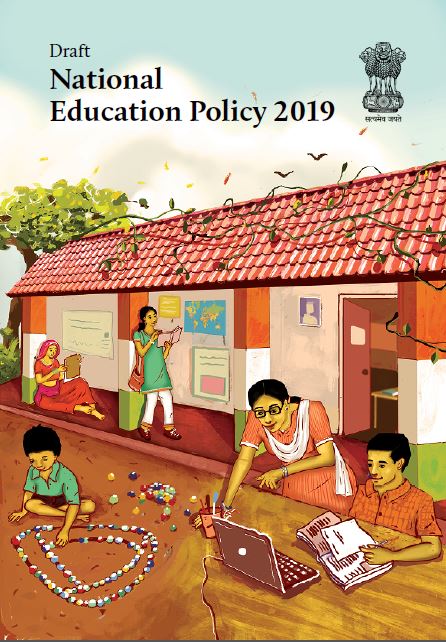
The draft of the National Policy on Education (2019) is out. The nine-person Committee under the chairmanship of Dr. K. Kasturirangan which put together the report (based on large public consultations), mentions that ‘the guiding principles of the policy are Quality, Affordability and Accountability’. The policy they say, attempts to look at education ‘in a single organic continuum from preschool to higher education and also touched on related sectors that form part of the larger picture’. The education of the next generation concerns all of us. This is an opportunity to give our inputs to strengthen it.
The 420+ page document can be seen on https://mhrd.gov.in/sites/upload_files/mhrd/files/Draft_NEP_2019_EN_Revised.pdf.
Comments can be given on https://innovate.mygov.in/new-education-policy-2019/.
To get into the reflective mood necessary to do this, here is a quick selection of thoughts and quotes from those in India who have thought deeply about education.
Hope this helps!
FROM TAGORE
The highest education is that which does not merely give us information but makes our life in harmony with all existence.
Education has its only meaning and object in freedom–freedom from ignorance about the laws of the universe, and freedom from passion and prejudice in our communication with the human world.
Education means enabling the mind to find out that ultimate truth which emancipates us from the bondage of dust and gives us wealth not of things but of inner light, not of power but of love. It is a process of enlightenment. It is divine wealth. It helps in realization of truth.
In education, the most inspiring atmosphere of creative activity is important. Primacy function of the institution must be constructive; scope must be for all kinds of intellectual exploration. teaching must be one withe culture, spiritual, intellectual, aesthetic, economic and social. True education is to realize at every step how our training and knowledge have an organic connection with our surroundings.
An education which does not teach us to discriminate between good and bad, to assimilate the one and eschew the other, is a misnomer.
Unless the development of the mind and body goes hand in hand with a corresponding awakening of the soul, the former alone would prove to be a poor lop-sided affair.
Persistent questioning and healthy inquisitiveness are the first requisite for acquiring learning of any kind.
True education must correspond to the surrounding circumstances or it is not a healthy growth.
I believe that religious education must be the sole concern of religious associations.
A balanced intellect presupposes a harmonious growth of body, mind and soul.
The emphasis laid on the principle of spending every minute of one’s life usefully is the best education for citizenship.
FROM DR. S. RADHAKRISHNAN
Education aims at making us into civilized human beings, conscious of our moral and social obligations.
Education must develop democratic attitude. Educational institutions should train people for freedom, unity, and not localism, for democracy, not for dictatorship.
Education has for its aims not merely acquisition of information but the capacity for discernment.
FROM INDIAN EDUCATION COMMISSION (KOTHARI COMMISSION) REPORT, 1966
Of all factors which determine the quality of education and its contribution to national development, the teacher is undoubtedly the most important. It is on his personal qualities and character, his educational qualifications and professional competence that the success of all educational endeavour must ultimately depend. Teachers must, therefore, be accorded an honoured place in society.
The academic freedom of teachers to pursue and publish independent studies and researches and to speak and write about significant national and international issues should be protected.
Strenuous efforts should be made to equalize educational opportunity.
The school and the community should be brought closer through suitable programs of mutual service and support.
With a view to accelerating the growth of the national economy, science education and research should receive high priority.
A major goal of examination reforms should be to improve the reliability and validity of examinations and to make evaluation a continuous process aimed at helping the student to improve his level of achievement rather than at ‘certifying’ the quality of his performance at a given moment of time.
FROM JIDDU KRISHNAMURTHY
Education is not merely a matter of training the mind. Training makes for efficiency, but it does not bring about completeness. A mind that has merely been trained is the continuation of the past, and such a mind can never discover the new.
Education is not merely acquiring knowledge, gathering and correlating facts; it is to see the significance of life as a whole.
Conventional education makes independent thinking extremely difficult. Conformity leads to mediocrity.
The function of education is to create human beings who are integrated and therefore intelligent.
Education should help us to discover lasting values so that we do not merely cling to formulas or repeat slogans; it should help us to break down our national and social barriers, instead of emphasizing them, for they breed antagonism between man and man.
–Meena
In 1900 the poet Rabindranath Tagore dreamt of a world that has “not been broken up into fragments by narrow domestic walls…a world where the mind is without fear and the head is held high.” Several generations of students (including yours truly) recited the stirring lines with passion.
In 1971 John Lennon imagined a world where “There’s no countries…Nothing to kill or die for, And no religion too. Imagine all the people living life in peace.” A whole generation of young people (including yours truly) joined the chorus in a spirit of optimism and hope.
Sadly the world seems to have gone in the completely opposite direction. Today people seem to exist in a state of war…not just a war between nations but an insidious war between every kind of difference imaginable—colour and creed, race and religion, gender and age…what you wear and what you eat… Anything to kill or die for.
“What a sad era when it is easier to smash an atom than a prejudice.” Albert Einstein
Imagine—the United Nations has to dedicate a special day (16 May) as the International Day of Living Together in Peace. And to remind us that living together in peace is all about accepting differences and having the ability to listen to, recognize, respect and appreciate others, as well as living in a peaceful and united way.
Peace Poem
If there is to be peace in the world
There must be peace in the nations.
If there is to be peace in the nations
There must be peace in the cities.
If there is to be peace in the cities
There must be peace between neighbours.
If there is to be peace between neighbours
There must be peace at home.
If there is to be peace at home
There must be peace in the heart.
Author Unknown
If only…..
–Mamata
 Millennial Matriarchs