
This week, newspapers have been headlining the news of Pune hosting a UCI-sanctioned international cycle race. The Bajaj Pune Grand Tour 2026, the country’s first UCI-category multi-stage professional road race, aims to put Pune into the centre of the global cycling world. The race — scheduled from January 19 to 23— will feature 171 elite riders from 29 teams representing 35 countries, and for the first time India is fielding its own national squad in a UCI event of this scale. Riders will pedal through 437 km of varied terrain, from urban loops to the Sahyadri foothills and rural plains.
The race has significance for India. The Union Cycliste Internationale (UCI) is cycling’s highest governing authority — the body that sets global rules, certifies races, ranks riders, and decides what counts as legitimate professional competition. When a race is UCI-sanctioned, it means it meets international standards of safety, equipment, timekeeping and anti-doping. Riders earn global ranking points.
For many readers, that the Indian riders’ cycles cost–upwards of ₹10 lakh–was the headline novelty. To put it in contrast, in1947, a new bicycle cost roughly ₹60 to ₹120 — a substantial sum at a time when a schoolteacher or clerk earned ₹50 to ₹100 a month. A cycle was not casually bought. It was saved for, negotiated over, sometimes purchased second-hand, and treated as a family asset. Owning one meant time saved, distances conquered, and opportunities expanded. And some service-providers like postmen depended on it, as did newspaper delivery boys, vendors, etc. In a fuel-poor, infrastructure-scarce nation, the bicycle was mobility itself.
Indian-made bicycles were only just beginning to gain ground in the 1940s. Many cycles in circulation were British brands or locally assembled models using imported parts. After Independence, companies such as Hero, Atlas, Avon and TI Cycles would expand production rapidly, bringing costs down over the following decades. Ludhiana emerged as a manufacturing hub, producing sturdy roadsters designed for rough roads, heavy loads and endless repair. These were not glamorous machines, but they were indestructible — and that was the point.
By the 1960s and 1970s, Indian bicycles were already travelling far beyond Indian roads. Manufacturers exported extensively to Africa, the Middle East and Southeast Asia — markets that valued exactly what Indian cycles offered: affordability, durability and ease of maintenance.
Then, gradually, cycling slipped out of aspiration. Motorisation took over the national imagination. Cycles remained everywhere — in villages, campuses, small towns — but rarely in headlines. What we are witnessing now, through urban cycling clubs, endurance events, and races like Pune’s, is not a new culture but a resurfacing one.
Girls go Cycling
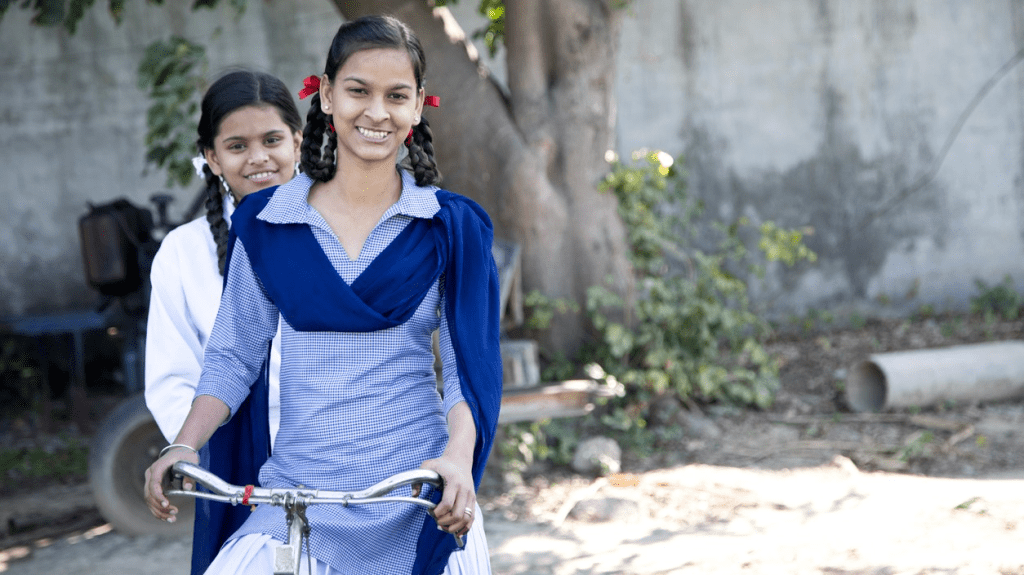
In 1947, a girl owning a bicycle was rare — often limited to fancy schools or unusually progressive families (and heroines in movies who not only cycled but also sang at the same time!). But things slowly changed. Manufacturers, once slow to respond, eventually followed demand, producing lighter, better-fitted cycles designed specifically for girls. What had once been radical became normal.
In 2001, Tamil Nadu launched a free bicycle scheme for students, including girls, under the Jayalalithaa government. The bicycles were procured and distributed by the state. Then in 2006 in Bihar came the game-changer. Mukhyamantri Balika Cycle Yojana, a statewide initiative launched by the Nitish Kumar government targeted girls entering Class 9, particularly in rural areas, and provided funds to purchase a bicycle rather than distributing cycles directly. Girls cycling in groups along rural roads became such a familiar sight that it changed public perception. With the success of the scheme, many states followed. . Few development interventions in India have delivered such disproportionate impact at such low cost.
Hearteningly, the cyclist who has brought India international fame in the past is a woman. Deborah Herold, from the Andaman & Nicobar Islands, is India’s standout name in track cycling. She won three gold medals at the 2019 South Asian Games, setting records, and went on to become the first Indian woman track cyclist to qualify for the UCI Track World Championships. She has represented India multiple times at World Championships and Asian Championships and won medals at the Asian Track Cycling Championships. In 2021, she received the Arjuna Award. Arpita Biswas and Minati Mohapatra are other women who have dominated the international cycling circuits. Esow Alben and Ronald Bira have also brought us glory.
Seen through this lens, the Pune race is not merely a sporting event. It is a cultural signal. It tells us that the bicycle is once again being taken seriously — as sport, as industry, as solution.
God speed!
–Meena
Pic: Deccan Herald
 Millennial Matriarchs