
The story of Sleeping Beauty, in one form or the other, has been around since the 1300s. The story of Rip Van Winkle was written in 1819.
But there is one famous sleeper who goes much further back—to the Ramayana in fact. That is Kumbhakarna, the brother of Ravana. Kumbhakarna’s sleep was different from that of the first two—it was intermittent sleep. He slept for six months, then woke up and ate and drank for six months to satiate his enormous appetite, and then fell back asleep.
Kumbhakarna was a good and decent man, a mighty warrior, who was, as is often the case, cursed thanks to the fears/insecurities of some gods. There are two popular stories regarding his curse, though they may be many others.
Both begin with Kumbhakarna carrying out intense austerities, praying for months to Lord Brahma. The first variation goes that Indra knew that what Kumbhakarna would ask for was his throne, and so begged Brahma to curse him. The other goes that all the devas were worried that the asura-prince would gain too much power if Brahma decided to shower his benevolence on him. So they went to Goddess Saraswathi to beg her intervention.
After a length of time, Brahma appeared to Kumbhakarna, quite pleased with him, and said ‘Ask what boon you will.’ At that moment, Saraswathi, the Goddess of words and music and learning, put a hex on Kumbhakarna’s tongue so that he mis-spoke as he articulated his requests.
Kumbhakarna meant to ask for “Indrasaana” (the home of Lord Indra), but it came out as “Nidrasaana” (bed for sleeping) and when he asked for “Nirdevatvam” (destruction of Devas), it came out as “Nidravatvam” or sleep.
Brahma was quite a hasty God and obviously did not reflect too much on the boons he was granting and probably just said ‘Thatastu’—so be it. And in fact, the original grant was of unending sleep. Ravana had to intervene on behalf of his brother and go through loops before getting the boon modified to six months of sleep, followed by six months of waking. And so it was.
When Kumbhkarna slept, nothing could wake him—not horses and elephants walking over him, not a war or battle, nor all the musical instruments playing next to his head. And when he woke up, he would be so hungry, he would eat anything in sight.
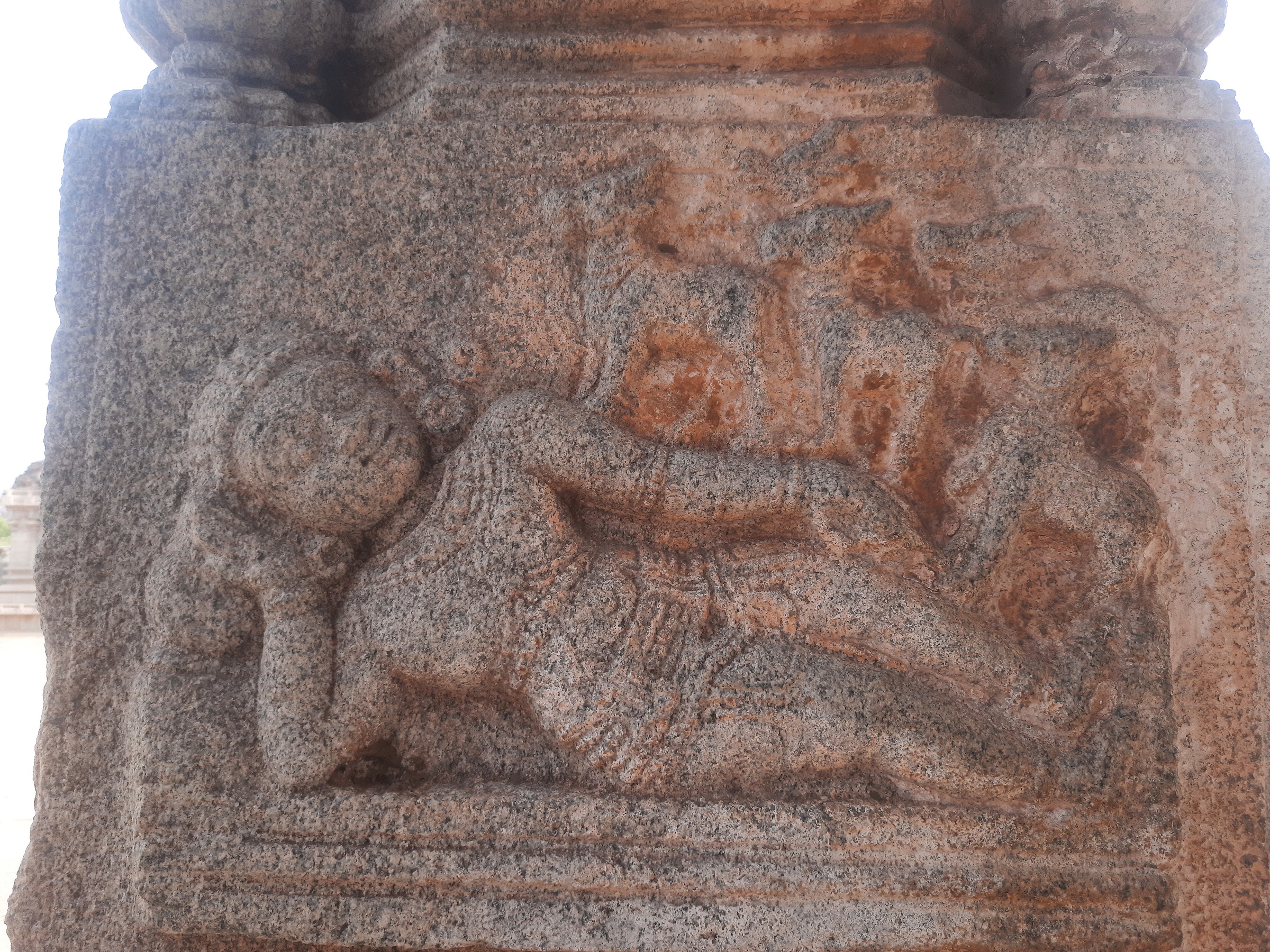
As the war between Rama and Ravana began going against the asura king, his one hope was Kumbhakarna. Some accounts say that he ordered a 1000 elephants to walk over his brother to wake him up. When he did wake up, he counselled his brother against the war. He told him that he was not in the right, and they should give up Sita in all honour, and plead for peace. But Ravana obviously refused. Kumbhakarna, knowing they were fighting an unjust war, still threw himself into it in loyalty to his brother and kingdom. He is said to have killed 8000 monkey-warriors before Rama himself finally subdued and killed him.
Some scientists, analysing texts about Kumbhakarna suggest that he suffered from hypothalamic obesity whose symptoms include obesity, somnolence and rage (all three of which Kumbhakarna exhibited).
Well, whatever it was, his story had a sad ending. When Sleeping Beauty woke up, it was to love, a prince and a kingdom. For Kumbhakarna, it was death, defeat and loss of a kingdom.
–Meena
 Imagine needing so much help to get a good night’s sleep! I have grown up in an age when mattresses had very different connotations. Mattresses were filled with cotton, and were usually of the same size and thickness. Often this cotton was carded by hand by itinerant carders who established camp at the house for a few days marked by the twang of their simple tools, and fluff-filled air. The cotton was filled in covers, stitched in with strong thread, and then beaten heartily with sticks to even out the lumps and bumps. All this done with dexterity and the long experience of a traditional occupation. With mechanisation, these occupations were replaced with neighbourhood shops where the same process was done by a simple machine. Now one took one’s old mattresses there to be opened and redone, with dire warnings that the cotton within was not to be mixed up with any other inferior variety!
 Millennial Matriarchs