
Celebrating Vishwakarma, Master-Craftsman

Vishwakarma Jayanthi is marked every year on Kanya Sankaranthi, which falls this year on September 17th. As per legend, Vishwakarma was a master architect and craftsman. The son of Brahma, he is supposed to have been the engineer for the creation of the world. He is also said to have built Lanka, Hastinapur and Dwarka.
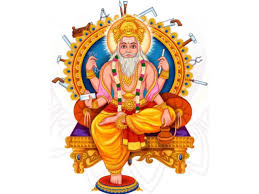
Vishwakarma plays a pivotal role in the two great epics, Mahabharat and Ramayana. In the Mahabharat, the Pandavas retained him to plan and build their new capital of Indraprastha, which evoked the wonder and envy of all the other kings. One of the triggers for the Mahabharat war however was this amazing architecture. The pools of water looked like floors, and floors looked like water-bodies. Duryodhana mistaking a pool for a floor, slipped ignominiously and fell, evoking the mirth of the onlookers. He took particular exception to Draupadi’s laughing and commenting at his plight, and this was almost the last straw contributing to the breakdown of relations between the Pandavas and the Kauravas.

Vishwakarma’s work also features as a turning point in the other epic Ramayana. He is said to have built Pushpaka Vimana the flying chariot. It was built originally for Brahma, who at some stage gifted it to Kubera, the God of Wealth. But Ravana, Kubera’s half brother, stole the flying chariot, and used it for the infamous abduction of Sita. The Vimana however was also part of happy times, ferrying Ram and Sita back to India after the victory over Ravana. Ram later returned the vehicle to Kubera.

Vishwakarma has his equivalents in Greek and Roman mythology. The god Hephaestus was blacksmith to the Gods of Olympus, and made all their weapons of the gods in Olympus. He used to be worshipped in the manufacturing and industrial centres of Greece. Vulcan was the Roman God of fire and forge as well as fire and volcanoes. He was the patron of artisans and smiths, and there were several shrines dedicated to him. Vishwakarma like his peers also designed weapons, including Krisha’s Sudharshan Chakra and Indra’s Vajra.

We in India continue to remember and commemorate Vishwakarma. Vishwakarma Jayanthi is a special day for engineers, architects, mechanics, craftsmen, welders etc., and it is marked with pujas in factories and industrial estates. The prayers are for increased mastery and success in their field, as well as for safety.

As an ancient culture, excellence in engineering and the crafts were so revered that not only was there a God for this, but his achievements were enumerated and remembered. We still remember him and worship him. But ironically, we don’t seem to value the excellence he stands for. Our towns and cities are unplanned chaos—surely not Indraprastha or Hastinpur were.

In India, barely one in five persons at the workplace is skilled. We stand at 129 out of 162 countries ranked. As someone who has been involved in skill training, I am aware of some of the challenges in this sector. Critical among these are that skills except those related to IT and computers are not aspirational. To get a young person excited about being a master-electrician, master-plumber, master-anything that needs working with hands is next to impossible. In our culture, manual skills are not valued and respected—plumbers and masons feature way down in the social hierarchy. Nor are they paid in accordance to the value they bring. And sadly, career pathways don’t lead them very far.  

Nor is the skill-training we provide of very high quality, such as will lead them to excellence in their vocations. Most skill training is outdated and out of sync with what industry needs. Our ITI and other skilling institutions are bureaucratic set-ups, far behind where they should be. The faculty has no real experience on the shop floor. Nor do most students ever go into a factory or workplace during their education.

For a country which marks Vishwakarma Jayanthi with widespread events, we don’t seem to really value skills or our skilled craftspeople. Until that changes, there does not seem much point in observing yet another day.

–Meena

Small Is Not Yet Beautiful

June 27 was declared as World Micro, Small and Medium Enterprises (MSME) Day by the UN in 2017, to focus on the contribution of this sector to inclusive and sustainable development, both locally and globally. The importance of MSMEs is huge, but not fully registered in the mindsets of most people. Globally, they account for two-thirds of all jobs. In developing countries, 4 out of 5 new jobs in the formal sector were created by MSMEs. Many MSMEs in developing countries, especially the smallest, are often run by women.

There is no standard international definition of MSME. In India, as per changes brought in last year, the classification of units in the sectors is based on a composite of Investment in plant/machinery/ equipment as well as Annual Turnover.

ClassificationMicroSmallMedium
Manufacturing and Service rendering EnterprisesInvestment in Plant and Machinery or Equipment:
Not over Rs.1 crore; and Annual Turnover not over Rs. 5 crore
Investment in Plant and Machinery or Equipment:
Not over Rs.10 crore; and Annual Turnover not over Rs.50 crore
Investment in Plant and Machinery or Equipment:
Not over Rs.50 crore; and Annual Turnover not over Rs.  250 crore

For us, as for many other developing countries, this sector is critical in terms of contribution to employment and GDP. There are about 6 crore MSME units in India today, of which 99.4 per cent of are micro-enterprises, while 0.52 percent are medium, and 0.007 per cent, are medium enterprises. In other words, micro-enterprises dominate. MSMEs account for about 30% of GDP and about 48% of exports. They employ about 11 crore people. About 41% MSMEs are engaged in Manufacturing while 59% of them are in Service activities

The number of MSME units and the people employed have been growing for the last 4-5 years.

But the contribution to the GDP has been almost stagnant. This clearly speaks for the extremely low, and falling productivity of the sector. Studies estimate that Indian MSMEs have a productivity of at best 65% and at worst, 25% of such units in other countries.

This is compounded with the difficulties these units face in scaling up and accessing markets. And not to speak of the challenges of the external environment and regulatory environment challenges. The pandemic has devastated the sector. Not only have orders dried up, but even where there are orders, units have been hit with a reduction of workforce and huge challenges in procurement of raw materials.

In a scenario where jobs are getting scarcer and entrepreneurship is being seen as the answer, we obviously need to do many things at many levels. Speaking as someone engaged in the education and skilling sector, for me a major part of the solution has to do with Education and Training.

First and foremost, we need to get basic education right.  

And then, respect for and practice of vocational skills, as well as concepts like quality consciousness and systematic approach to doing any task have to be inculcated right from primary levels. These are not mindsets which can be added on at a later stage. They are very fundamental to a person’s make up, and influence how he/she performs any task in later life.

Skill training has to be much more rigorous than it is today. A student in Germany for instance, would spend about 2 to 3.5 years learning a skill, spending half the time in vocational school and half the time in a real factory, being systematically trained. We are ready to certify youth who go through a 3-month programme as skilled! And even pass-outs from ITI institutions or Polytechnics who spend a longer time, still have zero exposure to any real life workplace situation, and at best spend some time on old and outmoded machines. Not a recipe for productivity!

Third, MSME entrepreneurs need management education. Whether it is managing finances or people, production or marketing, each small entrepreneur seems to be making mistakes, discovering first principles, and reinventing the wheel. Surely not conducive to productivity. There are such initiatives, but they seldom reach the grassroots and the audience who really need these inputs.*

MSMEs have a huge role to play in inclusive development. They have the potential to impact the lives of the poorest, the most vulnerable through creation of local businesses. We need to act now!

–Meena

PS:  Those interested in MSMEs and Skilling should watch a webinar by National Skills Network on the subject.

  • * I am currently involved in a very interesting initiative of developing an ‘MBA’ programme for rural women entrepreneurs who are Std 8 pass and above. An initiative of Access Livelihoods supported by GIZ.