
Focus on Citizen Science

April is marked as Citizen Science Month—not in India, but in the US. But it can only be to the good to take best practices from anywhere at all, and adapt them for our use, right? And an acceleration of the citizen science movement is something that is definitely a crying need in our country!

What is citizen science? The term probably appeared first in 1989, in an issue of the MIT Technology Review 1989, but till today, there is apparently no consensus on a single definition–one paper cites 34! But a working definition we could go by is the one given by the National Geographic Society: ‘Citizen science is the practice of public participation and collaboration in scientific research to increase scientific knowledge.’ The benefits of such initiatives are manifold: large public participation in scientific pursuits; raising scientific awareness and knowledge; democratization of science; ability to pull in indigenous and community knowledge, etc. In fact, without wide-spread involvement of a large number of people, many projects would be very difficult to do—nationwide bird counts, butterfly counts, monitoring water quality across large areas, weather monitoring, space watch, etc. 

India has its share of action on this front. The Indian Biodiversity Portal launched in 2008 is a prime example. It ‘aims to aggregate data through public participation and provide open and free access to biodiversity information’ and invites the public to participate in gathering and documenting such knowledge. It currently has 1.54 million observations on 58.3 thousand species. It is an invaluable resource, which would have been difficult to put together without the participation from people across the country.

Another interesting initiative is by the CitSci (Citizen Science for Biodiversity) India–they organize an annual Citizen Science of Biodiversity Conference. Their site also shares useful information on on-going biodiversity and conservation related citizen science projects undertaken by a host of NGOs, like the Citizen Sparrow initiative, which is ‘a public participatory project to which all members of the public are invited to contribute. ‘

It is not just conservation. There are projects in various other scientific research areas as well. The Pune Knowledge Cluster develops research projects where citizens from all walks for life can participate to help analyse big data from various scientific streams including astronomy. Yet another organization in this area is the Centre for Citizen Science (a Pune based organization with the explicit objective of promoting citizen science) whose ‘Project Meghdoot’ aims to study the phenomenon for monsoon across the country.

River Quality Monitoring, CEE
River Quality Monitoring, CEE (Joy of Learning II)

Nor is this a recent phenomenon. I recall in the 1990s, when I was working at Centre for Environment Education (CEE), we had a project wherein school children, as part of the Ganga Pollution Awareness programme, were monitoring and reporting the water quality in the river in their stretch. Similarly, we had green-cover mapping and biodiversity census by college students in Karnataka, which was then correlated to remote sensing data.

The initiatives for spreading scientific knowledge, a necessary precursor of citizen science, have a hoary history in India, and several institutions have been committed to doing this for decades now. Two of the oldest are VASCSC and KSSP. Dr. Vikram Sarabhai, in the ‘60s, created an institution, today called the Vikram A. Sarabhai Community Science Centre (VASCSC), one of whose objectives is to encourage scientific thinking. The Kerala Sastra Sahitya Parishad (KSSP) is a People’s Science Movement of Kerala, India, founded in 1962 has over 1200 units spread all over Kerala.

In fact, the recognition of the importance of science for national development is enshrined in the Constitution as a Fundamental Duty of every citizen! This section explicitly states that ‘It shall be the duty of every citizen of India.. to develop the scientific temper, humanism and the spirit of inquiry and reform.’

From here to citizen science should not be too long a distance to traverse. But it questionable if we have even achieved the scientific temper, so earnestly endorsed by Pandit Nehru as ‘the scientific approach, the adventurous and yet critical temper of science, the search for truth and new knowledge, the refusal to accept anything without testing and trial, the capacity to change previous conclusions in the face of new evidence, the reliance on observed fact and not on pre-conceived theory, the hard discipline of the mind—all this is necessary, not merely for the application of science but for life itself and the solution of its many problems.’

Even with such strong foundations and a bunch of dedicated organizations, neither scientific temper nor citizen science is very widespread in India today. While there is much talk of the importance of STEM, it is yet a theoretical approach aimed at cracking exams, and not an effort to inculcate scientific thinking and the spirit of science as a part of how we live, think and take decisions.

Maybe we should pause to ponder on this now—because it is Citizen Science Month somewhere in the world!

–Meena
For anyone who wants to explore the subject more, ‘Citizen Science in India: Introduction, Challenges and Way Forward’, a paper by Suryesh Namdeo and Moumita Koley provides a contemporary overview of the subject.

VASCSC: Dr. Vikram Sarabhai’s Vision for Science Education

As we approach Dr. Sarabhai’s birth anniversary (12 August), time to pay tribute to a great visionary, scientist and institution-builder.

His role in the nation’s space and atomic energy programmes, in creating institutions like ISRO, PRL, IIM-A, ATIRA is well known, as was his zeal for the planned use of science and technology in the development of a newly-independent India are known. His passion for science education however, needs to be more widely discussed.

Dr. Sarabhai was keenly aware that creating a scientific temper and promoting scientific thinking among the population was fundamental in our progress as a nation. He felt that science teaching needed to be innovative to achieve this, and also that the best scientists should engage with young minds, and inspire them towards science. His own background of being home-schooled in a very open learning environment, where exploring and innovating were the key, may have been the foundation of his conception of science education.  

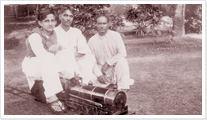
Vikram Sarabhai as a boy, with his model train

It was in this background that in 1963, Vikrambhai got scientists of the Physical Research Laboratory (PRL) involved in a project called ‘Experiment for Improvement of Science Education’, to take science to citizens. These early efforts were institutionalized in 1966, with the creation of an institution called the Community Science Centre (CSC), whose foundation stone was laid by Dr. Sarabhai’s guru, the Nobel Laureate, Sir CV Raman.  The famous lecture ‘Why the Sky is Blue’ was delivered by Sir Raman at the Centre on this occasion.

CSC was the trailblazer in the country, and the country’s active Science Centre/ Science Museum movement owes a lot to the pioneering work of this institution. CSC was re-named Vikram A. Sarabhai Community Science Centre (VASCSC) after the passing away of Dr. Sarabhai.

To quote VASCSC’s website, ‘The core of the Centre’s philosophy is to take school and college students out of the rigid framework of textbooks and encourage them to think, explore and create. Over the years, the Centre has combined formal and non-formal techniques to formulate many innovative methods to give students a better understanding of Science and Mathematics, which not only make the process of learning enjoyable but also sustained and long-lasting.’  It aims to bring teachers, students, research workers, administrators and the community together for a better appreciation and understanding of science.

VASCSC has been the pioneer of several innovative science education programmes, including interactive science exhibitions, open laboratories, math-lab, science playgrounds. These are today the backbone of many a science education programme in the country.  The educational kits and materials developed by it are of a very high quality.

A landmark initiative of VASCSC was the Science Express, done for the Department of Science (DST), which ran for several years. This was an innovative science exhibition mounted on a 16-bogey train, specially designed by the Indian Railways. Launched in October 2007 by DST, Science Express covered over 1,22,000 km across the country, receiving more than 1.33 crore visitors at its 391 halts, over 1,404 days. It has thus become the largest, longest running and most visited mobile science exhibition, probably in the world and has created several records in its wake’ (DST). The exhibition has six entries in the Limca Book of Records.

Mrs. Mrinalini Sarabhai wrote of Dr. Sarabhai: ‘‘He often said that on retirement he would like to spend time with young children talking to them about science.’ Sadly Dr. Sarabhai died young, so he could not fulfill this dream. But the initiative he started at the CSC has indeed contributed to the vision of transforming science-education in India

–Meena

I am privileged to be a member of the Governing Council of VASCSC.

Vikram Sarabhai Centenary

A Life Too Short: A Tribute to Dr. Vikram Sarabhai

Vikram Sarabhai Centenary

A Life Too Short: A Tribute to Dr. Vikram Sarabhai

Vikram Sarabhai Centenary

A Life Too Short: A Tribute to Dr. Vikram Sarabhai

Thinking About Science

A few days ago, on Feb 28, we marked National Science Day. This commemorates the discovery of the Raman Effect.

As we think about the state of Science in India, there are two historical documents I would like to quote as my contribution to this day, to remind ourselves of the vision of the early national leaders, as well as the scientific leaders of yore.

The first is India’s earliest policy statement on the subject, tilted “Scientific Policy Resolution’, brought out by the Govt. of India in March 1958:

‘1. The key to national prosperity, apart from the spirit of the people, lies, in the modern age, in the effective combination of three factors, technology, raw materials and capital, of which the first is perhaps the most important, since the creation and adoption of new scientific techniques can, in fact, make up for a deficiency in natural resources, and reduce the demands on capital. But technology can only grow out of the study of science and its applications.

2. The dominating feature of the contemporary world is the intense cultivation of science on a large scale, and its application to meet a country’s requirements.

3. It is only through the scientific approach and method and the use of scientific knowledge that reasonable material and cultural amenities and services can be provided for every member of the community, and it is out of a recognition of this possibility that the idea of a welfare state has grown.

4. The wealth and prosperity of a nation depend on the effective utilisation of its human and material resources through industrialisation. The use of human material for industrialization demands its education in science and training in technical skills.

5. Science and technology can make up for deficiencies in raw materials by providing substitutes, or, indeed, by providing skills which can be exported in return for raw materials. In industrialising a country, heavy price has to be paid in importing science and technology in the form of plant and machinery, highly paid personnel and technical consultants. An early and large scale development of science and technology in the country could therefore greatly reduce the drain on capital during the early and critical stages of industrialisation.

6.  It is an inherent obligation of a great country like India, with its traditions of scholarship and original thinking and its great cultural heritage, to participate fully in the march of science, which is probably mankind’s greatest enterprise today.

The Government of India have accordingly decided that the aims of their scientific policy will be

1. to foster, promote, and sustain, by all appropriate means, the cultivation of science, and scientific research in all its aspects – pure, applied, and educational;

2. to ensure an adequate supply, within the country, of research scientists of the highest quality, and to recognize their work as an important component of the strength of the nation;

3. to encourage, and initiate, with all possible speed, programmes for the training of scientific and technical personnel, on a scale adequate to fulfil the country’s needs in science and education, agriculture and industry, and defence;

4. to ensure that the creative talent of men and women is encouraged and finds full scope in scientific activity;

5. to encourage individual initiative for the acquisition and dissemination of knowledge, and for the discovery of new knowledge, in an atmosphere of academic freedom ;

6. and, in general, to secure for the people of the country all the benefits that can accrue from the acquisition and application of scientific knowledge.

The Government of India have decided to pursue and accomplish these aims by offering good conditions of service to scientists and according them an honoured position, by associating scientists with the formulation of policies, and by taking such other measures as may be deemed.’

The second quote is from an important document called ‘A Statement on Scientific Temper’, put out by the Nehru Centre, Mumbai, in 1980, which lays down what scientific temper is:

ATTRIBUTES OF SCIENTIFIC TEMPER

Spread of scientific temper in society is much more than the spread of science or technology. Scientific temper is neither a collection of knowledge or facts, although it promotes such knowledge; nor is it rationalism although it promotes rational thinking. It is something more. It is an attitude of mind which calls for a particular outlook and pattern of behaviour. It is of universal applicability and has to permeate through our society as the dominant value system powerfully influencing the way we think and approach our problems—political, social, economic, cultural and educational. 

Scientific temper involves the acceptance, amongst others, of the following premises:

  1. that the method of science provides a viable method of acquiring knowledge;
  2. that human problems can be understood and solved in terms of knowledge gained through the application of the method of science;
  3. that the fullest use of the method of science in everyday life and in every aspect of human endeavour—from ethics to politics and economics—is essential for ensuring human survival and progress; and
  4. that one should accept knowledge gained through the application of the method of science as the closest approximation to truth at that time, and question what is incompatible with such knowledge; and that one should from time to time re-examine the basic foundations of contemporary knowledge.’

There is no need to re-articulate anything. The path is clear. What needs to be done is to ask ourselves, why we are not there!

We can judge for ourselves whether the Science Policy articulated close to 65 years ago has achieved what it set out to. And agonize how to put the focus back on ‘scientific temper’ which is relegated to the archives as a quaint and old-fashioned term.

Definitely needed more today than ever before!

–Meena