
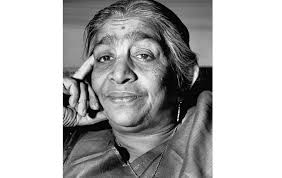
In a week when women are being celebrated, and their achievements extoled, it is fitting to remember that in every era of history, in every part of the world, there have been women who have broken boundaries and glass ceilings, and have excelled in numerous fields. This is a good week to celebrate a woman who combined seemingly contrary abilities, and played a significant role in several fields of endeavor. This is Sarojini Naidu.
Textbooks traditionally describe Sarojini Naidu as the Nightingale of India. But she was far more just a singer of songs. A poetess, patriot, fierce nationalist and freedom fighter, politician, eloquent orator, inspirer of masses, perfect hostess, and a feminist and firebrand leader in every sphere.
Sarojini was born on 13 February 1879 in a Bengali Brahmin family, the eldest of eight siblings. Somewhat of a prodigy, she entered the University of Madras at the age of 12; she composed 1000-line poems at 13. After graduating in 1895 with the highest rank, she was awarded a scholarship by the Nizam of Hyderabad, and she spent three years in England, studying at King’s College London, and later at Girton College in Cambridge. During this period she also became involved with the suffragist movement in England. She returned to India in 1898 and married Dr M Govindarajulu Naidu whom she had met in England, (the inter-caste marriage attracted opposition) when she was 19. By the age of 25, Sarojini was mother to four children. Her first major collection of poems was published when she was 26. She had literary fame, and a comfortable lifestyle in Hyderabad where she played the perfect hostess.But this was hardly a deterrent to what was to be an extremely active political life.
Sarojini and Gandhiji shared a special relationship. She had first met him in 1914 in London just as the First World War had broken out. That was the start of a long and close bonding between the two. Sarojini was one of the few who could joke about, and with, Gandhi (she nicknamed him Mickey Mouse!). The two exchanged witty repartees, and reproaches, which were totally free from malice. She could stand up to Gandhi and never hesitated to speak her mind. Yet she remained one of his staunchest supporters all her life, and revered him as a guru.
Sarojini Naidu was drawn to Gandhi’s non-cooperation movement and in 1924 travelled across the world to spread the word about the movement. She was a sought after public speaker. In 1925 she became the first Indian President of the Indian National Congress. She was a front-line participant in the Independence movement. Her participation in the Salt Satyagraha and the Quit India Movement was deemed as ‘anti-British activity’ and she was imprisoned several times for this.
Sarojini Naidu believed that the nationalist cause could not be separated from the movement for women’s rights. She helped establish the Women’s Indian Association along with Annie Besant and a few others, in 1917, which championed women’s right to vote. The same year, along with Annie Besant she went to London to represent the case for women’s franchise before the Joint Select Committee.
She was elected to the Constituent Assembly that drafted the Constitution of India. After India achieved independence on 15 August 1947, Sarojini Naidu was appointed governor of the United Provinces, making her the first woman governor in the country. She remained in the post until she passed away on 2 March 1949.
Sarojini Naidu’s contribution to the freedom movement and to the early years of our new republic was marked by her total dedication combined with her boundless energy and multi-faceted brilliance. This was summed up thus by her fellow freedom fighter Jawaharlal Nehru: She began life as a poet, in later years when the compulsion of events drew her into the national struggle, she plunged into it with all the zest and fire she possessed…. whose whole life became a poem and a song and who infused artistry and grace in the national struggle, just as Mahatma Gandhi had infused moral grandeur to it.
Despite her active political life Sarojini’s literary output was also prolific. She published several volumes of poetry, and held ‘salons’ which attracted an array of intellectuals. She led a hectic and productive life despite suffering from a variety of ailments throughout her life. Her zest for life was undiminished till the end, when she passed away at the relatively young age of 70. As she wrote to her youngest child a few years earlier: One is not so concerned with a long life as with a ‘merry one’—merry as the sum of worthwhile, rich, full, interesting, and who can say that mine has not been and is not in that sense ‘merry’ as well as long?
On a more serious note, several years earlier when she was in Yervada jail, Sarojini wrote to her daughter Padmaja Naidu: In the course of a long and most variegated life I have learned one superlative truth…that the true measure of life and oneself lies not in the circumstances and events that fill its map but in one’s approach and attitude and acceptance of those things.
An inspiration, and a role model indeed!
–Mamata
 Millennial Matriarchs