

High in the Sky, Celebrating the Sun

Today is Makar Sankaranthi. It marks the day the Sun starts moving from the South to the North, and coincides with its transition from the zodiac of Sagittarius (dhanu) to Capricorn (makara). Dedicated to the Sun, the day is observed across India in many different ways, but all signifying thanks-giving and a new beginning.

Kite-flying marks the day, especially in Gujarat. The sky is full of colour, with myriad shapes and sizes of kites, and fierce battles to bring down opponents’ kites.

Since media is full of reports of kites, kite-festivals and other sundry related topics, I thought I would mark Sankaranthi by writing about another flying object which is used to denote joy and celebration—balloons!

Definitionally, a balloon is a flexible membrane bag. It is inflated using a gas. At the most basic level, it is about filling it with as much air as our lung-power allows.  But otherwise, a range of gases is used– helium, hydrogen, nitrous oxide, oxygen etc. Balloons can also be filled with smoke, liquid water, small solids like sand, flour or rice.

Though in everyday life, we go out to buy balloons for birthdays, parties and events, the rubber balloon was invented for scientific experiments by the great scientist Michael Faraday in 1824. He came out with these for use in the lab for experiments with various gases.

Even today, apart from their use in fun and games and as decoration, more serious uses include meteorology, medical treatment, military defence, or transportation. The fact that a balloon is low cost and has a low density, makes it useful in several situations.

The use of balloons for decoration has extended into balloon modelling or balloon twisting where special balloons are twisted into various shapes, often animals, by artists called twisters, balloon benders or balloon artists. 

Balloon or Inflatable Art museums and exhibitions too dot the world. Artists who work with this medium are fascinated with the concept of how the air element can fill various shapes. They translate this fascination into installations, inflatable sculptures, interactive and digital artworks.

Prime among these is Balloon Museum– a curatorial team that designs contemporary art exhibitions with specific works in which ‘air’ is a distinctive element. Their ‘The Pop Air Tour’, with the tagline ‘Art is Inflatable’ has been travelling across Europe. It has several immersive exhibits: ‘A Quiet Strom’ in which infinite white spheres fall to the ground, as tiny soap bubbles caress the audience. ‘Aria’, a ‘digital interpretation of inflatable art in which the visitor finds himself enveloped, in a tight space, surrounded by a multitude of balloons lost in the sky, involving visitors in the journey through the metaphysical experience of suspension. This exhibit like many others has immersive sound design ‘intended to bring back in sound the sensations created around the visitors with the same intensity and depth of a breath taken miles high with the unique intention of experiencing a space without limits.’ Apart from these serious exhibits, there are also fun ones like  the independent inflatable maze, and The Goof — an entourage of inflatable Monsters that are taking over the world, but how they got here and what their motives are is unknown! 

The US has its share of Balloon Museums, including the Anderson Abruzzo International Balloon Museum Foundation with a ‘mission to uplift’!

So this Sankaranthi, let us be uplifted along with the kites (or balloons), pay homage to the Sun, and wish for a healthy, happy, prosperous year for all!

–Meena
Sun, Giver of Light and Life

Makar Sankaranthi is linked to the solar calendar, and marks the beginning of the annual  transit of the Sun from the Southern Hemisphere to the Northern Hemisphere. Sankaranthi is also called ‘Uttarayan’—deriving from ‘uttar’—North, and ‘aayan’—movement.  The Sun moves from the Tropic of Cancer to the Tropic of Capricorn that day.

Makar Sankaranthi is celebrated across the country, but in different ways. In Tamilnadu, it is a harvest festival, and three days of Pongal celebrations mark worship of the sun, the rain and cattle—all fundamental to agricultural economies. It is a wonderful occasion to remind ourselves of how much we owe Nature, and that without the energy of the Sun, we can do nothing. ‘Pongal’ itself means overflowing, and the pot with rice, jaggery and milk is allowed to overflow to calls of ‘pongal-o-pongal’—welcoming abundance in the coming year.

The fundamental importance of the Sun has been recognized by many ancient cultures, and in many of them, kings ruled by the power of the sun and claimed descent from the sun.

In ancient Egypt, the sun god Re was dominant among the higher gods. The sun was not one entity– he sets out on his journey in the East as the young god Kheper; he appears at noon in the zenith as the full-grown sun, Re; and by the evening, when he is in the West he is in the shape of the old sun god, Atum.  When the Pharaoh Akhnaton (husband of the famed Queen Nefertiti) reformed Egyptian religion somewhere around 1350 BC, he took Sun worship to the next level by making it the official religion and the sun’s qualities as creator and nourisher of the Earth and its inhabitants were worshipped.

As far as Roman history is concerned, sun worship became fairly important in the later period.

Both Sumerian and Akkadian religions put sun worship at the centre of their belief system, and in Iran, sun festivals were celebrated as a heritage from pre-Islamic times.

In North America, the Plains Indians followed a solar cult with the Sun Dance as an important ritual. In South America, especially Mexico and Peru, sun worship was widely prevalent.  The ruler of Peru was believed to an incarnation of the sun god, Inti. The Aztecs worshipped Huitzilopochtli, the Sun God who was one of their most powerful and most revered gods. In fact, Aztec people considered themselves to be ‘the people of the sun’.

The sun goddess Amaterasu  played an important role in ancient Japanese mythology and was considered to be the supreme ruler of the world and the guiding deity for the imperial rulers. 

Sankaranthi
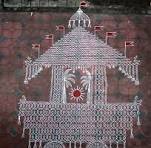
Sun Chariot Kolam

In many of these ancient traditions, the Sun God rides in a chariot drawn by horses. In Hindu mythology too, he rides chariot drawn by seven horses—which are said to stand for the seven colours of visible light or the seven days of the week. There are different versions of the names of the seven horses. In some traditions, they are named after the seven meters of Sanskrit poetry: Gayatri, Brihati, Ushnih, Jagati, Trishtubha, Anushtubha and Pankti. In others, they are called Jaya, Vijaya, Ajaya, Jitapraṇa, Jitasrama, Manojava and Jitakrodha , which are different phases of light transmission through the length of the day.

The most traditional rangoli or kolam made in Tamilnadu for Pongal is the Ratham or Sun’s chariot. While there are 5×5 dot ratham kolams for amateurs, these designs can become incredibly complex and set off a competitive spirit across streets!

So let us rejoice in the spirit of Sankaranthi, and pray for abundance, peace and prosperity in the coming year!

–Meena

PS: The beautiful kolam is from the Net. I can claim no credit!