
The town of Kumbakonam in Tamilnadu has a hoary history. It is supposed to be the cradle of life of this yug, namely the Kali Yug. Each yug ends with a pralayam or flood which leads to the destruction of all living beings on the earth. When the last yug was about to end, Brahma put the seeds of all living organisms as well as the Vedas and Puranas, in a pot called the Amrita Kalasam or Kumbham (pot of nectar).
The pot was befittingly decorated with flowers, leaves, ausipicious cloth, sandalwood paste and a sacred thread. The Kumbham’s mouth was stopped with a coconut and it was placed on the top of mount Meru.
When the floods came, they destroyed all creatures on earth. The Kumbham prepared by Brahma was displaced, and floated on the flood waters for years and years. Finally, it settled at a spot considered to be present-day Kumbakonam.
But the seeds had to be released in order for life to start again on earth. Siva, in the guise of a hunter, discharged an arrow from His bow, breaking open the pot. The seeds of life and the Vedas and puranas in the pot were scattered around, and thus life on earth re-started.
And this spot is the site of the other great Kumbh festival. The place where the pot broke and the contents flowed out–Mahamaham kulam (tank) is where the Mahamaham festival is celebrated.
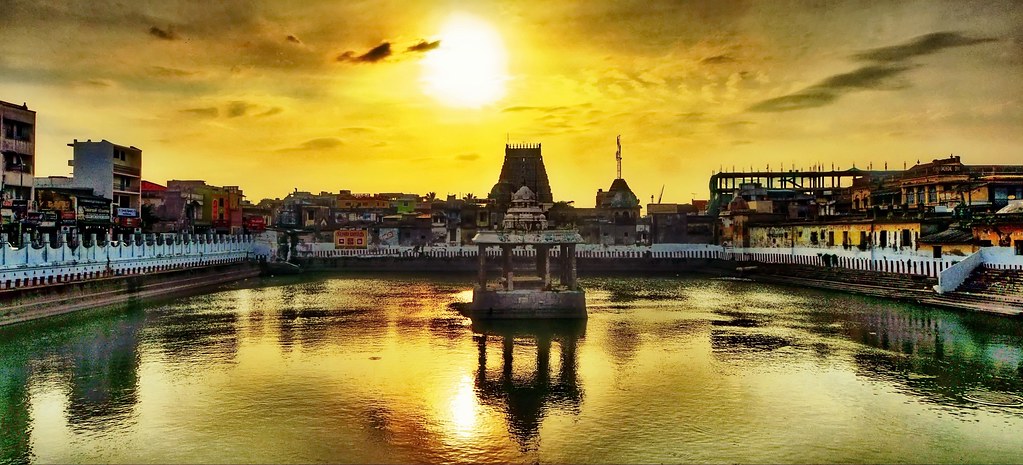
While Masimaham is an annual event that occurs and thousands of people gather for a dip during this time, it takes on special significance once in twelve years. For it is believed that every 12 years, when Jupiter passes over Leo, the waters of all of India’s holiest rivers, including the Ganges, flow into the tank, and it is at this time that the Kumbh mela of South India is celebrated at the Mahamaham tank. Since it is believed that all the rivers of India meet at the tank on this day, a bath here is considered equal to the combined dips in all the holy rivers of India! Over 10 lakh people congregate here for the event.
Kumbakonam, meaning ‘pot’s corner’ to remind us of where the pot-of-life landed, is considered a very holy place. There are any number of ancient temples in and around the town—there is a temple wherever any shard of the pot landed. In all, there are around 188 temples within the municipal limits of Kumbakonam!
The region around Kumbakonam was inhabited as early as the Sangam Age (third century BC to third century AD), and it has played its role in the history of the region.
Down the passage of time, Kumbakonam has been a major learning center. During the British times, it was referred to as the “Cambridge of the South” with several institutions of repute, the most notable of them being the Government Arts College, considered one of the oldest colleges in Tamil Nadu. The town is home to many libraries and is considered the hub of modern Tamil writing.
Kumbakonam, relative to its size, is associated with more than its share of great achievers, including:
Srinivasa Ramanujam, the world-famous mathematician was born here and studied here. After a stint in Chennai, he went to Cambridge where he shook the world of mathematics with his uncanny understanding of numbers.
MS Swaminathan, the agricultural scientist who saved India from food-crisis and laid the foundation for food-security in our country.
Indira Parthasarathy, a Padma Shri awardee and reputed Tamil novelist whose works have been translated into many world languages.
Srinivasa Sastry, dubbed the Silver Tounged Orator of the British Empire by Winston Churchill, who played a prominent role in the Independence struggle and was an educator and administrator of repute.
2028 will see the next Mahamagam in Kumbakonam. Over 20 lakh people are expected to participate. But don’t wait till then to visit this town—it has so much to offer.
-Meena
Dedicated to Malathi Athai, whose house in Kumabakonam is the site of the most cherished memories of summer vacations.
 Millennial Matriarchs