
Last week Meena wrote about the thirst quenchers–sherbets and squashes that make the long Indian summers bearable. The famous Rooh Afza headed the list. Quite by coincidence, I recently read more about the interesting history of this sticky red drink that is a favourite of the Indian subcontinent.

Sharing the cool story for the long hot days.
The tale dates back to the early twentieth century and a Hakim named Hafiz Abdul Majeed. When he was very young Hafiz memorized the holy Quran and learnt the Persian language. He then went on to earn a degree in Unani medicine.
The Unani system follows the humoural theory which postulates the presence of four humours in the body: dam (blood), balgham (phlegm), safra (yellow bile) and sauda (black bile), a parallel to kapha, vata and pitta, the three doshas in Ayurveda. In the Unani system of medicine there are six basic factors which are considered essential for the maintenance of good health and prevention of diseases. These are: air, drinks and food, sleep and wakefulness, excretion and retention, physical activity and mental activity, and rest.
In 1906, Hakim Hafiz opened a clinic in the by-lanes of the old city of Delhi, that was then undivided India’s capital. The clinic was to treat poor people based on the Unani system of medicine. He called his clinic Hamdard Dawakhana. Hamdard is a combination of two Persian words hum (used in the sense of ‘companion’) and dard (meaning ‘pain’). Hamdard thus stood for ‘a companion in pain’.
Hakim Hafiz also experimented with different herbs to create medicines. He was looking for something that could help in the treatment of heat stroke, dehydration and diarrhoea that were very common in the summer when the hot dry ‘loo’ wind blew cross the northern plains. He combined a number of ‘cooling’ ingredients (mainly herbs and fruits) to produce a thick red syrup which he believed would combat the effects of severe heat.
It is believed that the original formulation included the following:
Herbs: Purslane (luni-bhaji or kulfa seeds), chicory, wine-grape raisins (Vitis vinifera), white water lily (Nymphaea alba), blue star water lily (Nymphaea nouchali), lotus (Nelumbo nucifera), borage (starflower) and coriander.
Fruits: Orange, citron, pineapple, apple, berries, strawberry, raspberry, loganberry, blackberry, cherry, concord grapes, blackcurrant and watermelon
Vegetables: Spinach, carrot, mint and luffa gourd.
Flowers: Rose, kewra (Pandanus fascicularis), lemon and orange.
Roots: Vetiver (Chrysopogon zizanioides).
The story goes that when Hafiz made the concoction for the first time in 1907, the fragrance was so enticing that curious crowds collected. The entire first batch was sold within one hour. Soon it was not just the fragrance, but also the taste that became so popular that demand for this ‘herbal medicine’ soared. The Hakim gave his creation the name Rooh Afza which in Urdu literally means ‘something that refreshes the soul’. It also reflects the Hakim’s early exposure to Persian literature. Rooh Afza is the name of the daughter of King Firdaus (Heaven) in a book Masnavi Gulzar -e- Naseem.
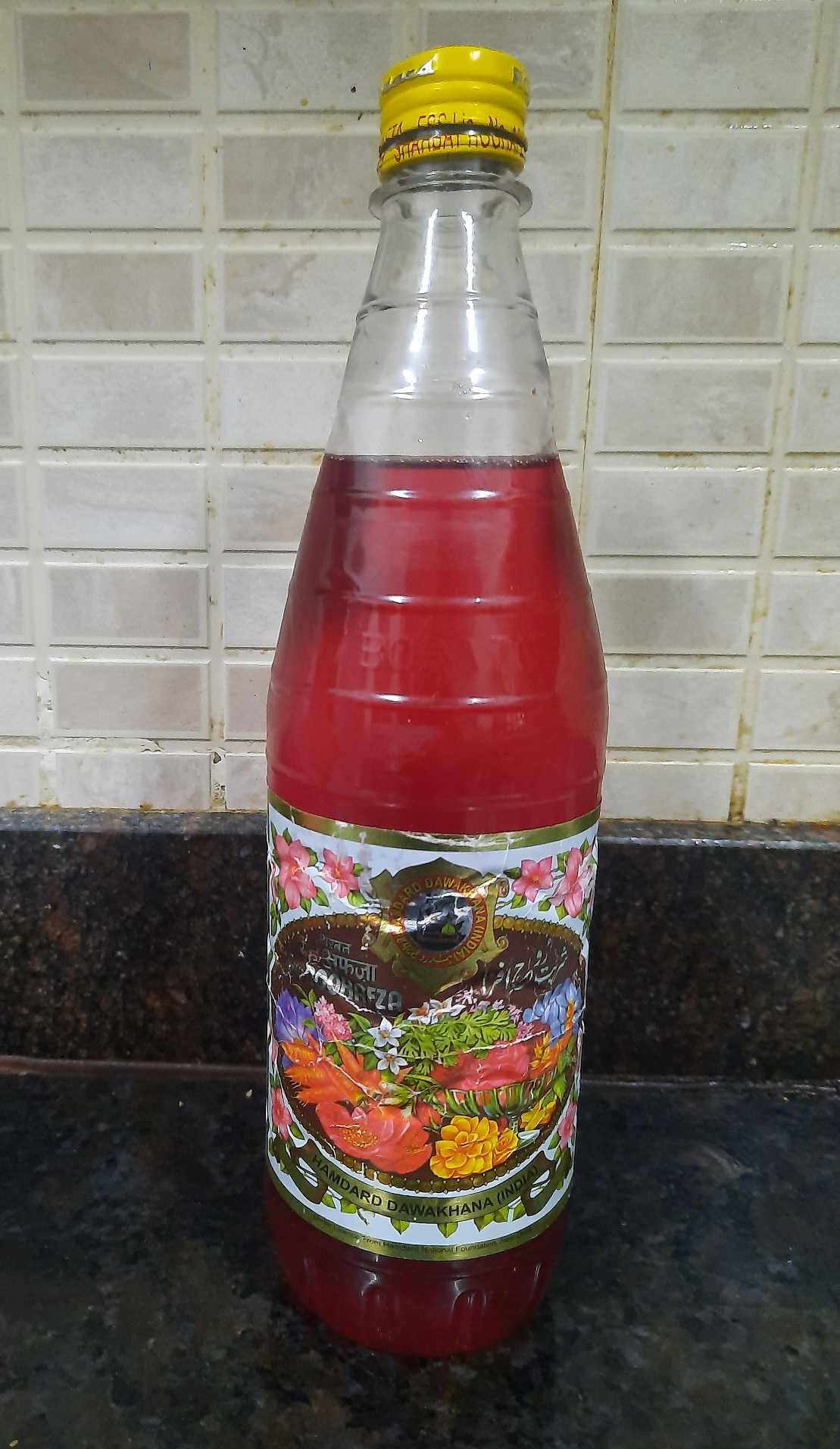
As the popularity of the syrup grew beyond its medicinal uses to become a refreshing summer drink, the Hakim turned his attention to its marketing. In 1910 he took help of an artist Mirza Noor Ahmad to create a logo that integrated flowers, fruits and herbs in its design. The overlays of colour in the design could not be accurately printed in the printing presses in Delhi. So the printing of the labels was done by the Bolton Press run by Parsis in Bombay.
At that time, there was also no standard container for the syrup. Hakim’s Hamdard Dawakhana used old wine bottles of any size, colour and shape that were available for the other syrups. For Rooh Afza Hamdard started using white bottles of uniform size (750 ml) and shape which were called ‘Pole’ bottles. It became the first sherbet to be bottled in these bottles. It was also the first sherbet to be presented in a beautifully printed wrapper of butter paper.
In the early days the news of the product was spread through pamphlets that were literally thrown in the air for wide outreach. With growing attention, Hamdard increased its marketing activity by advertising in national newspapers. By 1915 the drink became very popular well beyond Delhi as a thirst quencher and refresher.
Hakim Hafiz Abdul Majeed died in 1922 at the age of just 34 years. His sons were only 13 and 2 years old at the time. His widow Rabia Begum took charge of her husband’s Hamdard Dawakhana. But instead of running it as a private clinic she declared Hamdard as a Waqf or Islamic Charitable Trust, where the entire profits would be used for public welfare.
While Rooh Afza was initially prepared and bottled in a small kitchen, the growing demand required larger premises. A factory was set up in Daryaganj in Delhi in 1940, and his two sons managed the business. The Partition of the country in 1947 led to the parting of ways of the brothers. Abdul Majid’s eldest son Abdul Hamid remained in India and continued to manage Hamdard India. The younger son Hakeem Muhammad Saeed went to Pakistan in 1948, where he founded a clinic named Tibb-e-Unani in Karachi. This subsequently became Hamdard Pakistan. Both brothers continued to carry on the legacy left behind by their father. Rooh Afza has transcended political and geographical boundaries and continues to be a favourite in both countries.
Apart from the India and Pakistan, Hamdard also has a presence in Bangladesh. Hakim Saeed had opened a branch of Hamdard in what was then East Pakistan. After the creation of Bangladesh, instead of winding up the operations in the country, he gifted the plant to the people of Bangladesh to be run and managed by its workers.
In all the three countries, Hamdard is registered as Waqf (a Muslim endowment entity). It means it is a non-profit organisation under Islamic Law. In India, Rooh Afza sells close to 40 million bottles a year. Hamdard reinvests only 15 per cent of their profits in business and the rest is transferred to Hamdard National Foundation (HNF) which distributes it to different charitable organisations.
Rooh Afza—truly the refresher of the collective soul of the subcontinent! And a drink that triggers a kaleidoscope of personal memories for so many, across generations.
–Mamata
 Millennial Matriarchs