
The mule has always borne the brunt of uncomplimentary analogies. Stubborn as a mule, mulish behavior… a synonym for obstinate, pig-headed, refractory, headstrong, wilful, and generally self-willed. This uncomplaining beast of burden has hardly received its fair share of credit. And yet, over centuries it is these silent plodders and sloggers that have been the backbone of many military campaigns.
Mule trains were also the primary means of transporting goods across difficult mountainous terrains, especially in Central Asia. They were ideal pack animals to accompany the trading caravans. In Mughal India Emperor Akbar popularized the use of mules in place of oxen which were commonly used then. He kept stables for mules and expected his officers to keep a certain number of mules. The British were not as impressed with the local mules and imported large numbers of these sturdy workhorses from South Africa and Argentina.
The tables were turned during World War II. By this time the British army was beginning to phase out Animal Transport Companies which used to be an integral part of the army. But the conditions in France where the war was raging required transportation of supplies to remote areas where mechanized vehicles could not reach. Thus the decision was taken that each division in the British Expeditionary Force in France should have an animal transport company made up of mules. 2700 mules were shipped from Bombay to Marseilles; they reached without any losses and successfully operated in France through the bitterly cold winter conditions.
What makes the mule such a sturdy animal? But even before exploring that, what makes a mule?
A mule is a cross between two species of equine: the horse or pony (Equus caballus) and the domestic donkey (Equus asinus). The word ‘mule’ is generally used for the cross of male donkey and female horse. The cross between a female donkey and male horse, is known as a ‘hinny’. Usually mules do not breed naturally, but are specifically bred. Properly-bred mules are handsomely rugged creatures, larger than donkeys, but more solid than horses, giving them a distinctly different look.
The hybrid of horse and donkey makes for a sturdy combination. Mules are stronger than horses (weight for weight), and have tremendous stamina and resilience. They can sustain on frugal diets. They are exceptionally sure-footed, and have very hard hooves, which enables them to successfully negotiate difficult terrains. Their hide is thicker than that of horses so they can wear a harness and carry heavier loads for longer stretches. They can withstand extremes of temperature, and are relatively less prone to lameness and illness.
The stubborn temperament that makes for the many analogies is in fact more than just a mule being mulish! The obstinacy is a manifestation of a mule’s talent for self-preservation. A mule instinctively follows the path of great care when treading on uncertain terrain. It will instinctively balk when its feel its life is threatened. In looking after itself, it also takes care of the cargo it is laden with, and therefore can be trusted to deliver its cargo, including humans, safely.
The mule’s reputation for obstinacy and bad-temper is not a manifestation of its thick skinned appearance, but on the contrary an indication of its wary nature. A mule is very defensive until it trusts a person, and will kick out as a protective measure, not an act of aggression. Whatever the case, mules kick fast, hard and accurately, and hence are best kept at a safe distance till they are comfortable with what they need to do. The mule cannot be forced to do anything, but must be persuaded to cooperate! And till this happens, the tug of war between man and mule will continue, as will the “stubborn as a mule” epithet.
Mules are highly intelligent, perhaps even more than horses. They are very quick to learn, and have an instinctive grasp of a situations. They just need the right handling. A badly trained and handled mule can be a real problem. A well-trained and handled mule can be obliging, kind, patient, persevering, calm, tolerant, sensible, loyal, affectionate, even playful. Not words usually associated with its legendary truculence!
Little wonder then that mules have continued to be an important component of the Indian Army. They are invaluable at high altitudes where the road connectivity is very bad, and the terrain impassable in the severe winters. The mules are the lifeline for the army, carrying essential supplies of food, construction material, and arms and ammunition to remote border posts. A mule can carry a load of 100 kg and can cover a distance of 40 km in a day. Mules are often described as the unsung heroes of the Indian Army.
The Indian Army has more than 6000 mules who tirelessly carry out these challenging missions. The mules are divided into 15 units. They are categorized on the basis of the loads they carry. The mules assigned the task of carrying heavy arms and ammunitions are part of the Mule Artillery, while other supplies ranging from food and water, to medicine is transported by the Mule General Service. Each mule has one or two handlers, depending on the load and terrain. There is also a nursing staff with them as they move from place to place. They are fed a fixed ration of 2.55 kg of barley, I kg of chana and 7 gm linseed per day.
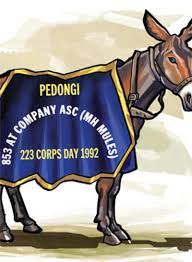
The recognition of the critical role of mules has been largely overlooked by the army. However, there are some legends shared about exceptional mules and their feats. Perhaps the best known one is that of Pedongi, a mule who carried out her duties in the 1971 war unfazed by the crossfire. She was part of an Animal Transport column captured by the Pakistani army, but managed to escape and cross the border back to an Indian post, carrying Pakistani munitions on her back. Pedongi was honoured by the Indian Army for her bravery, and continued to serve at high altitudes for many years. Pedongi entered the Guinness World Records as the longest serving military mule when she died in 1998. Her contribution continues to be remembered in the Central Army Service Corps officer’s mess lounge which has been named Pedongi in her memory.
Recently there is news that the Indian Army plans to disband its entire Army Transport fleet by 2025 and replace it with drones–unmanned systems that would carry loads in high-altitude areas. It has already reduced its numbers of mountain artillery mules and plans to retire the general service mules. The retired mules will receive commendation cards for their service with the Indian military. The retirement of mules will also mark the end of unique links between man and beast that have contributed to the security of our nation for over a century. Truly the end of an era!
–Mamata
 Millennial Matriarchs