
Generations of Indians have grown up on RK Narayan’s writings. If you have not read his novels, maybe you have seen ‘Guide’, starring Dev Anand and Waheeda Rehman? Or the charming TV series ‘Malgudi Days’? Well, suggest you visit or re-visit all of the above!
RK Narayan was one of the first Indian authors to gain international recognition. His first novel, Swami and Friends, which he wrote in 1930 did not find a publisher for many years. But sometime in 1933, his friends in Oxford to whom he had sent the manuscript, showed it to the famous author Graham Greene. The senior author liked it so much that he recommended it to his publishers and the book saw the light of day in 1935. It got good reviews across the world. RKN followed this up with The English Teacher and The Dark Room, which also won appreciation. From then, it was a steady stream of novels, short stories and articles.
Narayan created the fictional town of Malgudi as the setting for his novels. So authentic was it to his readers that many even today believe it is a real place.
But why the sudden piece on RK Narayan, one might ask.
Well, it has been triggered by a visit to his house in Mysuru. Just last week, when I was there, I was lucky to get to visit this house. RKN spent many years in Mysore (as it was spelt then)—some of his growing up years, as well as his adult life when he accepted a commission in the State of Mysore.
It was in the second stint that he built a house which I visited. Set in the quiet area of Yadavagiri, it is a beautiful house typical of the 1950s, full of light and air, with red oxide floors and a beautiful balcony.
It was indeed gratifying to see the house so well preserved. Especially after we heard the story of how it was almost demolished. The author passed away in 2001. All of his family had left Mysuru by then. The house was falling to rack and ruin, when a builder wanted to pick it up and re-develop it. It was at this time that Mysuru woke up to this legacy. Led by a journalist, the people of the city protested. Finally in 2011, the city corporation bought the house and restored it.
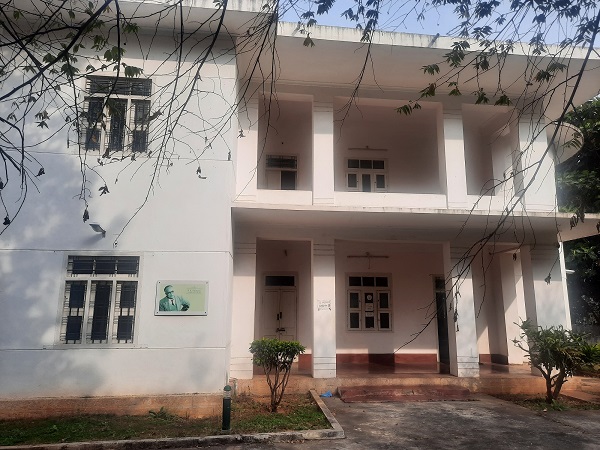
And we must be thankful for this! For not only is the house in good shape, it seems to have been restored fairly faithfully. There is also an exhibition of several artifacts, including his awards, personal items etc., many photographs, as well panels of text for those who have the patience to read them.
But…
And it is a very big BUT!
When one thinks of the potential that the house has for the students, literature lovers and citizens of Mysuru, not to mention the thousands of tourists the city attracts, it is a tragedy to leave it to routine care-taking and not very imaginative management.
As we reflected on our visit, we could come up with more than 10 ideas in less than 5 minutes:
- Have a lively permanent exhibition, along with special temporary exhibitions to explore specific themes: maybe selected books; his relationship and collaboration with his brother, the famous RK Laxman, who illustrated so many of his books; maybe the process of turning his books into movies or TV (he is said to have hated the movie Guide), RK Narayan compared to comtempory Indian writers, etc., etc.
- Sell RKN’s books (no, unbelievably, they don’t!)
- Make it the hub for meetings of book-clubs
- Make it a venue for book-launches
- Host lit fests
- Have literary events for children
- Have screenings and discussions of movie and TV shows based on his books
- Have an author-in-residence programme
- Develop an archive related to his life and work
- Create and sell souvenirs based on Malgudi
- Start a café in the lovely little garden space around the house, and serve his favourite dishes
- Make it a wifi café, so young people hang out
- And charge a small fee for entrance (the Corporation has kept entry free..generous but it would be more sustainable to charge something).
Ideas are of course easy. Execution is difficult. But do this for RK Narayan’s house we must. He is a very important part of Indian writing in English.
While India does not have a great tradition of making author’s houses into educational and enjoyable experiences, there are more than enough international experiences to learn from: Shakespeare’s birthplace; Mark Twain’s house; Emily Dickenson’s House; Jane Austen’s House; Milton’s House are among the many which are successfully keeping the legacy of these authors alive.
Maybe RK Narayan House can set the example for homes of other Indian authors?
–Meena
 Millennial Matriarchs