Kuldhara: Ghosts of the Past, Vandals of the Present

Kuldhara is on the tourist map of Jaisalmer district. On the way to Sam where the desert starts, is this ‘ghost town’ abandoned by its inhabitants about 200 years ago. The history of the town goes back to the 13th century when it was first settled by Paliwals, people from Pali district. Over the centuries, it grew into a prosperous place, with about 400 houses and over 1500 inhabitants at the peak. It had a pond, Udhansar, excavated by one of the first inhabitants, and at least one temple dedicated to Vishnu, as well as several wells and a step-well. It is actually a planned city, with proper layouts and a place for everything.

Till it was suddenly abandoned. It is not clear why the inhabitants left, but many reasons are given. Was it dwindling water supplies? Was it an earthquake? Or, more dramatically, was it the unwanted pursuit of one of the beautiful girls of the town by a local minister?

Well, whatever the reason or combination of them, it is a fact that people started leaving the place, probably not fleeing overnight as the tourist guides will tell you, but probably in trickles.

The mud-brick houses, temple and various other structures still stand in fairly good condition. Local legend of course goes that the township is haunted, and visitors are assured it is a dangerous place at night! The legend also says that the Paliwals while leaving the place, placed a curse on it, saying that anyone who tried to occupy it would meet dire consequences. All this led to its attracting tourists.
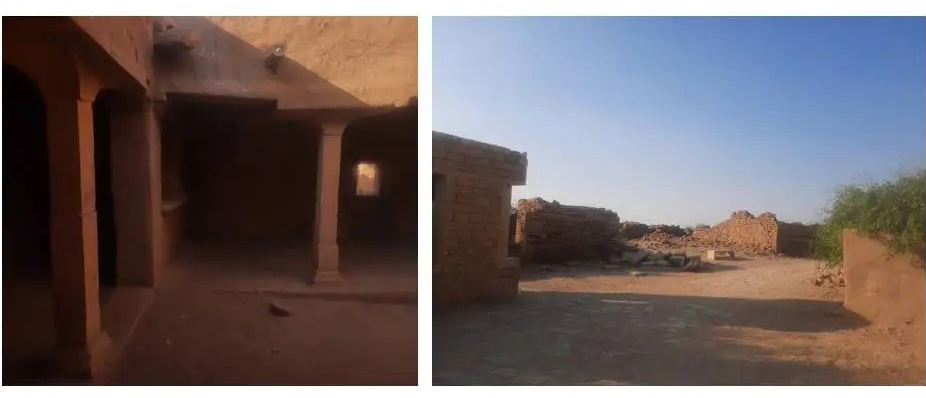
Kuldhara

The Rajasthan government decided to develop this as a tourist site around 2015. This is definitely a strategic move, given that it is just 18 kms away from Jaisalmer, and makes for a comfortable half-day trip, and it had already gained notoriety for its ghosts.

It is well-maintained by the Archeological Survey of India. There are of course guides. And importantly, fairly clean toilets. To this day, the neighbouring villages insist the gates be closed in the evening, so the Kuldhara ghosts don’t wander into their houses!

Of course, a lot more could be done—more signage, re-creation of a typical house, visualization of the town as it must have originally been, a more serious delve into the reasons for its abandonment, etc.

All of this will hopefully be done by the authorities in due course.

But an extremely disturbing incident that happened last week brings to fore the need for us as citizens and tourists to be more responsible. Newspapers report on a video that went viral. The video shows two tourists holding hands and kicking down the ancient brick wall of one the houses in Kuldhara. They were apparently doing this for putting up the video on social media.

The police are waiting for a formal complaint to be filed before taking action. Hopefully, this will be done fairly soon and action will be taken. The penalty for those who deface structures of national and historical importance has fortunately been enhanced in 2010 vide an amendment to the Ancient Monuments and Archaeological Sites and Remains Act. Now, such vandals will have to face imprisonment up to 2 years and/or a fine of up to Rs. 1 lakh.

Sadly, very few cases actually come to the stage where the punishment is given. Often, even the FIR is not registered—though in this case, the police seem to be ready to do this.

Kuldhara is just the latest example—from tourists knocking down pillars at Hampi to graffiti in Golconda, we have a long sad story of vandalism at cultural heritage sites.  If our monuments are to have a chance, punishment in these cases needs to swift, exemplary and well-publicized. Maybe there needs to be a sign outside the monument as to how someone tried to vandalize and what punishment they got!

And of course our educational institutions need to instill respect for our cultural and natural heritage, and strongly din home the need to take the greatest care of them.

The responsibility rests with each and every one of us.

­­–Meena

Forts, forts, forts…

A visit to Rajasthan leaves one with a head swimming with visions of elephants and camels, turbans and bandhini saries, sweets and more sweets .  And of course forts and palaces. I spent last week at Rajasthan, and so obviously these grandiose structures are very much on my mind.

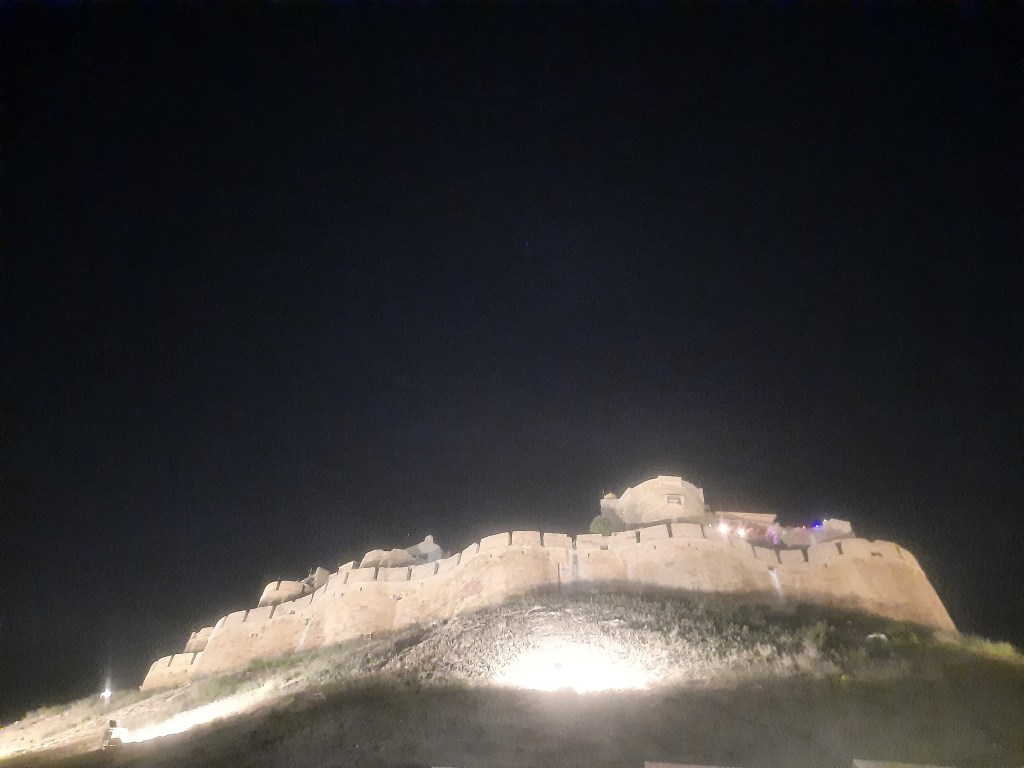
Jaisalmer Fort by Night

Which got me wandering: what are forts vs. fortresses vs. castles vs. palaces,? Well, here we go:

A fort is not a residence, but rather a military fortification. These structures were built specifically for war situations, and used to defend specific territories. A fortress is similar, but it is a larger fortified area than a fort.

A palace is primarily a residential place, occupied by royalty, heads of state, or very rich and important people. They are not fortified against attacks, but rather designed for comfort and elegance, and are often status symbols. 

Castles are large residences or a group of large buildings that have been constructed with strong walls to protect against attacks. Basically, castles are fortified residences. 

Apparently, there are about a thousand forts in India. Going strictly by the book, most forts in India are either fortresses or castles. But the British when classifying them, used the conventional British system and called them all forts.  The oldest surviving fort is thought to be the Qila Mubarak in Bathinda, Punjab, whose origins go back to the period 90-110 AD. This Qila was built by Raja Deb, a Rajput king.

That is a pretty ancient fort! But the thinking about forts goes back to even earlier times. Kautilya, the man who wrote prodigiously on all aspects of governing kingdoms, as far as the 3rd Century BC, had discussed various types of forts and fortifications.

‘On all the four quarters of the boundaries of the kingdom, defensive fortifications against an enemy in war shall be constructed on grounds best fitted for the purpose: a water-fortification (audaka) such as an island in the midst of a river, or a plain surrounded by low ground; a mountainous fortification (párvata) such as a rocky tract or a cave; a desert (dhánvana) such as a wild tract devoid of water and overgrown with thicket growing in barren soil; or a forest fortification (vanadurga) full of wagtail (khajana), water and thickets.’ he says in Book II of the Arthashastra in a section which elaborates “The Duties of Government Superintendents”. He goes into great detail not only about the construction of the fort, ramparts, towers, turrets, gates  and staircases, but even to the extent of specifying the width of various types of roads within the forts which would make for easy movement in war and peace. He details out how the spaces within the fort should be planned, and where which facility should be set up.`

However strongly fortified a fort, the danger of sieges was always present. It was for this reason that Chanakya laid down that: ‘There shall be a water-well for every ten houses. Oils, grains, sugar, salt, medicinal articles, dry or fresh vegetables, meadow grass, dried flesh, haystock, firewood, metals, skins, charcoal, tendons (snáyu), poison, horns, bamboo, fibrous garments, strong timber, weapons, armour, and stones shall also be stored (in the fort) in such quantities as can be enjoyed for years together without feeling any want. Of such collection, old things shall be replaced by new ones when received.’

Well, I suppose all this detailing could possibly have been done by any conscientious bureaucrat. What really gives the Chanakya twist to the discussion on forts is Book XIII, “Strategic Means to Capture a Fortress”. It mentions such tactics as: Sowing the Seeds Of Dissension; Enticement Of Kings By Secret Contrivances; The Work Of Spies in a Siege; The Operation of a Siege; etc.!

Wow! India not only has the most amazing forts, it probably has the oldest document guiding their conception!

–Meena

The Lacy Brittle: Beawar Til Papad

Indian sweets are yum to the Indian palate. But they don’t lend themselves to hyper-levels of visual appeal enhancements as do cakes and pastries and other sundry desserts, as portrayed in various TV shows.

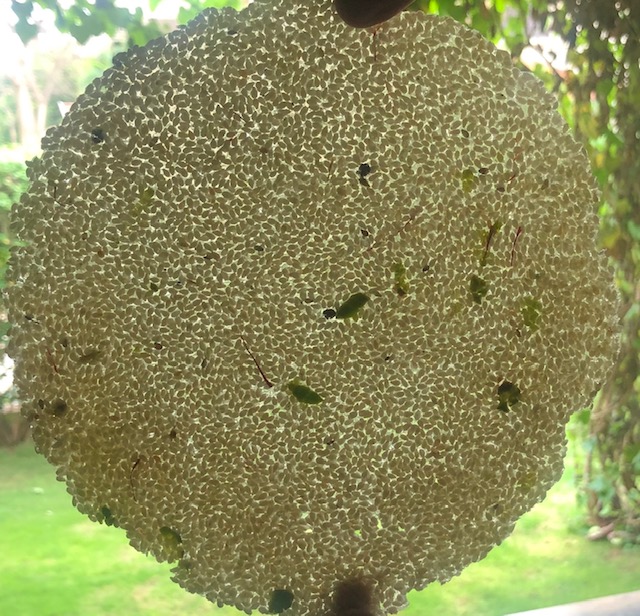
One traditional sweet which is intrinsically beautiful and delicate is the Til Papad from Beawar. A mono-layer of sesame and thinly sliced pistas and almonds in sugar syrup, each papad is see-through. Just hold it up to the light for a lacy view of the world beyond!

055F6DD4-BC24-4333-B75D-C362216E65A6

At some point in my life, I studied in Mumbai, and it was always an adventure to reach Jodhpur, where my parents were, for the vacations. One such journey must have entailed some portion being done by bus, because I distinctly recall wandering around the Beawar Bus-stop. And that is when my fascination with this sweet began. Several shops were making the til papad. Basically til and nut-slivers were cooked in sugar syrup, which was taken off the heat at just the right moment; balls made of the goo; and highly skilled cooks rolled them out, one til-thick. It was amazing to see them at work, for they had to work with hot goo, and roll it really fast and thin.

A few weeks ago, someone from Rajasthan kindly gifted us a box of til papad, and that brought all the memories back.

Digging a little deeper into Beawar, I found that it was not one of the ancient cities of Rajasthan, the story of whose founding is part-history, part-mythology. Beawar was established by a British officer, Colonel Charles George Dixon, in the 19th century as a military cantonment. Situated as it is at a tri-junction of Jodhpur, Jaipur and Udaipur, it gained and still retains importance as a trading centre.

The people of the area were apparently as brave and war-like as from any other part of Rajasthan, and the British had a healthy respect for them. One source tells me that the name ‘Beawar’ originated from the term ‘Be aware’.

In recent history, Beawar’s claim to fame is its link to the Right to Information (RTI) movement. The RTI movement started with a number of activists demanding  transparency, after conducting investigations into wide-spread corruption at panchayat and block levels. The then-CM of Rajasthan, Mr. Bhairon Singh Shekawat assured them he would bring in RTI. But even after a year, this did not happen. So on April 5, 1996, thousands of citizens and activists congregated in Beawar. The protest took place at a busy traffic roundabout called Chang Gate, and lasted 40 days. This laid the foundation for the RTI being brought in.

So sweet little Beawar is strong too!

–Meena


Cry, Beloved Blue City 

A stranger in India, reading the news in the last few weeks, would think that the most prominent landmark of Jodhpur was a huge prison, dominating the landscape. That the principal function of the city was to host trials for all kinds of ‘celebs’ accused of all types of crimes, and to then house the convicted in its boundaries.

I have lived in Jodhpur for several years, and my family has close ties to the city. None of us had any clue where Jodhpur Jail was. After the news of Salman’s conviction, we had to look up Google to figure out the location.

What we do remember of Jodhpur is the magnificent 550+ year-old Mehrangarh fort, one of the best preserved and best kept monuments in India. When I lived there 30 years ago, we would be greeted by drummers when we entered, and there were some friendly moustached guides who would take us around. They almost became like family, so often did I take visitors to the Fort. (Now there are proper displays and exhibits and shops and what not. Still nice, but not so intimate).

When you look down from the ramparts of the fort, you know why Jodhpur is called the Blue City. And there is also a walking path from the heart of the city up to the fort, which we did a few times as students (on furlough from college, no doubt). And the very unique Jaswant Thada, lined with different coloured translucent marbles, as you came down from the Fort.

Then the Umaid Bhavan Palace, the newest palace in the world, built as a drought-relief work and completed in the ‘40s. Part-hotel, part-museum, part-royal residence and wholly fascinating. Specially the indoor swimming pool lined with mosaics of the zodiac signs. And the huge murals of scenes from the Ramayana, with the heroes and heroines of distinctly Greco-Roman cast of features, done by a Polish painter.

The most interesting was where I had the good fortune to live on the grounds of—the Ratanada Palace, one of the palaces of the royal family, never really inhabited because it seems it wasn’t lucky for them. It was turned over to the Government after Independence and became the Defence Laboratory, a lab under the Defence Research and Development Organization. Imagine a lab in a palace! There were rumours that it was haunted, and ‘jingling ghungroos’ and ‘strange noises’ were sometimes an excuse not to stay too late at work!

The Palace-Lab

8F83F2EB-DA84-4F24-B34C-2A579E498DF6

The housing for the Lab scientists was on the palace grounds, in converted elephant and horse stables, garages,  band-house, aloo-khana, etc. So there was the most amazing array of very quaint but probably very uncomfortable houses for the families. I never knew whether we were lucky my father was allotted a proper  house—one that was built for the king’s British pilot, who seems to have lived in true colonial style, in a 14-room bungalow . (The same king, I think, who features in the very interesting movie ‘Zubaida’).

The Pilot’s House

98470196-BBCB-475B-A984-B8F2863C8535

The food—the mirch wadas, the badi pakodis, the kabuli, the sponge rasgullas, ghewar and the array of sweets. The lassi in which we could stand a spoon, the dal-bhatti-churma, the kachodis.

The people—hospitable, chivalrous, generous, entrepreneurial.

The ‘khamma ghanis’ and the ‘padaro sas’ and the courtesy.

The bandhinis, the leherias, the silver jewellery and the lac bangles.

The  bazaars, the gullies, the bargains.

I want these images to dominate my mindscape and Jodhpur memories. Not the prison and the prisoners!

–Meena