
Art thefts make the headlines fairly frequently (as do movies and OTT series on the theme). They have a long history—the first art heist probably dates back to 1473 when Polish pirates boarded a ship and stole Hans Memling’s a painting called ‘The Last Judgement’. They took it back to their country, where even today, it is displayed at the National Museum in Gdańsk. Italy has, since the 15th century been trying to get the painting back!
Patriotism and national feeling were also behind the theft of the Mona Lisa in 1911 from the Louvre. Vincento Peruggia, a handyman at the Museum, along with two compatriots, spent the night in a closet there, and quietly walked away with the painting in the morning. Peruggia thought that the painting was an important part of Italy’s heritage stolen by Bonaparte, and wanted to get it back to the homeland. He hid the painting for over two years, trying all the while to sell it to a buyer who would help in the repatriation. It was no easy task, because the theft had gained international notoriety and everyone was on the lookout for the painting. Finally, after 28 months, a dealer whom Peruggia approached called the police, and the painting was recovered and Peruggia jailed. In fact, it is this theft which is supposed to have catapulted the Mona Lisa to the fame and popularity it enjoys today—few had really bothered about it before this incident.
The biggest art heist in terms of monetary value is the theft of several paintings of incalculable value from the Stewart Gardner Museum, Boston. The stolen works, still missing, include a Vermeer, a Rembrandt, and a Monet among others, and are valued at about $500 million.
Another art-theft that caught the popular attention was the one where the thief was dubbed ‘Spiderman’. Vjeran Tomic entered the Musée d’Art Moderne de la Ville in Paris several times without being noticed, by spraying acid on a window. On the final visit, he stole several artworks, including a Picasso and a Modigliani. He was finally caught.
The point of art thefts is a little difficult to decipher, because the stolen works are usually well-known and even if there are people willing to buy them, they can hardly be displayed, as they would soon be recognized. Of course there are some people who steal art for ‘noble’ reasons, like Peruggia who wanted to restore his country’s heritage. Or there may be others who are happy to pay in the millions and billions, and take enormous risks to enjoy the paintings in very private situations. Or maybe just the idea of outwitting complex security measures gives some a kick.
At least paintings are not too large and heavy, especially if the thief at some stage takes them out of the frame, and are therefore relatively easy to move and hide.
But that cannot be said of stolen public art. One of the most famous of such thefts is that of a Barbara Hepworth sculputre, Two Forms (Divided Circle), from its plinth in South London’s Dulwich Park. The bronze standing at 93 x 89 x 23 inches was installed in the Park in 1970, and disappeared overnight on 19–20 December 2011. While the art piece was valued at about £500,000, the thieves probably stole it to sell as scrap—for which they would likely have got £750!
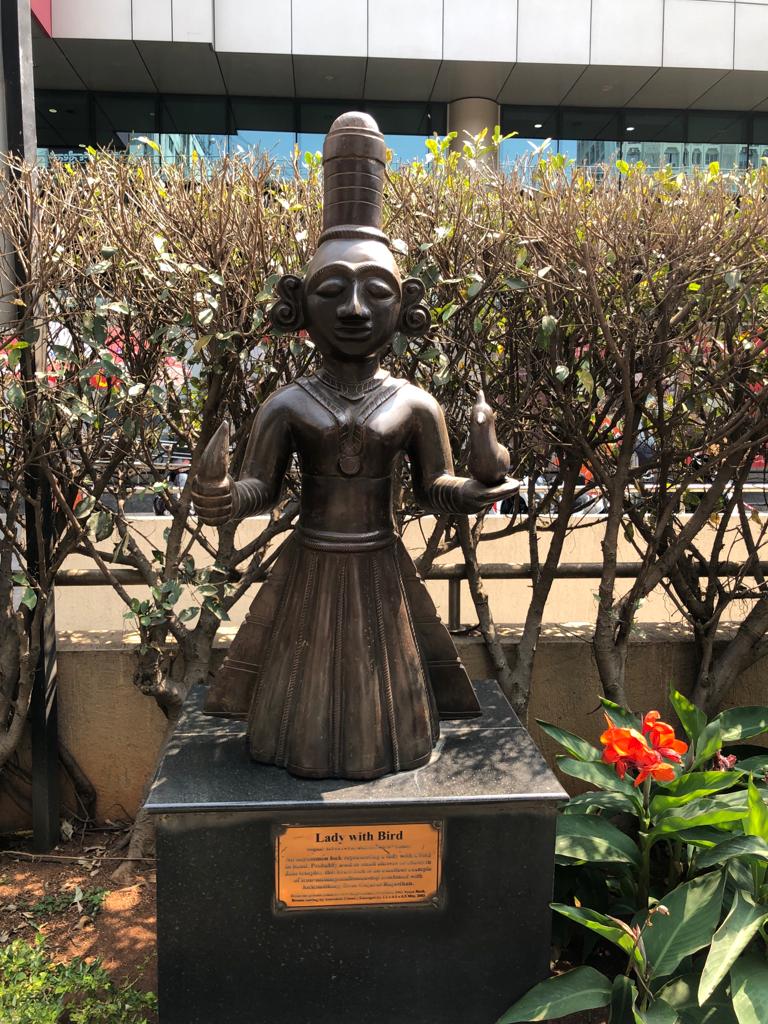
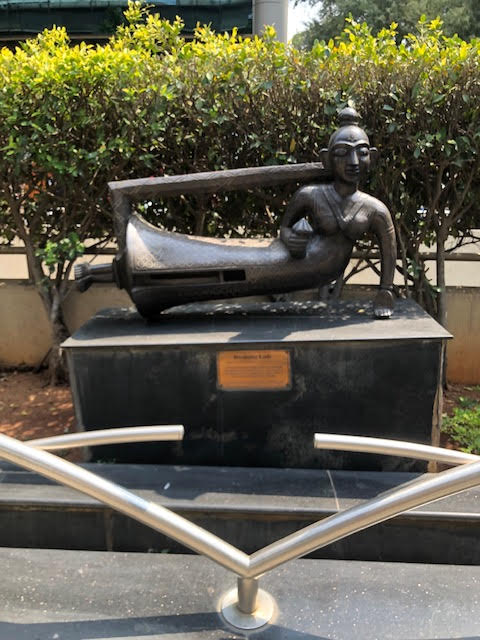
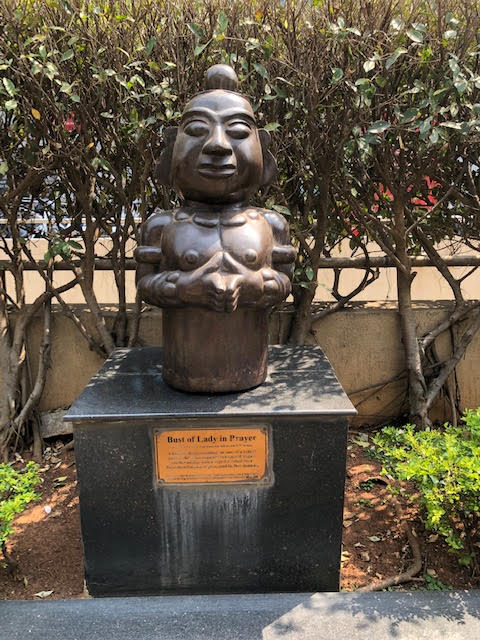
Not at this scale, but our own Bangalore (and we personally) suffered such a loss last month. Raghu is an avid collector of locks, and seven of the locks from his personal collection were blown up in bronze, and placed on the kerbside of a large bank located on MG Road. The idea was to add an element of aesthetics and interest which could be viewed and enjoyed by all passers-by. Alas, on a night in June, one of the seven bronzes disappeared! And will probably be sold for scrap. A loss to the Bank, to us who love and cherish the locks, and to the general public.
Many curators and security specialists have thought through how thefts of public art can be prevented. Stephen Feeke, curator at the New Art Centre, a gallery and sculpture park in Wiltshire, offers common sense solutions—for instance, flood-lighting to deter thieves and vandals; securely gating and fencing the perimeter; and blocking access for vehicles, as a bronze sculpture is far too heavy to carry off without a car. Others suggest high-tech measures like using forensic coding that might allow the metal to be traced.
But many are united in that there must be an outcry and voices must speak out against these thefts, which are not only a personal loss to the owners, but a loss for the public for whom this may be the most accessible form of art.
Lady Lock did not have Lady Luck on her side the night she was stolen, but let’s hope our cities do more for their public art.
–Meena

 Millennial Matriarchs