
This Independence Day week there have been many pieces celebrating the numerous freedom fighters who were part of the nationwide movement for independence. The movement was unique in that it took the path of non-violence to achieve this goal.
Whilst many of the names are part of history textbooks, there were thousands of people who played their part in the fight for freedom. Not all of these are as well remembered. Among these, there were also some who were driven by the same aims but who chose to take another path of showing resistance to the colonial rule.
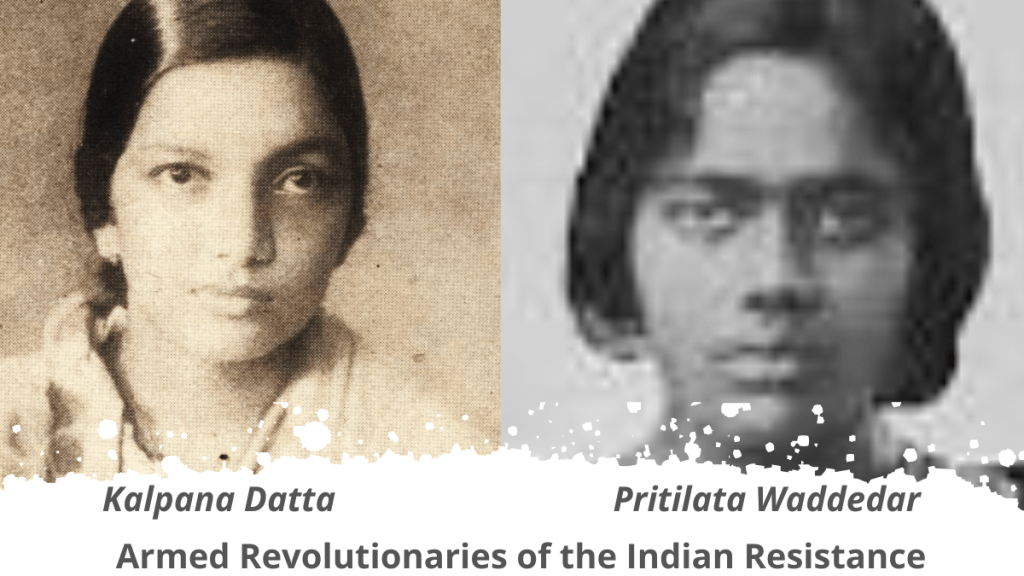
This is a story of two feisty young women who chose the path of direct resistance, and who dedicated their life to the cause. They are Pritilata Waddedar and Kalpana Dutta.
Pritilata Waddedar
Pritilata Waddedar was born on 5 May 1911 into a middle-class family in a village of Chittagong, now in Bangladesh. She did her schooling in her hometown and then moved to Dhaka for high school studies at Eden College. It is here that the young Pritilata came in contact with other women who were strong anti-colonialists and who were inspired by revolutionary ideas. The spark was ignited. Pritilata then moved to Bethune College in Calcutta to pursue a higher degree in Philosophy. On completion of her course, Pritilata’s degree was held back by the British authorities at Calcutta University because of her anti-British activities. The seeds of rebellion were firmly sown. Pritilata returned to Chittagong in 1932 where she joined as a teacher in a school and went on to become the headmistress.
It was during this period that Pritilata was introduced to Surya Sen who led an underground revolutionary group. Pritilata approached Master Da as Sen was called by his followers with a request to join his group. Initially Sen as well as his comrades were hesitant to include a women in the group, but Pritilata’s revolutionary passion and steely resolve to overthrow the British, as well as her abilities to carry out risky assignments gave her entry into the group.
Comrade Pritilata was a key member of the group that planned and strategized armed attacks on railway lines, telegraph office, the armoury, as well as the famous Chittagong Uprising—the raid on the armoury of police and auxiliary forces that cut Chittagong off from the rest of the country. Pritilata played an important role in supplying explosives to the revolutionaries. The raiders managed to escape but the British authorities tracked them down in the Jalalabad hills near Chittagong. Several thousand troops ambushed the rebels and many of them (some merely teenagers) were killed in the encounter. Sen’s depleted band had to reorganize and re-strategize.
They decided to avenge the Jalalabad massacre by burning down the Pahartali European Club. This club was targeted because, among other white supremacy symbols, it also had a sign at the entrance which declared that ‘Dogs and Indians are not allowed.’ Pritilata was the leader of the eight-member team. The team prepared by intensive training in the use of firearms. As in any military formation the leader was to be the first to attack and the last to return after the rest of the team had moved to safety.
On the night of 23 November 1932 Pritilata and her team, dressed as Sikh men laid siege to the club and set fire to it. British troops were quick to retaliate. Pritilata and her team were chased and ambushed with little hope of escaping alive. Nevertheless Pritilata tried to divert the gunfire to give her comrades a chance to escape. In the process she was shot in the leg. Rather than die under British arrest, the wounded Pritilata swallowed cyanide and ended her life. She was 21 years old. The police found her body early next morning and were surprised to discover that the leader of the attack was a young woman.
Kalpana Dutta
A lot of what we know about Pritilata is thanks to the memoirs of Kalpana Dutta which describe in detail the Chittagong Uprising. Inspired by Pritilata, Kalpana became a fellow comrade, and was also one of the few women members of Surya Sen’s underground group of revolutionaries. Kalpana often travelled disguised as a man, to transport explosives and other supplies to the group. She also became an expert in preparing gun cotton, an explosive agent.
Born on July 27, 1913 in Sreepur village in Chittagong, (now Bangladesh), Kalpana Dutta was fond of listening to adventurous stories since childhood. While studying in high school, she read many biographies and stories of freedom fighters, which inspired her with the passion to join the struggle for freedom. She joined a semi-revolutionary student organisation called the Chhatri Sangha and became one of its most active members. It was here that she met Pritilata, and the two became close friends. It was Pritilata who introduced her to Surya Sen.
Following the Jalalabad massacre, both Pritilata and Kalpana were designated as the key executors of the arson attack on Pahartali Club. Just a week before the attack, while she was on a reconnaissance trip of the area, Kalpana was detained by the British. She was released on bail, she immediately went underground to ensure that the plan would continue without any obstacles. Pritilata became the sole leader of the team. As we know, the team was ambushed and the wounded Pritilata took her own life rather than die in the hands of the enemy.
Kalpana remained underground, even when the British finally managed to locate and capture Surya Sen in 1933. Three months later, she was eventually arrested and sentenced to life in the second supplementary trial case of the Chittagong Armoury Raid incident. She was released after six years of imprisonment. After her release from prison, she completed her studies and graduated from Calcutta University in 1940. Following independence, she led a relatively quiet life until her death in February1995. She wrote her autobiography in Bengali which was translated into English as Chittagong Armory Raiders: Reminiscence.
The note left by 21-year-old Pritilata when she died sums up the spirit of these two fearless young women who broke many stereotypes of the time.
There may yet be many among my dear countrymen who would question [women being fighters]. Nursed in the high ideal of Indian womanhood they may ask, how can a woman engage in such ferocious task of murdering and killing people?
I am pained at the distinction being made between a man and woman in the struggle for freedom of the country. Today if our brothers can enlist in the war of independence, we too the women should be allowed to do the same and why not?
–Mamata
 Millennial Matriarchs