
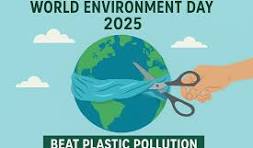
Last week marked World Environment Day. The theme for this year was Beat Plastic Pollution. In events around the world to mark this day, much was discussed and written about the dire state of the environment due to the over-accumulation of plastic. In recent years plastics have become the bane of the environment. It is ironic that it is this material that was once hailed as a boon! The history of this ‘wonder material’ goes back to the mid-nineteenth century.
This was a time when elephants and turtles were becoming seriously endangered due to demand for ivory and turtle shell which were used in the making of numerous things from piano keys and billiard balls, to combs. The biggest consumers of ivory were high-quality billiard balls. Between three and five balls could be made from a tusk, and at least two elephants needed to be killed to make one set of billiard balls. The increasing popularity of billiards in England as well as America, led to the slaughter of thousands of elephants. There was a serious threat to elephants, and also there was an increasing cost of ivory to make the balls.
This led to the quest for some man-made materials which could be used as substitutes. One of the earliest such attempts was to dissolve cotton fibres in nitric and sulphuric acids, and then mix these with vegetable oil. In 1862 an English chemist Alexander Parkes was the first to patent this new material with the name Parkesine. It was presented at the Great London Exposition in 1862, but it was not a commercial success.
In the meanwhile in America, Michael Phelan ‘the father of American billiards’ took out an ad in 1863 offering a sum of $10,000 for a substitute for ivory. John Wesley Hyatt, a young printer with no formal training in chemistry took up the challenge. He spent six years experimenting with various solvents. In one experiment he blended camphor with nitrocellulose and produced a hard mouldable substance that he called ‘celluloid’. He patented this in 1869, and along with his brother began to produce it in 1871, marketing it as a substitute for natural materials like ivory and tortoiseshell.
As it turned out celluloid was not the perfect substitute for billiard balls; when two balls collided it produced a mini explosion. But the new material had a number of properties that made it attractive. It could be moulded into any form, hardened or left flexible; it was waterproof, it would not rot or corrode like metals; it was extremely durable, and it was cheap.
Celluloid was hailed as an environmental saviour. A sales pamphlet in 1878 claimed that “it will no longer be necessary to ransack the earth in pursuit of substances which are constantly growing scarcer”.
Celluloid was the first industrial plastic that would transform the world as multiple uses were found for it. It was followed by polyvinyl chloride or PVC. Since then plastics have undergone numerous stages of development. Plastic was not immediately adopted widely. But by the mid-20th century, as the benefits of this ‘trendy, clean, cheap’ material were loudly touted, plastic became ubiquitous, and took over every aspect of daily life.
The world embraced plastic with a clear conscience. The products made of plastic provided the added attraction of being easily disposable. The convenience of single- use throw-away products were extolled and countries like the United States made a whole-hearted example of this. The use-and-throw lifestyle became the aspiration of every society.
Today we are seeing the legacy of this throw-away lifestyle. The world is producing 300 million tonnes of plastic a year, a figure expected to triple by 2050. The chemical properties that have made plastic such a multi-use and durable material also makes its disposal difficult. Plastic takes a long time to degrade, in some types even thousands of years. Thus landfills are overflowing. Even the degradation of plastic is a serious environmental issue as it breaks down into microscopic particles that pollutes the oceans, land and the air. These micro-plastics are also accumulating in our bodies, the health impacts of which are not even known as yet.
The modern plastics industry relies on fossil fuels for its raw material contributing to global CO2 production. Thus the production of plastic also has an impact on climate change.
In the oceans, plastic ingestion and entanglement is harming and killing marine creatures including turtles. On land climate change is one of the factors that is changing habitats and endangering all living things from elephants to ants. Ironically, the material that was once celebrated as the saviour of these creatures is today the scourge of the environment across the globe.
Sadly, over these decades the state of planet Earth has only deteriorated. The issues with overuse of plastic not only remain, but have been exacerbated. While there have been efforts in terms of policy initiatives, technological advances, and even public awareness these have not been able to cope with the even faster increase in plastic consumption, pollution, and waste generation. Even after decades of advocacy for Recycle, Reuse and Refuse, the picture is grim. In 2025 the world is expected to consume 516 million tonnes of plastics. And only 9% of all plastics produced as actually being recycled globally. The theme for WED 2025 ‘Beat Plastic Pollution’ spotlights the growing scientific evidence on the impacts of plastic pollution and hopes to sustain the momentum to refuse, reduce, reuse, recycle, and rethink plastics use.
— Mamata
 Millennial Matriarchs