
Our biology teacher tried her hardest to fill our brains with all kinds of information about plants, flowers, and creatures big and small. I am not sure how much of it stuck. But Rafflesia arnoldi was one of the plants that we studied about that all of the students were fascinated with, and I can still recall many details about it.
For after all, a parasitic plant is fascinating isn’t it? Especially when its blooms are the single largest individual flower in the world, and which emit an aroma similar to rotten meat? It is a parasitic plant that grows on vines of the genus Tetrastigma. It has no green photosynthetic tissues, leaves, stems or roots. It essentiallylives inside the Tetrastigma vines as a mass of strands which absorb water and nutrients from the host. It grows out of the host plant’s bark as brown, cabbage-like buds which bloom over several days. The flowers have five lobes, are reddish-brown with white spots, and grow up to 1 m across and may weigh up to 11 kg. The smell of rotten meat they emit attracts insects such as flies and beetles, and this helps in the pollination cycle.
We all dreamt of the day that we would travel to the wilds of Indonesia to see this plant.
Another parasitic plant, which we didn’t realize was parasitic, was the mistletoe. The books we read were generally by British authors, and the tradition of hanging up mistletoe during Christmas and kissing under it drew many a schoolgirl snigger. Readers of Asterix comics would recall Druid Getafix forever up on top of a tree cutting some plants with a golden sickle. This would be the mistletoe which was believed to have medicinal and magical powers. There are many species of mistletoe, which are parasites on a variety of hosts. Some species even parasitize other mistletoes, which in turn are parasitic on a host! Unlike Rafflesia, mistletoes are hemiparasites—they have chlorophyll and can make some of their own food.
Thanks to all these references, another ambition was to see miseltoe.
I have definitely not seen Rafflesia.
But I have had recent encounters of a mistletoe type in my own backyard.
The parijaat or coral-jasmine tree is the pride of my garden. Come July, the lawn is carpeted with the delicate, fragrant white blossoms with orange stalks. A few months ago, I saw another type of leaf among the parijaat leaves. I took it for a climber, though I could not see where it had originated from. I didn’t pay too much attention. Then I saw a different kind of flower on the tree, and was kind of happy, because these were rather pretty too, and I thought I had two beautiful flowers for the price of one.
But as l looked more closely, I became more and more perplexed. The climber was simply not rooted anywhere! I clumsily clambered up a stool to check out where the branches with the different leaves were originating from. And to my dismay I found that there were knots at various places on the parijaat branches, and each of them sprouted thin branches with these different leaves.
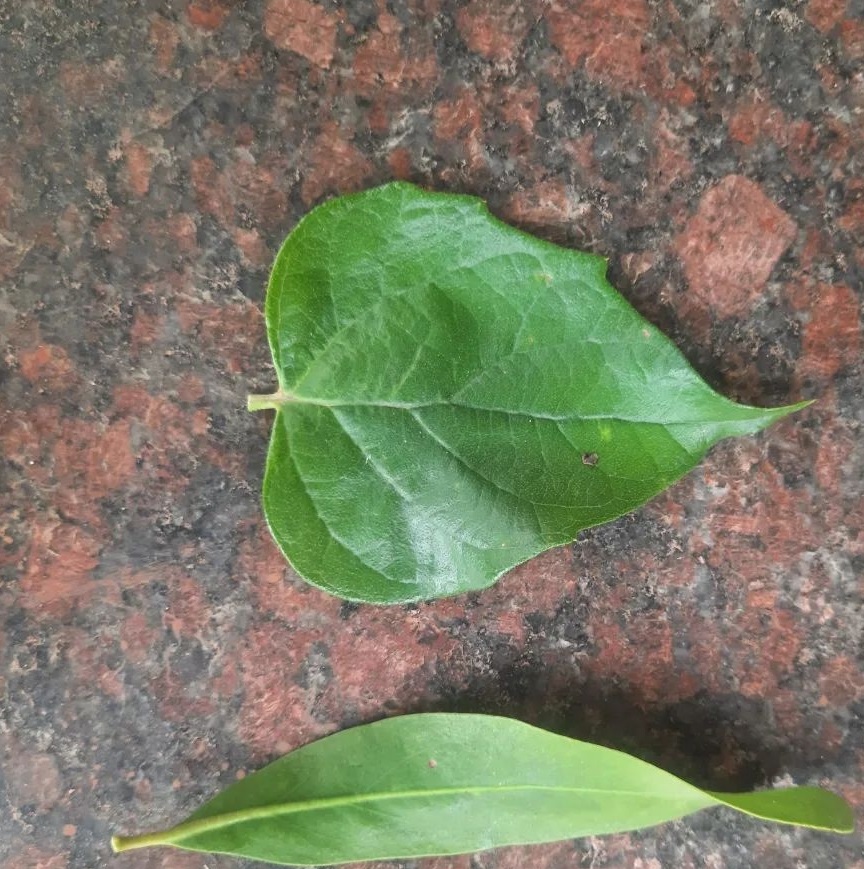
Consultations with experts has finally resulted in the conclusion that my poor parijaat is infested with the parasitic Loranthus. It belongs to Loranthaceae, the showy mistletoe family. So the ambition to see mistletoe has come true, though I am not happy about it!
Some species of Loranthus are parasites on cultivated trees, for example, on mango s, chiku and poplar trees. Though the books don’t say so, they obviously infect parijaat, and are also seen on my neighbour’s anar.
Loranthus grows on the branches and stems of other trees and obtains water and nutrients from the vascular tissues of the host plant. Birds like sunbirds and flowerpeckers spread the seeds after eating the berries, either by excreting them or wiping off the seeds from their bills, to the branches of neighbouring plants. Seeds germinate and sink parasitic haustorium (an attachment mechanism) into the branches of their host. Secondary haustoria are formed from the same parasitic plant wherever there is a contact with the host.
A parasite takes up the host tree’s water and mineral content and harms the host while the parasite gets benefitted. While most of these parasites don’t draw enough to kill the tree unless there is a serious drought or other drastic conditions, the host does weaken.
I have had all the branches with Loranthus knobs pruned. Apparently, the huastoria spread quite deep, so fairly drastic surgery had to be performed on some branches.
I think my paarijaat is looking happier!
–Meena
 Millennial Matriarchs