
This morning’s newspaper tells me that the city Municipal Corporation is on the move to fill up potholes in the city’s roads as a Diwali gift to citizens. While this is indeed a noble announcement, it is a bit ironic as the sorry state of the roads needs much more than a superficial patching up of random ruts and depressions on the road, with more of the substandard material and workmanship that causes the potholes in the first place. In fact on many roads across the city, there are more ragged and rough patches than there are even surfaces. These make headlines a couple of times a year, especially during the monsoon when there are accidents, sometimes serious, caused by two-wheelers and pedestrians slipping and falling into waterlogged potholes. Potholes are not only dangerous, they are also a major source of frustration and inconvenience for commuters. This receives a few days of media coverage where questions of quality and responsibility are raised, and a few contractors are taken to task and fined, before returning to ‘business as usual.’
While I had not given it any thought, for the first time I wondered why these depressions are called ‘potholes’? The origin of the word is not clear. From the purely linguistic angle it could be the literal meaning of the word ‘pot’ that meant a ‘deep hole’, or referred to deep cooking vessels; and the word ‘hole’ being self-explanatory. There is a more interesting version. In 15th and 16th century England wagons and coaches with heavy wooden wheels were the main form of transportation. As they traversed the roads, the wheels gouged deep ruts in the soil. Pottery makers would take advantage of these ruts to dig deeper to reach the clay deposits beneath to make their clay pots. Those driving wagons and coaches over those roads knew who and what caused these holes, and referred to them as ‘potholes’.
Whatever the origins of the word, potholes are a feature of roads in almost all parts of the world. Potholes are caused by a variety of factors, including poor quality of construction materials and labour, lack of proper maintenance and repair, heavy rainfall, and high traffic volume. In cold climates the expansion by freezing of water that has seeped into the crevasses and depressions in the road surface also causes cracks which expand to become ruts and potholes.
Civic authorities in cities around the world do their bit to repair potholes, and are usually far behind in their reach. However, there is one man in Europe who has taken it upon himself to turn potholes into works of art!
While the artist’s work is in the public domain, the artist himself remains anonymous and enigmatic. His true name or identity are not known. He simply goes by the name Ememem. He gave himself this name as he felt that it sounded like his moped does when he sets off for his pothole repair mission. He does not give interviews, nor allow himself to be photographed; he prefers his work, rather than himself, to be seen, as he feels that he is not good at social interactions.
What he does interact with, are the roads that he walks along, absorbing the noises of city life as he looks, and absorbs. What grabs his attention are potholes on the roads. As he claims ‘some of these vibrate and some don’t.’ When he comes across a pothole that “speaks to him” he takes stock of its size and shape. This inspires him to put together pieces of colourful tiles, majolica (glazed earthenware with bright metallic oxides), and ceramics (mainly from waste material) to create artworks that fill or repair the pothole. For obvious reasons, (including that what he does is not strictly legal), he works at night when the roads are relatively less busy, and so that he can work without interruption, or identification. The on-site exercise is preceded by a study of his ‘canvas’, as he describes potholes, cutting the tiles to perfectly fit the space while creating an artwork, and using quick-drying glue to paste them in place. His pothole ‘makeover’ could take from one hour to six hours depending on the condition of the hole, the weather, and the time it takes for the creation to dry.
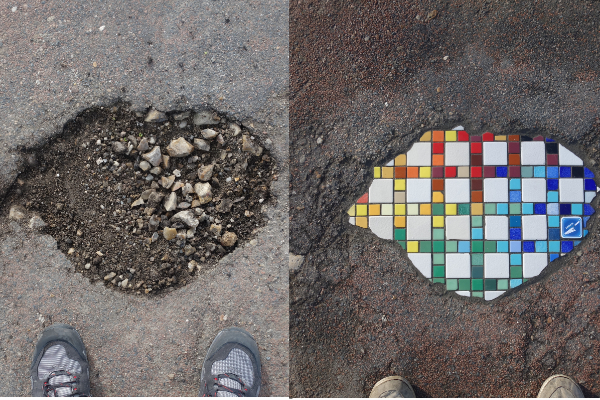
Ememem has coined the word ‘flacking’ to describe his technique. It is derived from the French word flaque which means puddle. The term is also used used figuratively to refer to an area that looks entirely different from its surrounding. And Ememem’s vibrant colourful designs certainly stand out in stretches of dull grey pavements.
Street art, a form of artwork that is displayed in public on surrounding buildings, streets, trains and other publicly viewed surfaces, is today regarded as one of the largest art movements. Much of this art (which includes graffiti) often reflects social and political issues. It is often also regarded as a form of vandalism.
Ememem does not see himself as an artist with a particular message, or a mission to change the world. Rather he says that his art focuses on the ‘art of healing the street’. He feels that he could just as well be called ‘bitumen mender’ or ‘poet of the asphalt’. In his hometown Lyon, Ememem is described as a “pavement surgeon” who heals fractures in the streets and gives them a new look. Fortunately the civic authorities in most of the places where his ‘operations’ take place let the art remain, to be appreciated by both the residents as well as visitors.
Today his healing works can be seen not only in France, but in many European cities including Paris, Barcelona, Madrid, Milan, and Oslo and Aberdeen. He continues to keep his identity a secret, but displays his work on Instagram where he has a huge following.
As we prepare for Diwali with the beautiful floor art of rangoli, would it not be magical to wake up to see Ememem’s colourful mosaics brightening up our roads? One can only dream!
–Mamata
 Millennial Matriarchs