
This week the world celebrated Earth Day on 22 April. What started in the United States in 1970 as a one-day demonstration of concern about the threats to the natural environment, grew into a sustained global movement to conserve and protect our Planet Earth which is increasingly threatened in every way. Earth Day continues, to this day, as the largest secular day of celebrating Mother Earth across the world.
The reverence and celebration of Earth as the all-sustaining and nurturing Mother goes back millennia. All indigenous cultures believe that Earth sustains and nurtures all living things, of which humans are but one part. This belief is manifested in the traditions and practices of communities in different parts of the world. One of these is the deification of the Earth as a Goddess, especially in indigenous cultures of the Meso-Americas. This Goddess is Pachamama.
In the culture of the Andean people Pachamama represents the Earth and all its life forms. The word Pachamama comes from the Quechua, an ancient language of the Andean people. Pacha means ‘world’ and mama means ‘mother’, translating to ‘Mother Earth’. It represents the Goddess that exists in all elements of nature. It is the spirit of the land, the essential force that sustains life. Communities celebrate Pachamama through ceremonial rituals and offerings before embarking on any important activity: as a prayer for good crops; to overcome adversities, or requesting protection for livestock, people, and all living things. They also offer thanksgiving for each season’s harvest. The ceremonies demonstrate the integral role that Pachamama plays in agriculture and their daily sustenance. For the Andean people, who have a tradition of herbal medicine, Pachamama is also integral to health and well-being. They believe that honouring Pachamama supports both physical and spiritual health.
Pachamama is a vital life force encompassing four cosmological Quechua principles of Water, Earth, Sun, and Moon, which she embodies as the ultimate Earth Mother deity. The word thus is also taken to mean Mother Cosmos.
For the Andean people Pachamama’s presence is woven into the daily fabric of their lives. As a powerful force that sustains and nourishes, they are careful that their actions should not provoke her wrath. They believe that earthquakes are a manifestation of her displeasure. The rituals and traditions such as challa a ritual where a small portion of chica a fermented corn drink is poured on the ground as an offering to the Goddess, and offerings of cocoa leaves are a symbol of the respect and reverence of the people for Mama Pacha or La Pachamama as she is also called. Another ritual includes burying food, throwing sweets and burning incense to give thanks for the harvest. This is an expression of Ayni, the principle of reciprocity, a giving back to the earth, fostering a balanced relationship between Nature and humans. Shrines dedicated to the goddess are also constructed from natural materials such as tree trunks or rocks.
As in all cultures, culinary traditions also play a part in expressing gratitude for the sustenance that the earth provides. The preparation and sharing of Pachamanca, as part of community feasts is rich in symbolism. The word comes from the Quechua words for ‘earth’ and ‘pot’, and refers to the feast of potatoes, meats, vegetables, and sweet potatoes and corn that have been steamed in a stone-heated, herb-infused underground oven. The oven is made in a pit in the earth, lined with a sequence of layers of stones which have different heat holding capacities. The stones symbolize Inti, the Sun God, and the source of warmth. The ingredients are wrapped in banana leaves and also layered according to their cooking time, from meat and potatoes at the bottom to fruits such as plantains and pineapples at the top. Following a smattering of herbs and beans, the earthen oven is covered with soil and the buried ingredients cook slowly as they are imbued with aromatic heat and smoke. The ritual of burying the food signifies a return to the womb of Mother Earth. Pachamanca is a tribute to Pachamama, with all the offerings fed to the Earth before they are ceremonially dug out and shared to be eaten by the community. Even today this traditional feast symbolizes the community’s history and tradition of thanksgiving and reverence for the all sustaining Pachamama.
The concept of Pachamama symbolizes the interconnectedness of all living things who are sustained and nurtured by a healthy and vibrant Earth. This concept has resonated with ecological movements across the world. And yet, day-after-day, this Earth is being damaged, disturbed and pushed to the brink in every sphere.
It is in such dire moments that we need to look for some rays of hope. The concept of Pachamama is a reminder that we need to look beyond our own needs, wants and luxuries to remember and respect the source of all that meets these human demands.
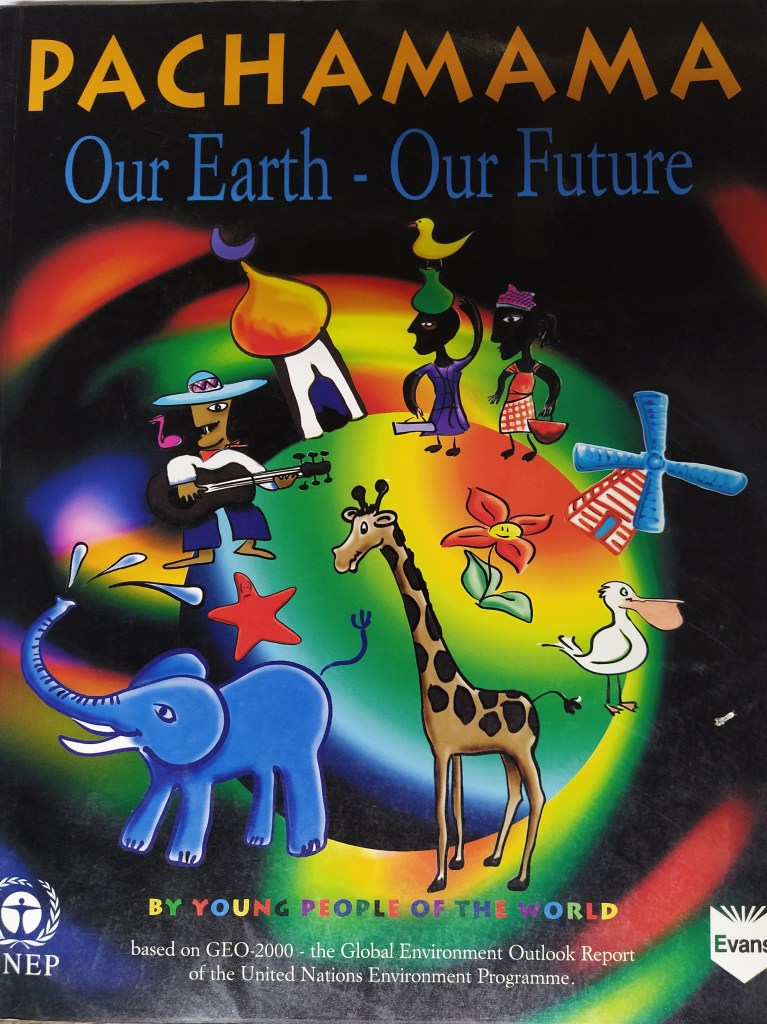
Several years ago I was part of an international project that invited contributions from young people around the world to read the UN Global Environment Outlook Report and send in their reactions and responses to the state of the environment, as well as suggest possible ways of tackling these issues. Case studies and examples of positive actions were also collected. The enormously rich inputs (text as well as visual) were sorted and edited also by a panel of young editors. The outcome was a heart-warming book. The unanimous choice for the title: Pachamama: Our Earth Our Future.
This stemmed from one of the young editors: I have visited South America and I have a personal relationship with Pachamama. I know her—she exists. She breathes in the forests, she rages in the earthquakes and volcanoes, she flows through the rivers and crashes on the shore with the sea. I feel her arms around me, nurturing me and all she asks of me in return is to love her, care for her, nurture her.
–Mamata
 Millennial Matriarchs