
Last week, newspapers in Bangalore were full of reports of a man who jumped a queue at a super-market. Happens every day, everywhere, right? So why did this hit the news? Well, a determined lady ahead of him in the queue stopped him and asked him not to break the queue. In response, he abused and manhandled her. Other customers stopped him. A police complaint was lodged and he was arrested.
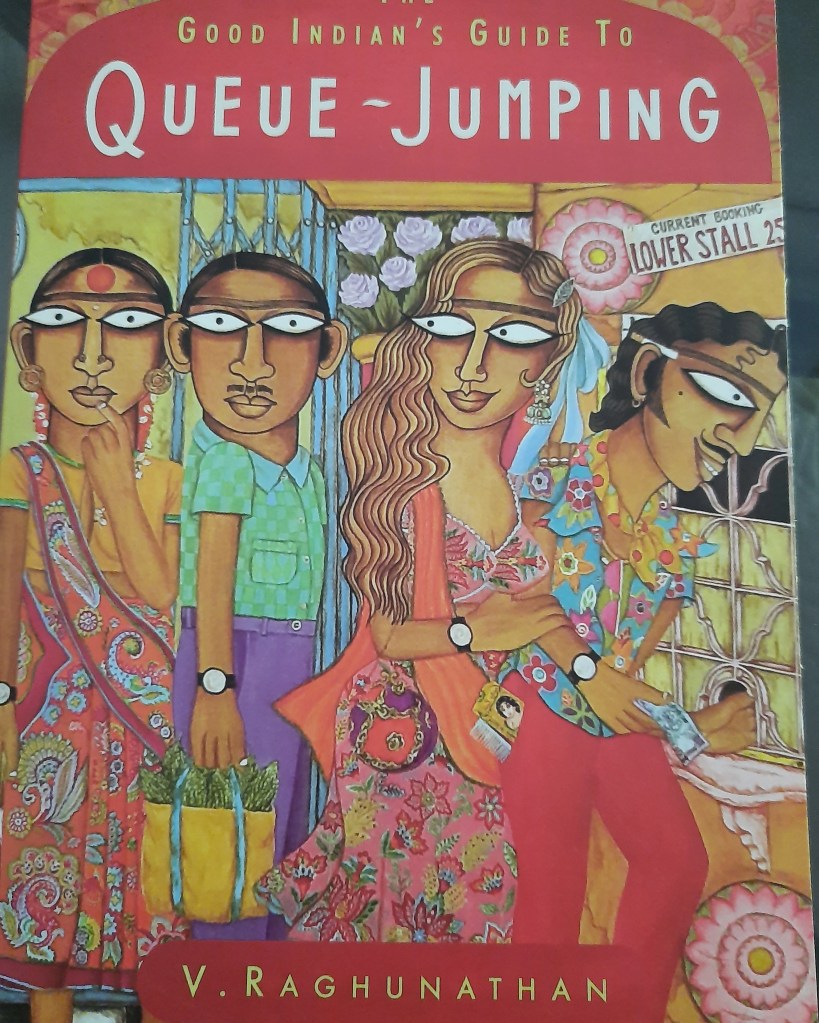
A sad commentary on the casual rule-breaking and the casual violence that pervades our lives. It sent me back to ‘The Good Indian’s Guide to Queue-jumping’ by V. Raghunathan (Harper Collins), to refresh my understanding of the phenomenon of queue-jumping. A whole book that deals with the sociology, psychology, and several other ‘ologies of the phenomenon! Fortunately, it also helped me smile a bit, even though the issue itself is disturbing.
To share a few insights from the book gleaned from research:
- Research shows that more than half the time, queue-jumpers get away scot-free. In only about 54% of the cases does anyone protest, and it is only 10% of the times that queue-jumpers are thrown out of the queue.
- In most cases, the person protesting is the person immediately behind where the queue is broken. People further back in the queue don’t react much.
- If the first and the second person behind the point of the queue breach don’t protest, there is 95% chance that the queue-jumper will get away with the it.
- When someone gives a reason, however absurd, people are ready to let him or her get ahead of them in the queue.
- When a single person breaks a queue, there was not much opposition. But when groups break queues, there is more likely to be resistance.
- Different nations have different propensities for queuing and queue-jumping. The devotion of the English to queues is legendary. In fact, a popular saying is that if there is one Englishman, he will form a queue. Sadly, India is among the nations with a great propensity for queue-breaking.
Physically muscling in is not the only way to break queues. Here are some other ingenious ways to do it:
- Use professional queuers: Yes, that is a profession! It is essentially a person who takes a payment to stand in a queue in your place. Remember the old days when we used to queue up for railway tickets? We used to often pay someone to do it. In some countries, there are agencies which will send people for this. In a variation of this, when some US states brought in a regulation that car-poolers would get access to fast-lanes, there were professional companions who would ride the car with you so you could join the fast-lane—essentially a form of queue-jumping.
- Become a VIP: In India of course, it is not at all difficult to break a queue. Every official and politician with a light on their car to speed through traffic is essentially a queue-breaker. The practice, curbed by law is less prevalent today, but has not disappeared. But it’s not just on the road. You go to a government office, and someone who is ‘someone’ will cut in front of you. When you go to the hospital, a person wearing the hospital-employee tag will escort someone to the head of the queue, even as those have booked appointments wait. You go to get a vaccine, you will face the same. But we experienced the most ironical situation of all once when we were waiting to cast our votes on election day. A politician tried to cut-in in front of us. He was a candidate in that very same constituency. Democratic elections based on universal adult franchise are founded on the premise that we are all equal. But the politician-VIP obviously did not believe in this!
- Pay to get fast-tracked: There are several instances where one can pay to jump to the head of the queue. Temples for instance have free queues, Rs. 100 queues, Rs. 500 queues etc.
- Fake it till you make it: From across the world there are reports that more and more people citing illness or old-age use wheelchairs at airports, thereby cutting queues and getting express entry. Only to walk away briskly once they clear all the obstructions!
While many of us would hesitate to physically jump a queue, hand-on-heart we cannot say we have not used any of these other ingenious ways. Often we even convince ourselves that these are not instances of queue-jumping at all. But in our heart of hearts, we know they are!
To end on a lighter note, here is a story about the English: ‘During the London riots in August 2011, I witnessed looters forming an orderly queue to squeeze, one at a time, through the smashed window of a shop they were looting. They even did the ‘paranoid pantomime’, deterring potential queue-jumpers with disapproving frowns, pointed coughs and raised eyebrows. And it worked. Nobody jumped the queue. Even amid rioting and mayhem – and while committing a blatant crime – the unwritten laws of queuing can be ‘enforced’ by a raised eyebrow.’ Kate Fox (Watching the English: The Hidden Rules of English Behaviour).
–Meena


 Millennial Matriarchs