
A few weeks ago, India celebrated Republic Day. It was, as always, a solemn occasion. For us, Republic Day marks the day when we adopted our Constitution and became a Republic.
But not all Republic Days are solemn. Nor do they come every year. Whangamōmona, a small settlement in rugged New Zealand’s North Island, celebrates Republic Day in January, but only every two years. It last celebtrated its Republic Day on Jan 18, 2025, marking 36 years of independence. Hundreds of visitors attended the event, which featured rural activities, a sheep race, presidential elections
Whangamōmona has a funny backstory. It seceded from New Zealand. How and why did this come about?
In 1989, New Zealand restructured its local government boundaries. For decades, Whangamōmona had been part of the Taranaki region. But the reforms shifted it into the Manawatū-Whanganui region instead. On paper, this was administrative housekeeping. On the ground, it felt like cultural displacement.
The town identified economically and socially with Taranaki. Farming networks, community ties, supply routes were all there. But suddenly, they were told they belonged somewhere else.
So on 1 November 1989, in response to what they saw as distant bureaucratic meddling, Whangamōmona declared itself an independent republic.
But this wasn’t angry secession. It was satire with a straight face.
The Republic of Whangamōmona established:
- A president
- A passport (yes, you can get it stamped)
- A national day
- And a constitution — loosely interpreted
The tone was tongue-in-cheek, but based very much on community pride. Every two years, on Republic Day (in January), thousands of visitors descend on this tiny town of fewer than 50 permanent residents. There are sheep races. Gumboot throwing. Debates. Parades. And, most importantly, the presidential election.
The candidates over the years have included:
- A goat (Billy Gumboot)
- A poodle
- A human (briefly)
- And even a tortoise
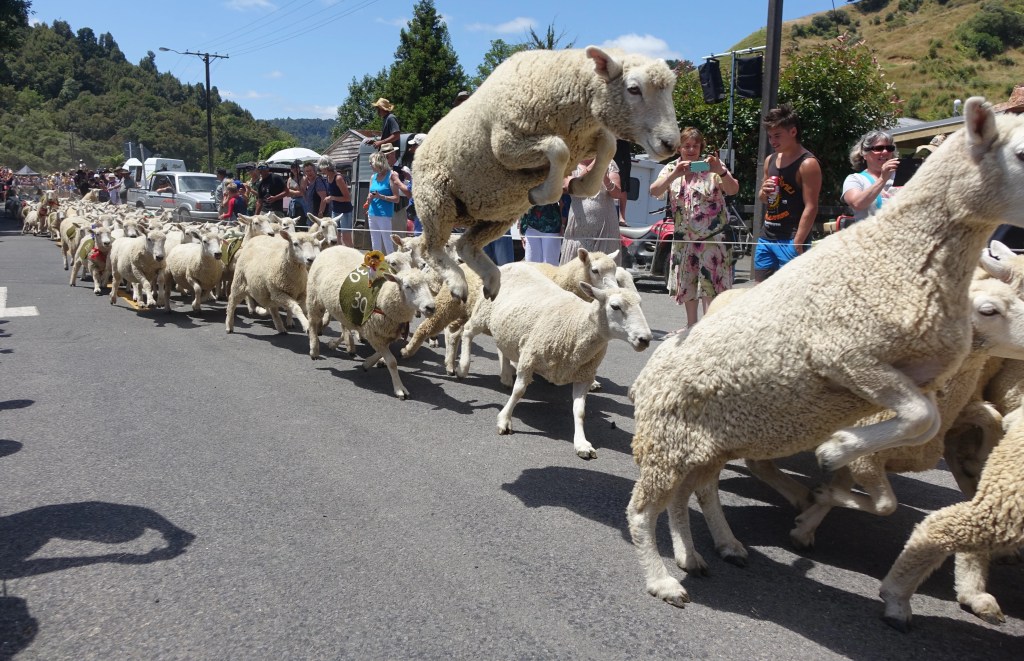
A race to choose the President
Billy Gumboot, the goat, was perhaps the most iconic president. He reportedly served with dignity until his untimely death in 1999. His successor? Tai the poodle.
Isolation as Identity
Whangamōmona isn’t easy to get to. It lies along the Forgotten World Highway — which is honestly one of the best road names ever conceived. The route winds through dramatic hills, misty valleys, and farmland that feels cinematic in its remoteness.
In the early 20th century, Whangamōmona was a frontier settlement, established during railway expansion. It once had a hotel, a school, a hall, and enough settlers to sustain real momentum.
Then the railway declined. Young people left. Farms consolidated. The population shrank.
Like many rural communities worldwide, it faced the existential question: how do you survive when the economic centre shifts away?
Whangamōmona’s answer was genius: if you cannot compete on scale, compete on story.
The “Republic” became a brand. Visitors stop at the Whangamōmona Hotel (the town’s social nucleus), get their passports stamped, and take photos with the republic signage.
Instead of being “a place left behind,” Whangamōmona became “that place bold enough to declare independence.”
Why This Tiny Republic Matters
In a world where declarations of independence are usually soaked in conflict, Whangamōmona offers something softer: protest through humour.
It reminds us that governance is, at some level, a social agreement — and that local identity matters deeply. The town’s mock-secession wasn’t a rejection of New Zealand. It was a wink at centralised decision-making.
There is no bitterness in it now. Only tradition.
Republic Day is less about rebellion and more about reunion. Former residents return. Visitors become temporary citizens. The town swells with life.
For one weekend, the population multiplies many times over. And the republic thrives.
Who gets to decide where we belong?
Sometimes the answer is: we do.
And maybe that’s why this story resonates so widely. It’s about scale — how small places can assert symbolic power. It’s about humour as strategy. It’s about community cohesion in the face of administrative indifference.
Whangamōmona could have quietly faded into obscurity. Instead, it elected a goat.
That choice tells you everything.
A funny story with profound lessons about identity and self-assertion.
–Meena
 But that is not the subject of the blog today. April 25th is marked as World Penguin Day, and that is the occasion of the blog. This day coincides with the annual northern migration of Adelie penguins.
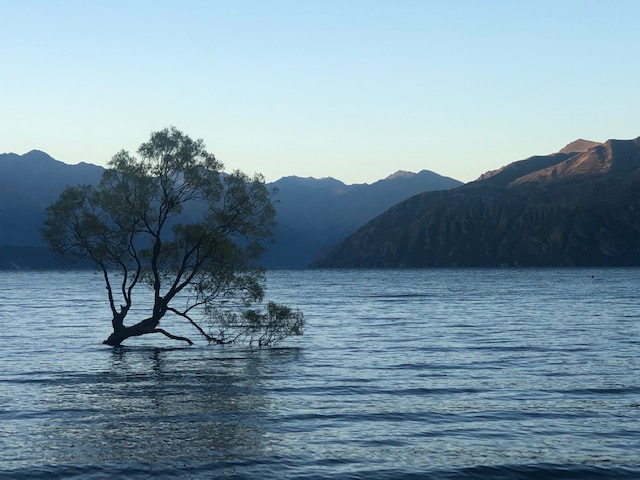 The connection is a tree that is reputed to be the most instagrammed tree in New Zealand, almost a symbol of NZ tourism. On a recent trip there, we were urged to set aside time to see the tree, specifically around sunset. So we worked around our program to ensure we got to the spot—a stretch of a beach—well ahead. We drove past a few times, keenly looking at the beach. We could see some people, but nothing special in the way of trees. We asked natives and tourists alike, and they all pointed us to the same area which our GPS had shown us, and which we had passed, looking in vain for a landmark. We decided to make our way down to the beach anyway. Lo and behold, there were many, many people there, jostling for some spot (we could not figure out what the spot was for), all setting up professional looking camera equipment. It came to a pass when we had to ask a friendly-looking lady what everyone was waiting to photograph, where the famous tree was, and what it was about. She kindly pointed to this spindly willow tree, standing a few feet into the waters of the beautiful Wanaka Lake, against a beautiful background of majestic mountains. But the tree itself? In my mind, this will forever define and exemplify ‘under-whelming’. ‘Why is the tree famous’, we asked many around us in bewilderment. While there was some story of how it was part of a fence and had survived in the water for several years, the general consensus was that it was famous because it was famous! So famous , it even has its own insta handle #ThatWanakaTree.
 Millennial Matriarchs