
They were probably our first glimpse of the wonders of the natural world. As children we eagerly awaited the arrival of the yellow cover magazines with their breathtaking pictures. My father, a lover of maps found a wealth of meticulous cartography in the maps that often accompanied the magazines. The glossy pages with fantastic photographs were the hallmark of the National Geographic Magazine. The magazine has maintained the same level of excellence for the last 136 years!
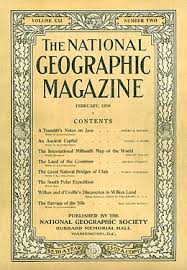
This month marks the important milestones that led to the launch of this enduring visual record of the world. This began with the founding of the National Geographic Society. The journey started in early January 1888 when a small group of gentlemen prominent in the scientific and intellectual circles of Washington DC received an invitation that read: Dear Sir: You are invited to be present at a meeting to be held in the Assembly Hall of the Cosmos Club, Friday evening, January 13, at 8 o’clock, for the purpose of considering the advisability of organizing a society for the increase and diffusion of geographic knowledge.
On the given date, 33 gentlemen who were sufficiently intrigued by the invitation to brave the fog and rain, gathered at the Cosmos Club. The guiding spirit leading the discussion was Boston lawyer Gardiner Greene Hubbard, supported by explorers John Wesley Powell and Adolphus Greely, as well as geographer Henry Gannett. The topic of discussion was the organization of a society for the increase and diffusion of geographic knowledge. One week later on 20 January the second meeting had twice the original number of participants, who agreed to incorporate themselves as a geographical society, and just one week later the Certificate of Incorporation of the National Geographic Society was formally signed on 27 January 1888. Interestingly, the average age of the founding group was around 40 years, and half of these were in their late 20s to 30s, several working for the US Geological Survey or the US Coast and Geodetic Survey. And, they were all male. Ironically, only one member was a journalist, and there is no photograph of any of the three occasions that led to the birth of the iconic magazine. National Geographic Magazine started publication in October 1888 as the official journal of the National Geographic Society.
The original issues were all text articles. The magazine began the transition from a text-oriented publication to including pictorial content with its January 1905 issue which had several full-page pictures of Tibet. By 1908 more than half the magazine’s pages were photographs.
One of the founding objectives of the non-profit Society was to fund science and exploration across the planet. The first scientific expedition supported by the Society was to survey and map the Mount St. Elias region in North America, which led to the discovery of Mount Logan, Canada’s highest peak. Initiated in 1890, and led by explorer Israel Russell, this marked the beginning of thousands of explorer-led National Geographic expeditions. Significant among the early expeditions supported by the National Geographic Society were Robert Peary’s which was the first to reach the North Pole in 1909, and expeditions (1912-1915) to excavate Machu Pichu the lost city of the Incas in the Peruvian Andes. Since the first expedition, the Society has provided more than 15,000 grants to explorers to work across the world.
The earliest natural-colour underwater pictures were taken by the National Geographic staff photographers in 1926. The magazine continued to bring to the readers hidden deep sea treasures with a series of articles by Jacques-Yves Cousteau in the mid-1950s, including the deepest undersea photos from 25,000 under the sea in 1956. From deep sea to outer space, the National Geographic Society flag was carried by John Glenn on the first US orbital space fight in June 1962; and it reached the moon with the Apollo 11 astronauts in July 1969. The exploration of forest ecosystems also got Society support, with funding to Jane Goodall and Dian Fossey’s intensive work with chimpanzees and mountain gorillas in the African jungles. Over the decades, the Society has continued to support explorations in varied ecosystems, and in all spheres from ocean depths to outer space. The discoveries of these incredible missions are shared through the National Geographic Magazine, opening windows and vistas to millions of armchair travellers across the globe. The excellence of standards of journalism and photography are backed with the passion and commitment of documenting the wonders of history, science, anthropology and nature, while also bringing to the fore serious environmental and human rights issues.
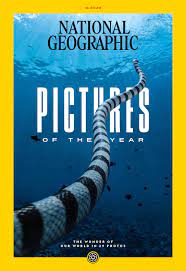
The National Geographic Magazine has continued to inspire generations for over a century, reaching out to 60 million readers worldwide each month, including 40 local-language editions. Keeping step with changing times and technology, in January 2001 National Geographic Channel was launched on cable and satellite television in the United States. The channel has expanded the scope of visual storytelling. Nat Geo continues to provide new digital experiences to find new ways of documenting the world and allowing readers to interact with content. In a rapidly changing world, the Society has stayed true to its original mission ‘to pursue and celebrate exploration, scientific excellence, education, and unforgettable storytelling’. National Geographic has remained a vibrant, relevant, world-class brand at the forefront of exploration and knowledge. However, the changing times are making their mark felt even here. Until 2015, the magazine was completely owned and managed by the National Geographic Society. Since 2019 the Walt Disney Company has taken over controlling interest. In June 2023, National geographic announced that it will focus on digital publication and subscribers. The magazine also laid off all of its staff writers, shifting to an entirely freelance-based writing model. Starting 2024, the hard copy will no longer be available on newsstands, while old subscribers will receive hard copies till their subscription runs.
Truly the end of an era. And a time to revisit the family collection of National Geographic Magazines (dating back to the mid-1950s) and enjoy the nostalgic savour of rediscovering the wonders of the world.
–Mamata
 Millennial Matriarchs