
Several generations of children grew up with The Tale of Peter Rabbit. The author Beatrix Potter is a familiar name in children’s literature, but what is less known is that she was also a notable woman of science, in an age when this was almost unheard of.
Helen Beatrix Potter was born on July 28, 1866 in London in a family that enjoyed culture and the arts. Although Beatrix was educated at home by a governess, she and her brother spent all their free time in the woods around their home, observing the small creatures that lived there, and even bringing some, like hedgehogs and rabbits home. Beatrix was a quiet shy girl who expressed herself through paintings and drawings of wildlife, and in coded notes in a secret diary.
When an uncle who was a chemist gave her permission to use his microscope, a whole new world opened up for Beatrix who could minutely study plants, and insects and make detailed sketches. Her interest in natural history was further spurred when she used to visit the South Kensington Museum. She found herself drawn to the study of plants and fungi as well as insects.
Beatrix’s interest in drawing and painting mushrooms, or fungi, began as a passion for painting beautiful specimens wherever she found them. As her biography says: She was drawn to fungi first by their ephemeral fairy qualities and then by the variety of their shape and colour and the challenge they posed to watercolour techniques.
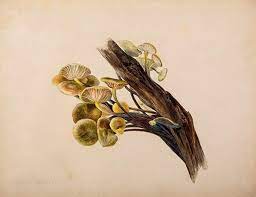
In October 1892, on a family holiday in Scotland, Beatrix got to know Charles McIntosh, a local postman and self-educated naturalist who was also an expert on British fungi. McIntosh admired her pictures, sent her specimens to paint and advised her on scientific classification and microscope techniques. She sent him copies of her pictures in return. She would go on to produce some 350 highly accurate pictures of fungi, mosses and spores.
Beatrix also started hunting for rare varieties of mushrooms, and growing dozens of different species of fungi at home, in order to study their development. She was intrigued by their life cycle. By 1895, Beatrix Potter’s interest in fungi was becoming even more scientific. Following advice from McIntosh, she began to include cross sections of mushrooms in her illustrations to show their gills and used a microscope to draw their tiny spores. She speculated about whether these spores could germinate and the environments in which they might do so.
In May 1896 her uncle Sir Henry Roscoe, a prominent chemist, introduced her to the mycologist at Kew’s Royal Botanic Gardens. This led to a post at the Royal Botanic Gardens where she produced faithful, detailed renderings, largely of mushrooms and toadstools as seen through a microscope. In addition to her art, the scientist in her also began experimenting with germinating spores of various fungi on glass plates and measuring their growth under a microscope. Her close observations and experiments, as well as her drawings showed in great detail how lichens, a common type of fungi found on rocks and trees, were actually not one but two different organisms that lived together. Her studies showed that this was a union between an alga and a fungus. The two different organisms are able to live together, with each of them benefitting the other in some way. Beatrix thus was one of the earliest to study and hypothesize what would later become the science of symbiosis. However, the botanists she showed her work refused to discuss even discuss the drawings she made.
Beatrix prepared a paper on her findings and submitted her work to The Linnaean Society of British Scientists but was not allowed to read it herself because, at that time, only men were invited to their meetings. The all-male panel rejected her paper and refused to publish it. Potter withdrew the paper, presumably to make amendments. But it was never published; and no copy exists today. Thereafter Beatrix turned her full attention to drawing and writing.
There is today some controversy about how serious Beatrix Potter was as a mycologist. But there is no doubt about the accuracy and detailing of her drawings and paintings of fungi which remain unparalleled, and are referred to mycologists even today. As her biography says: Beatrix Potter never saw art and science as mutually exclusive activities, but recorded what she saw in nature primarily to evoke an aesthetic response.
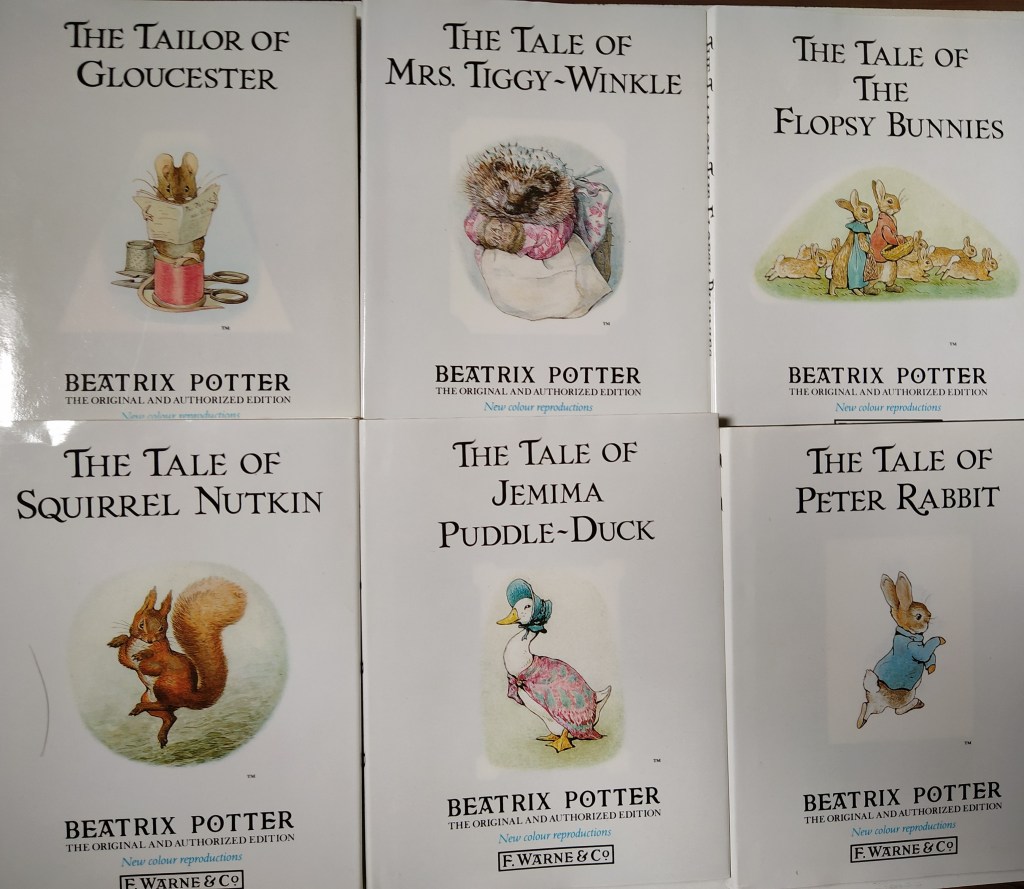
The name Beatrix Potter endures today as the author of well-loved children’s books. In 1893 she sent a letter with a picture story to a sick child of her old nanny which began with the words “I don’t know what to write to you, so I shall tell you a story about four little rabbits whose names were Flopsy, Mopsy, Cottontail and Peter.” Beatrix went on to create the loveable characters of Peter Rabbit, Benjamin Bunny and Jemima Puddle Duck, among others that had adventures in the 26 books that she published subsequently. Over 150 million copies of her books have been sold and have been translated into 35 different languages
As her books gained popularity, she channelled all the profits towards a large property called Hill Top which she purchased in 1905. Situated in England’s Lake District, this was her first farm. She enjoyed the quiet and solitude that the thirty-four-acre property brought her and this allowed her to work more efficiently. Aside from being a farmer and landowner, Beatrix also became recognized as a sheep breeder. She never lost her love for nature and became an advocate of traditional farming and the preservation of the wild environment surrounding the area. She continued buying patch after patch of land around her farm. By doing so, Beatrix hoped to further pursue her dream to provide land for the creatures that she had loved since her childhood.
Beatrix Potter died of bronchitis in 1943, aged 77, leaving behind a legacy across different fields of study. The British Natural Trust eventually became recipient to her donation of 4,000 acres of land. The property was named a UNESCO World Heritage Site in 2017, and is now open to the public. Beatrix Potter’s love for the land and all its creatures continues to provide a haven for all life.
–Mamata
 Millennial Matriarchs