
We usually think we know what we need to about the Moon. After all, we see it almost every night—peeking between clouds, trailing us on evening walks, or gleaming quietly over exam-season all-nighters. But ask most adults how to tell if the Moon is waxing or waning, or what phase it is in, and you’re likely to get a sheepish shrug.
Moon Day (July 20) is a good time to find out more—because the Moon is more than just a pretty face.
The Moon’s Phases
As we know, the Moon doesn’t shine on its own. What we see is sunlight reflecting off its surface. As the Moon orbits Earth once every 27.3 days, the portion we see illuminated changes depending on the relative positions of the Sun, Earth, and Moon.
But because Earth is also moving around the Sun, the complete lunar cycle (from New Moon back to New Moon) takes about 29.5 days. This is called a synodic month.
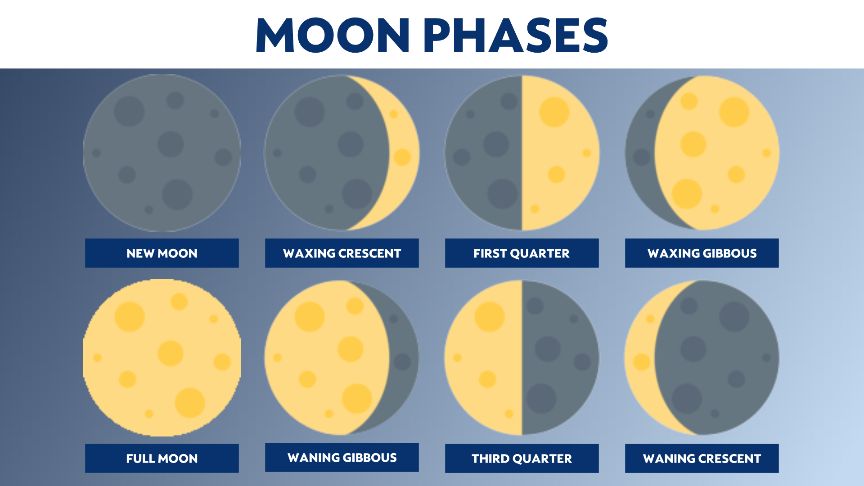
During this period, the Moon goes through eight distinct phases:
- New Moon – The Moon is between Earth and Sun; its illuminated side faces away from us.
- Waxing Crescent – A sliver appears on the right side (Northern Hemisphere). “Waxing” means it’s growing.
- First Quarter – Half of the Moon is visible—right half lit.
- Waxing Gibbous – More than half is lit, increasing toward full.
- Full Moon – The entire face is illuminated. Earth is between the Sun and Moon.
- Waning Gibbous – The light begins to shrink; left side remains lit.
- Last Quarter – Half again, but this time the left half.
- Waning Crescent – Only a small sliver remains on the left.
And then the cycle begins again.
What Does “Gibbous” Mean?
“Gibbous” comes from the Latin gibbosus, meaning hump-backed or bulging. It refers to the Moon when it’s more than half but not fully illuminated. A nearly full Moon—either on its way there (waxing) or just past (waning). So:
- Waxing Gibbous = swelling toward full.
- Waning Gibbous = shrinking after full.
Waxing or Waning?
If you are following the progress of the moon night after night, you will know if it is waxing of waning. But would you know if you just happened to glance up one night? Indeed there are ways to tell. In the Northern Hemisphere:
- If the right side is lit, the Moon is waxing.
- If the left side is lit, the Moon is waning.
This holds true whether you’re looking from a balcony in Bengaluru or walking through a park in Boston. But here’s where it gets interesting:
The Moon is Universal—but Not Identical
The same Moon is seen all over the world—but not always in the same orientation. If you’re in the Southern Hemisphere, everything flips:
- Waxing appears with left side lit.
- Waning shows up with right side lit.
In fact, a person in the Southern Hemisphere sees the Moon “upside down” compared to someone in the Northern Hemisphere. For example:
- When it’s a First Quarter Moon in India, the right half of the Moon is illuminated.
In Australia, it’s still the First Quarter—but they see the left half lit. - When it’s a Waxing Crescent in New Delhi, it appears on the right side.
In Cape Town, that same sliver appears on the left side.
It’s the same phase, same Moon—but reality shifts, depending on where you stand!
Once we learn to read the Moon, it becomes a kind of nightly compass. It connects us to the rhythm of the Earth, of time itself. And yes, it’s also fun to casually identify a “waning gibbous” and enjoy the raised eyebrows from unsuspecting friends.
So the next time someone asks, “Is it waxing or waning?”—you’ll know. And if you’re feeling generous, you might just pass on that little rhyme:
🌒 “Right is bright, it’s waxing with might.”
🌘 “Left is lit, it’s waning a bit.”
–Meena
Picture source: https://spectrumnews1.com/wi/milwaukee/

 Millennial Matriarchs