
Fever Tree

Clay tablets from Mesopotamia mention this deadly disease. Indian writings of the Vedic period (1500 to 800 BC) call it the ‘king of diseases.’ Traces of the disease have been found in remains of bodies from Egypt dating from 3200 and 1304 BC. The 270 BC Chinese medical canon has documented the disease’s headaches, chills, fevers and periodicity. The Greek poet Homer (circa 750 BC) mentions it in The Iliad, as do Aristotle (384-322 BC), Plato (428-347 BC), and Sophocles (496-406 BC) in their works.

The disease? None other than malaria, a disease that has taken its toll on not only humans down the ages, but our Neanderthal ancestors too. In the 20th century alone, malaria claimed between 150 million and 300 million lives, accounting for 2 to 5 per cent of all deaths!

Many have been the scientists who spent their lives trying to understand malaria. Charles Louis Alphonse Laveran (1845-1922) a French army doctor during the Franco-Prussian played a key role. He as the first to postulate that malaria was not spread by bad air, but rather that ‘Swamp fevers are due to a germ’. He was also the earliest scientist to detect crescent-shaped bodies in the blood of affected individuals, and then the four stages of the development of the parasite in the blood. These findings were confirmed by Camillo Golgi. Dr. Charles Ross and India played a huge part in the unravelling of the whole cycle and Ross received the Nobel Prize for discovering the mosquito-stages of malaria.

The story of uncovering the cure for malaria has been dramatic too. For centuries, when no one had a clue what caused malaria, treatments included blood-letting, inducing vomiting, and drastic things like limb amputations, and boring holes in the skull. Herbal medicines like belladonna were used to provide symptomatic relief. 
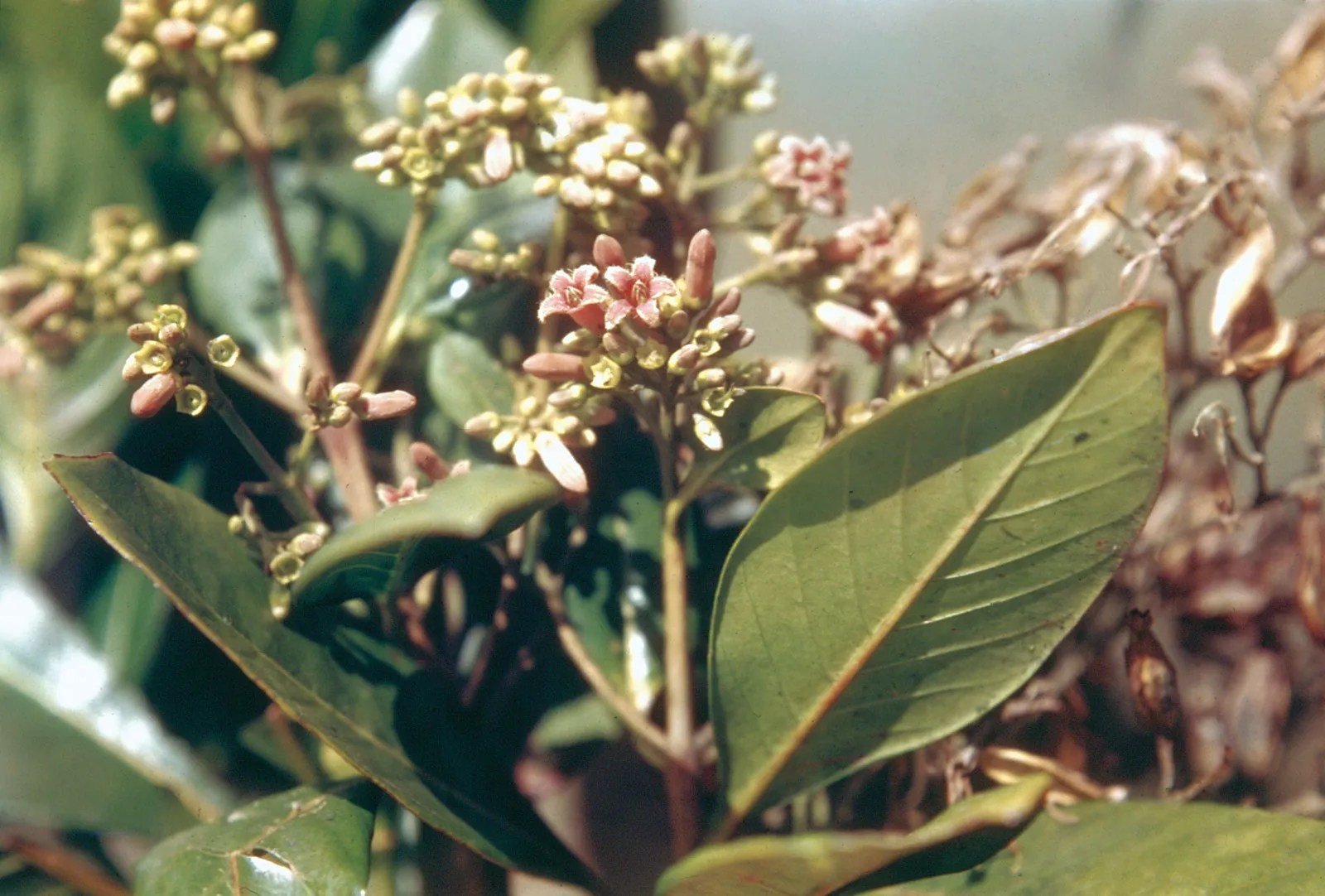
Cinchona-nitida-quinine
Cinchona Tree whose Bark yields Quinine

But the cure strangely came from South America—a region not originally plagued with the diease. It was probably brought from the outside around the 16th century. The native Indians were the first to discover the cure. The story goes that an Indian with a high fever was lost in the Andean jungles. Desperate with thirst as he wandered the jungles, he drank from a pool of stagnant water. The taste was bitter and he thought he had been poisoned. But miraculously, he found his fever going down. On observation, he found that the pool he had drunk from had been contaminated by the surrounding quina-quina trees. He put two and two together, and figured that the tree was the cure. He shared his serendipitous discovery with fellow villagers, who thereafter used extracts from the quina-quina bark to treat fever. The word spread widely among the locals.

It was from them that Spanish Jesuit missionaries in Peru learnt about the healing power of the bark between 1620 and 1630, when one of them was cured of malaria by the use of the bark. The story goes that the Jesuits used the bark to treat the Countess of Chinchon, the wife of the Viceroy who suffered an almost fatal attack. She was saved and made it her mission to popularize the bark as a treatment for malaria, taking vast quanitities back to Europe and distributing it to sufferers. And from then, the use of the powder spread far and wide. It is said that it was even used to treat King Louis XIV of France.

The tree from which the bark came was Cinchona, a genus of flowering plants in the family Rubiaceae which has at least 23 species of trees and shrubs. These are native to the tropical Andean forests. The genus was named so after the Countess of Chinchon, from the previous para. The bark of several species in the genus yield quinine and other alkaloids, and were the only known treatments against malaria for centuries, hence making them economically and politically important. It was only after 1944, when quinine started to be manufactured synthetically, that the pressure on the tree came down.

Not unusually, the tribe who actually discovered it is forgotten. The medicine came to be called “Jesuit Powder’ or ‘Chincona powder’ or “Peruvian powder’. Trees in the genus also came to be known as fever trees because they cured fever.

May the many indigenous community, their knowledge and their practices which are at the base of so many medicines today get their due recognition, credit and due.

–Meena  
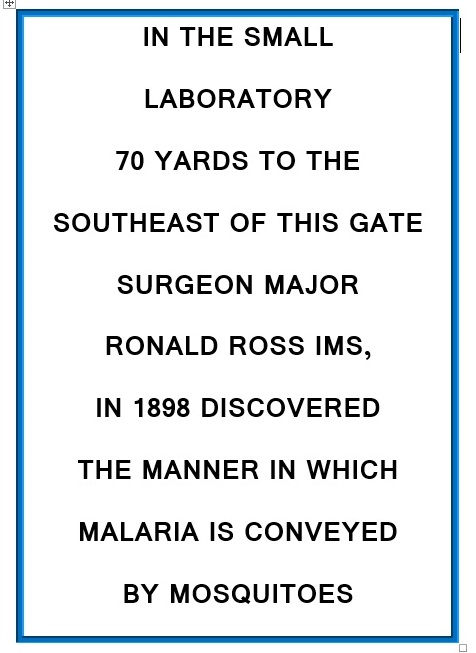
Ross: Malaria Detective

On the occasion Malaria Day (April 25), marked across the world to focus on efforts to rid humanity of this scourge, here is a short sketch of the life of Sir Ronald Ross, who made a life- mission of cracking the puzzle of the spread of malaria.

From: ‘Beyond the Call of Duty’. V. Raghunathan, Veena Prasad. Harper Collins.

Ronald Ross was born in 1857 – the year of Indian Mutiny — in Almora, to Campbell Ross an army officer. When ten, he was sent home to England for his schooling. Ronald was an average student, interested more in composing music and writing poems and plays than in academics. But his father would have none of it and forced Ronald into taking up medical studies, threatening to stop his money if he did not!

Young Ronald respected and trusted his father enough to give up his own ambitions and in 1875 ended up at St. Bartholomew’s Hospital, in Smithfield, London to study medicine. This was the oldest hospital in all Europe, established in 1123, and then re-founded by King Henry VII in 1546. The hospital occupies its original grounds even today.

Completing his medical studies, Ronald Ross landed up at Bombay on 23rd October, 1880 to join the Indian Medical Service in the army the following year.

Ronald, thanks to his mediocre performance in the LSA examination, was at first relegated to the Madras Services, considered the least attractive of the three presidencies – Bengal, Bombay and Madras. Then he was posted as acting Medical In-Charge to the 17th Madras Infantry for six months at Vizianagaram.  Later Ronald would reminisce about his life in Vizianagaram as being “better than the home life of a professional man in England”.

He soon was sent to the Presidency General Hospital in Calcutta where his early work on mosquitoes took shape. Visitors to Kolkata can still find the beautiful red brick Hospital within a stone’s throw of the Victoria Memorial. Today, it houses the Post Graduate Medical Education and Research Centre. The hospital, built in 1707, was probably the first hospital ever built in Kolkata, and was initially meant only for the British army. It was probably only after 1770 that the hospital was thrown open to the non-Europeans.

Malaria: The Mother of All Killers

In ancient times, it was assumed that malaria spread through bad air; hence the name mal-aria – Italian for bad air. Perhaps malaria and humanity evolved around the same time, somewhere in Africa (fossils of mosquitoes as old as 30 million years old have been found). It probably came to be recognized as a disease as early as 4000 B.C.

Malaria has killed millions over the centuries. Fortuitously, at the turn of the sixteenth century, Peruvian Indians found a cure f in the bitter bark of the Cinchona tree. By mid-seventeenth century the bark reached England, where quinine – the toxic alkaloid extracted from the bark – was used for the benefit of victims suffering from “agues”.

Quinine notwithstanding, as late as the turn of nineteenth century, the British Army in India which at the time had a strength of about 180,000 men, some 75,000 were found to be suffering from malaria.  In 1897 alone, an estimated 5 million Indians would succumb to malaria.  In 1935, about 1 million Indians died of malaria.

Ronald’s Medical Career in India Unfolds

Following his transfer to the Presidency Hospital, Ronald spent the next seven years in Calcutta, though from here was constantly being shunted to various other places including Calcutta, Bangalore, Burma and the Andaman Islands. His experience in Madras and Calcutta presidencies undoubtedly brought him close to the strange battlefields in which thousands of soldiers suffered at the hands of an enemy called malaria. Ronald an inquisitive and dogged mind which he would bring to bear on solving the mysteries of malaria.

Some kind of association of mosquitoes with certain diseases was not entirely unknown. For instance, only five years before, around 1878, one Patrick Manson had discovered that mosquitoes could be hosting the parasites responsible for filaria. Around 1880, another scientist, Charles Lavarean, had shown that the malaria parasite must in all probability lie outside the human body.

Since both mosquitoes and malaria are abundant where bad air prevailed, mosquito was beginning to emerge as a seriously shortlisted suspect in relation to malaria, and if, as Lavarean had shown, malaria probably had an external carrier, the mosquito was the the prime suspect– and the mosquito-malaria hypothesis was born.

In 1883 Ronald Ross built a small residence at Mahanad village on the Bandel-Burdwan line, and housed a little laboratory there. He would frequent this house every now and then journeying from Calcutta on mosquito-collecting forays to Mahanad and nearby villages, rich in mosquitoes, and peer into the innards of the pests for hours in his makeshift lab, trying to make the link with malaria in some way.

His work was interrupted when he was transferred to Bangalore as Acting Garrison Surgeon.  Here he was attached to the well-known St. John’s Hospital. For most, the transfer would have been excuse enough to let the study he had commenced in Calcutta to be disrupted. But not for Ronald Ross, who seems to have found a mission in life – to solve the puzzle that mal air, mosquito and malaria together seemed to present.

In Bangalore, Ronald, still only in his twenties, found his living quarters quite acceptable, though he could hardly relax here, what with the buzz of mosquitoes forever assaulting the eardrums. He noticed too that his own quarters seemed to be a more attractive destination of for these mosquitoes than the adjoining ones. The specific beacon to which the mosquitoes were drawn seemed to be an old drum with some stagnant water, near one of the windows. A closer inspection into the contents of the barrel revealed a mass of tiny grubs writhing in the water.

A very basic demonstration of cause-effect relationship between stagnant water and mosquitoes seems to have revealed itself to Ronald.

Ronald would take the lead from here and work on and on to study the malaria parasite – the grubs – all the way through their life cycle. Such was his diligence and sincerity of purpose that he spent his own money and earned leave to go collecting mosquitoes for his studies, because research into Malaria was not part of his official responsibility!

BORDER
Commemorative Plaque at Presidency General Hospital, Calcutta

His laborious exertions through 1880s and 90s, would ultimately prove the precise mosquito-malaria hypothesis, resulting in his winning the Nobel prize in 1911. Ross became Kolkata’s first Nobel Laureate (also the United Kingdom’s first, and the first laureate to be born outside of Europe).

With his growing fame and influence, it was only a matter of time before his admirers set up a prestigious Institution in his honour. Ross Institute and Hospital of Tropical Diseases and Hygiene was set up in London and Ronald Ross appointed its President for life. He also remained the President of the Society of Tropical Medicine.


In fact his fame had spread far and wide. There were few countries with scientific culture where Ronald had not been honoured for his many contributions.  His was an extraordinary story of the triumph of perspiration over inspiration.