
Do words have shapes? Or, in other words, are certain words or sounds associated with certain shapes?
Well till about a century ago, linguists did not think so. It was assumed that the connection between words and the objects they are attached to was arbitrary. For example, there is no link between the English word ‘dog’, or the French word ‘chien’, or the Hindi word ‘kutta’ and an actual dog. These are just names that people choose to give objects.
But in 1929 came an experiment by Wolfgang Kohler, followed by others building on this, which changed this thinking.
In the experiment, subjects were given these two words ‘bouba’ and ‘kiki’, and shown two shapes—one rounded and blob-like and the other spiky. Participants were asked to associate each of the given words to one of the shapes.
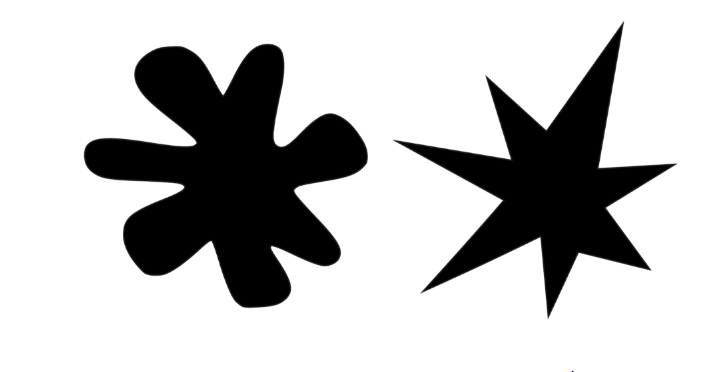
Over time, the experiment was carried out across regions and languages and ages—900 people across 25 countries.
And invariably, across countries and languages, the majority of people associated ‘bouba’ with the blob-like shape, and ‘kiki’ with the spiky shape. On average, more than 70% of the people tested confirmed the Bouba/Kiki effect– a non-arbitrary mental association between certain speech sounds and certain visual shapes
While this surprising phenomenon has now been accepted, there is no widely-accepted explanation of why it occurs, though several hypotheses have been put forward. One hypothesis is that the association is related to the shape of the mouth when producing the sounds—the more rounded shape of the lips when saying bouba, and the more taut shape when saying kiki. Another suggestion is that ‘the association is tied to the proportion of vowels and consonants and the phonemic qualities of the sounds in the words. It seems that people tend to base sound–symbol associations on the acoustic cues of the sounds.’ But exactly how they do so is yet to be explained.
Some researchers have extended these experiments to other senses. Professor Charles Spence explored the phenomenon in relation to taste. He asked his subjects to associate the words ‘ bouba’ and ‘kiki’ to the following tastes:
- Dark chocolate / milk chocolate
- Strong cheddar cheese / brie
- Sparkling water / still water
Prof. Spence found that kiki was associated with dark chocolate, strong cheddar cheese and sparkling water by most people— in other words, the stronger, more bitter or sour tastes (similar to the spiky shape). Bouba was associated with more rounded, sweeter tastes (similar to the rounded shape).
While researchers are still trying to figure out the science, several interesting practical implications have emerged. Since these associations of sound/shape, sound/taste etc. are real, what happens when there is a mismatch in the image conjured up by a sound, and the real object? Well, people don’t like such dissonance!
For instance, people associate round names (“Bob,” “Lou”) with round-faced (vs. angular-faced) individuals. And they like targets with “matching” names. One study has found that senatorial candidates in an election got 10% more votes when their names fit their faces very well, versus very poorly! (Will we be seeing a rush of name-changes before elections?!?).
And obviously, these insights are very important in naming products, developing brands, etc.
There are several such kiki-bouba association tests that you can find online. Go ahead and check if your conclusions range with the majority!
–Meena
 Millennial Matriarchs