WASTE NOT WANT NOT: WORLD THRIFT DAY

The First International Thrift Congress was held in Milan, Italy from 26 to 31 October 1924.  It was attended by over 300 delegates from 27 countries, who shared a vision: to promote savings as a key to financial security and independence. This was a period following the First World War which was marked by financial instability, and loss of confidence in banks. Banks were adopting a variety of measures and incentives to encourage people to deposit savings in banks in order to secure some stability for future uncertainties. In fact the word savings itself originates from the early 14th century, symbolizing ‘salvat’ a way to protect oneself from life’s uncertainties.  
On the last day of the conference one of the organizers Professor Filippo Ravizza proposed that there should be an annual International Savings Day or Thrift Day, as a reminder of the importance of saving, and to foster the habit of saving. It was unanimously agreed that this should be marked on 31 October. The informal symbol chosen to represent World Savings Day was the piggy bank.

Over a hundred years later, World Thrift Day continues to remind about the value of saving. Taken in a broader context, the word ‘thrift’ implies more than just accumulating coins in a piggy bank, or money accrued in savings accounts and deposits in banks. It refers to the prudent management of one’s resources. It is the opposite of extravagance and waste. It encompasses the philosophy and practice of moderation, conserving, and economizing.

Perhaps there is no better example of a life led by these principles than Mahatma Gandhi. For Gandhiji thrift was not just a habit of saving money; it was an ethical and philosophical principle which guided every aspect of his life. For him, the most direct application of this was in the frugal use of resources in one’s daily life. While his own lifestyle reflected this in every moment of his daily routine, he also expected that the people who lived in his ashram do the same.

There are several anecdotes recalled by his colleagues and ashram inmates that illustrate this.

Kishorelal Mashruwala started working with Gandhiji from the time that Gandhiji returned to India from South Africa, and continued to be closely associated with him for the rest of his life. He recounted some incidents.

‘One of my young nephews lived with me at Sabarmati. He once tore his clothing during play and then went straight to Bapu’s room. Bapu saw the torn condition of the cloth, and when he saw my wife later he showed his displeasure at it. He said: “One need not be ashamed of clothes repaired with sewing or patches. Poverty in itself is not a matter for shame. But there is no excuse for a person to put on unmended or dirty clothes. A cloth must be repaired as soon as it is torn, and washed if it has become dirty”.

It is well known that Gandhiji never threw away a used envelope or telegraph form that was blank on the reverse. He would collect these and convert them into scribbling pads, to be used on the day of his silence, or to write drafts of his articles and important letters, or, sometimes, to write notes to be left for others, or sent to them. Mashruwala recalled this: ‘I may also mention a habit which I developed under his influence. It is that of preserving and using bits of paper written on one side, wrappers on book-post packets etc., and used envelopes. Perhaps the instinct of thrift was inherent in me, and it got encouragement by his example.’ 

Kamlaben Patel came to stay in Sabarmati Ashram with her father when she was a young girl. Every inmate was expected to participate in all tasks from cleaning, washing, cooking, and spinning; and every resource was to be used with respect and frugality. She recalled one incident.

‘One day Bapu was passing by the store when the goods were being unloaded. He stopped and enquired how much soap had come. The soap that we all used was round and white but hard as stone, and the cheapest one that was available. The next day after the women’s prayer Bapu enquired about how much soap was used by each family. From their replies it was calculated that the cost of soap for each person was from 75 paise to one rupee. Bapu proposed that the use of soap be reduced. The women frankly told Bapu that any reduction in use was not possible as the soap was used to wash thick white khadi clothes, sheets, pillow covers, and mattress covers. Bapu said that “you all know that the Ashram runs on the donations of people. We claim to be servants of the people. Three hundred people live in the Ashram, and if each one used one rupee worth of soap, what will our donors feel about 300 rupees being spent on soap every month? Even in the days when there was no soap, our clothes were clean were they not? You must consider reduction in soap use.” After a lot of discussion the women agreed to use 50 paise worth of soap each month. Bapu proposed 37 paise. The women said they would respond after more thought. The prayer meeting dispersed. The women reconvened and after considering all options, unanimously decided to inform Bapu that it was not possible to do with less than 50 paise worth of soap per person, and remain firm on this decision. After the prayer Bapu jokingly said that the women’s ultimatum was like the Viceroy’s ultimatum. He would go to Bardoli to provide an answer to the latter, but he bowed to the women’s ultimatum, and accepted their 50 paise demand.’ 

These insistencies may seem as if Gandhiji was bothering over trifles, but for him such thrift was not simply a habit of saving money, but a practice of core principles connected to self-sufficiency, non-violence and social justice.

He believed that self-sufficiency through Swadeshi was not just an economic protest against foreign goods but a practical lesson in self-reliance and dignity of labour.  He emphasized the respect for resources (material and human) that went into creating any product. He believed that wasting or careless use of any product was to disrespect the person who made it.

These were some of the pillars of Gandhiji’s concept of ‘trusteeship’, a principle that suggested that rich individuals should not see their wealth as their own to squander but as a trust held for the benefit of society, especially the poor. He believed that wealth beyond one’s basic needs should be used for the public good. 

Gandhiji believed that genuine happiness lay in contentment, not in endless satisfaction of demands. He encouraged individuals to voluntarily reduce their wants, arguing that this would lead to a more satisfying life and a more peaceful society.

These ideas are best summed up in Gandhihji’s maxim that ‘The world has enough for everyone’s need, but not for everyone’s greed’. He believed that the world naturally produces enough to satisfy the needs of every person, but insatiable wants lead to exploitation and environmental ruin.

World Thrift Day is a thus not simply a reminder of saving for a rainy day, but a promotion of a way of life that values and respects all resources and their wise use.

–Mamata

Mary Poppins 2.0

Remember the loveable character of Mary Poppins who could fix messes in homes and families? Don’t we all sometimes wish that Mary Poppins would fly into our lives and set things straight? Someone who could discipline us to set ourselves in order? Believe it or not there is a real new-age Mary Poppins, and her name is Marie Kondo!clutter.jpg

Who is this new Marie and what does she do? Marie Kondo is a Japanese “tidying expert!” She helps people to clear up the clutter in their homes, and guides them towards creating spaces of order and serenity.

Marie was born in Japan in a culture which celebrates beauty in simplicity. Marie grew up with the ingenious origami art of folding, artistic ikebana, beautifully orchestrated tea ceremonies, and the art of creating minimalistic but serene surroundings, as well as an inborn gift for creating order out of chaos. She added to this, a canny entrepreneurial spirit when she started her “tidying consultant” business as a 19-year old university student in Tokyo. Realising the immense need and scope of “tidiness consulting” in an age when people lives were ‘cluttered’ in every which way, she went on to write a best-selling book “The Life-Changing Magic of Tidying Up.”

Where Mary Poppins created magic with the wave of her umbrella and a catchy tune on her lips, Marie Kondo starts her process of transformation in a more oriental style by making her clients calmly meditate on how their space is special to them, and to give thanks for this. She then proceeds to gently but firmly get them to review all their possessions, and let go whatever does not “spark joy” in them, after thanking these for their service! She then advises on how to rearrange and reorganise the remaining belongings by category, following the KonMari Method.

Today Marie is a global expert with her own Netflix’s hit show “Tidying Up With Marie Kondo, and founder of KonMari Media Inc.

I admire this young woman who has found herself a natty niche, and is smart enough to make a successful enterprise out of it. But I cannot but help thinking of the generations of homemakers who have kept beautifully organised and managed homes with limited resources, but much hard work, care and creativity. For them it was a way of life, into which they were oriented by mothers and mothers-in-law. Today when we have much more of everything, except time and patience, voila, Marie Kondo is at your service!

–Mamata

Effortlessly Antique

40CAEEBD-E296-4C56-B3BA-4B460523A19E

Raghu has a weakness for antiques and the house is a bit overboard on old bric-a-brac, carpets, furniture, etc., which he has been collecting for 30 years now.  He used to scour antique shops, flea markets, craft shops, furniture shops and what not, spending enormous amounts of time. And much more money than we could afford.

But a few days ago, I looked around and wondered why he even made the effort! Just by sheer living and reaching the age of 60ish, even our most mundane belongings are antique!

My wedding saris are over 35 years old.

My own jewellery is 40 years old. But my mother and grandmother both gave me pieces of their jewellery over time. So some of it is close to 65 years old. And a few pieces close to 85 years old.

Raghu has his first watch, which was a hand-me-down from his father–easily 70 years old. Also, his father’s fountain pen, probably of the same vintage.

My silver kodam (water pot), was given to my grandmother from her mother’s time and is probably a century old, give or take.

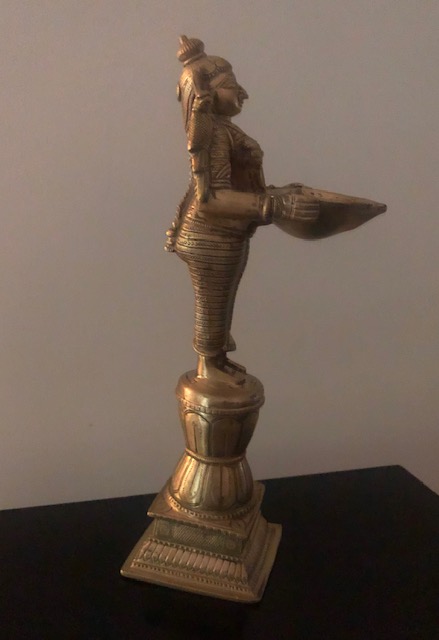
The idols in the puja cabinet may again be a 100 years old, since some of them belonged to great-grandparents.

We did go out of our way to buy some old pieces of furniture, but some of the most mundane pieces like the kitchen cabinet, by growing old with us, are close to four decades old.

My ever-silver (stainless steel for the non-South Indians) vessels come down from my mother-in-law’s treasured hoard, and may well be over 60 years old.

I have dessert bowls that my parents bought when they were in the UK in 1962.

I have a doll that was bought during the same visit.

Our photographs rest in albums dating back to the ‘50s.

So whether or not you know it, whether you want to be or not, you are an antique collector. And your house is a museum. Because life happens…

–Meena

Toxic

The word of the year is Toxic! Crowned by the Oxford Dictionary this word was selected as the one “judged to reflect the ethos, mood, or preoccupations of the passing year, and have lasting potential as a term of cultural significance.”

The claim to fame was gained by the word not only on the basis of the number of times it was searched, but more for the sheer variety of contexts in which it is being used today.  “Toxic” has been used to describe workplaces, schools, relationships, cultures, and most recently has become a keyword in the #MeToo movement.

My own association with the word dates back over 30 years when I started as an Environmental Educator. We used the word mainly in the context of something that poisoned the natural environment—air, water, flora and fauna. This was based on its dictionary definition as meaning ‘poisonous’, with its roots derived from the medieval Latin term toxicus, meaning poisoned or imbued with poison. Environmental Educators worldwide tried to create awareness about what makes things toxic and how this affects the environment—through ‘gloom and doom’ scenarios, through motivation and action, and even through humour!

An interesting example of the last one was a limerick competition run by the English newspaper The Observer in association with the Friends of the Earth inviting limericks that reflected the (then) toxic state of the environment. The competition was open to all, from ages 5 years and up!

Although this was almost 30 years ago, on revisiting these limericks, I felt that they are as relevant today (if not more, than ever before!) Here is a taste…

Said the seal to the salmon and otters,

Did God really design us as blotters,

To mop up the oil

From the sea and the soil

Spewed out by those corporate rotters?


When politicians say they are green

One wonders what they really mean,

For all their hot air

Only rises to share

In the Greenhouse Effect it would seem!


An ostrich from a tropical land

Once buried his head in the sand.

The move was a riot,

They all had to try it—

Evading the issue was grand!

Fast forward to 2018. Has anything changed? At least not for the better, alas! The word has simply exploded in scope and toxicity. As Oxford University Press’s president of dictionaries, said: “Reviewing this year in language, we repeatedly encountered the word ‘toxic’ being used to describe an increasing set of conditions that we’re all facing. Qualifying everything from the entrenched patriarchy to the constant blare of polarising political rhetoric, ‘toxic’ seems to reflect a growing sense of how extreme, and at times radioactive, we feel aspects of modern life have become.”

To sum up, cannot resist this one…

A girl with a problem was faced

Rushed off to her doctor in haste.

He said with a laugh

As she broke into half,

‘My dear, you’ve got toxic waist!’

–Mamata


Waste not…..

RecycleEarth_mediumNot many years ago, people returning from the US or England would relate shocking stories of how people there threw away everything—from TVs to beautiful containers to cars to old clothes. And we used to pride ourselves that in India, we re-cycled and re-used everything. Horlicks bottles were used to store pickles or dals. Bournvita tins became containers for masala powders. Bed sheets became pillow covers, which became shopping bags.

But now, ‘we’ are ‘them’!

Have you looked into your garbage bin recently? Have you noted how quickly it fills up? With changing lifestyles, we are buying more and more, and throwing away more and more. Today, In metro cities in India, an individual produces an average of 0.8 kg/ waste/ person daily.

India produces about 65 m tonnes of urban waste annually, out of which 5.6m tonnes consist of plastic waste, 0.17m constitute of biomedical waste, 7.90m tonnes constitute hazardous waste while 15 lakh ton is e-waste.

You may not want to do the exercise of researching the contents of your dustbin, so here are some facts. On the average, garbage is made up of 35% organic material, 30% paper, 12% construction related wastes, 9% plastics, 6% glass, 3% metal, and then miscellaneous.

The problem with garbage is that though you may throw it ‘away’, there is really no ‘away’! It is out of your house, but on the street. It is off the street but in a dumper. It is out of the dumper, but in a landfill. And at each stage, there are problems.

Just to understand what the problem is, just looks at the facts and figures below.

  • Banana peel – 3 to 4 weeks
  • Paper bag — 1 month
  • Cotton rag — 5 months
  • Wool sock — 1 year
  • Cigarette butt — 2 to 5 years
  • Leather shoe — 40 to 50 years
  • Rubber sole (of the shoe) — 50 to 80 years
  • Aluminum can (soft drink can) — 200 to 500 years
  • Plastic jug — 1 million years
  • Styrofoam cup – unknown–forever?
  • glass bottle – unknown–forever?

So what can we do as individuals? The mantra is ‘Reduce, re-use, recycle’.

REDUCE

Don’t create waste in the first place! Buy only what you need. Use all that you buy. Avoid heavily packaged products. Avoid disposable items like paper plates and plastic spoons. Buy the largest size package for those items that you use often.

REUSE

Reuse items – use them over and over until they are completely worn out. Borrow or share items you don’t use very often. Donate unwanted items. Repair items, instead of throwing away and buying new. Refill bottles. Plastic bags can be used for many times over. Use your imagination, not the trash can!

RECYCLE

Recycle means taking something old and making it into something new. Old newspapers, plastic bottles, glass bottles and jars, aluminum and steel cans can all be recycled. Sell these to the ‘kabadi wallah’.  Not only does it keep items out of the landfill, recycling conserves natural resources. For example, making newspaper out of old newspaper saves a valuable natural resource – trees.

And compost, compost, compost!

Think about it and see if you want to make these your New Year Resolutions!

–Meena

In Fashion

“Fashion sometimes ignores convenience, sometimes even causes inconvenience. All fashions may not have great thinking behind them, and sometimes thinking people fall prey to fashion.

Children of fashion-conscious parents have also to swim with the tides of the times. Children are often made to exhibit what parents find fashionable or what is ‘in style’ at the moment.

Take an example of girls’ dresses. Most of these have buttons at the back. No one knows who thought of this style, but children wear it, parents demand it and tailors stitch accordingly. So far, so good.

But what happens when a child wears a dress with buttons at the back. “Mother do my buttons.””Papa please fasten my hooks.” The parents are hassled with other tasks. The mother calls for the older sister. “Help her with her buttons”, or she calls for the servant,”Why don’t you close the buttons for her?”

The child with her own two hands is helpless. She is dependent on someone else to complete dressing. She cannot go out unless someone is there to button her up. She has to request, or plead, or shout for this. She is dependent all for the sake of being dressed in the fashion, a dress with buttons at the back!

That is just for dressing. What about undressing?

If the dress gets wet the child cannot take it off. If she is feeling hot, she can’t take it off. And, heaven forbid, if her dress catches fire, she can’t take it off.

But still the child wears such dresses. She likes them because her parents do. They like them because they want their child to be ‘well dressed.’

But fashion is really a series of fads. Started somewhere by someone who wants to be different, it sometimes catches on, and then everyone wants to follow blindly.

Sometimes the glamour of being different, or being in style blinds people to the basic tenets of simplicity, comfort, and practicality in the way they dress.

We might, as adults, indulge in this. But when it comes to our children we must first think of their comfort and convenience with respect to what they wear. Even infants often show distinct preferences for what they like, or do not like, to wear.

At our Balmandir we have a ‘front button’ attendance. Children whose clothes have buttons at the back take home a note requesting parents to get them clothes with buttons in the front. And parents do make an attempt to do so.

Sometimes they have not even thought about the difference it would make: that changing the orientation of a few buttons is indeed rendering a great service to their child.”

This is not taken from, nor meant for, a magazine on New-age Parenting. These words were written in the early 1930s–nearly 90 years ago, by my grandfather. The author Gijubhai Badheka is well known not only as the creator of some of the best loved and popular children’s literature in Gujarat, but equally for his writings for parents and teachers. He was also one of the pioneers of the Montessori system of education in India. Gijubhai observed children and adults and recorded his thoughts; he described dilemmas faced by both, and explored how these could be handled. Many of these were complied in a series of books in Gujarati called It Is Not Easy Being Parents.

This is one of the many pieces translated from the original Gujarati by me.

–Mamata

Needs, Wants and Luxuries

So the ultimate in luxury seems to be “Make Google Do It”! As the ads remind us your little Google Assistant will do it all for you—Play music, Cast videos, Control your lights, Get step-by-step cooking recipes, Stay updated with news and sports, and anything else that you shall wish for—Just Ask and your wish is its command. This is the new age Aladdin’s Lamp, no less!

Not so long ago, we still remember walking back and forth from the Black and White television set to change the channel (from the limited selection available). Then came the Remote! And its fallout—a generation of couch potatoes! And more recently, the Fitbit and Gym generation that needs to burn the calories collected courtesy the hard-working Bot!

It is the age of too much, an age of choices galore. For those who can afford it, the choice is no longer ‘Keeping up with the Joneses’, but staying ahead of ‘Those who have Everything.’

But what are the choices being offered, and what are we choosing?

I am reminded of a simulation exercise that we often did as environmental educators. We would ask participants to imagine that they have to leave their home due to a sudden disaster in the area. Before they leave they have time to take just 20 things that they can carry with them. They are not allowed to take money. They do not know where they are going, when they will reach, and if and when they will be able to return. They must make a list of these 20 things. Once they had done this, they were told that the truck that was carrying them is overloaded, and they have to drop 5 of the 20 things they were carrying. What would they choose to leave? Once they have done this, they were further told that the truck has broken down and they will have to walk. Which 5 of the 15 items will they discard? Now the list has 10 items. As they go ahead they are stopped by a gang of dacoits who demand five items from the ones they are carrying. Which ones will they give, and which ones will they keep? Now they are left with 5 items.

At the end we would review each one’s list, and think about the choices each one made, and the reasons for these. We would, perhaps for the first time, review our own belongings from the perspective of Needs–those that were essential for survival; Wants–those that were desirable but not indispensable, and those that were things we owned because we could afford to—Luxuries.

This is not simply an abstract exercise;  in news reports every day we see heart-rending  scenes of millions of refugees—ousted from their countries and homes by natural calamities, political upheavals, social and cultural persecution. People with nothing to their name. People for whom simple survival is a luxury.

For those of us fortunate enough to have choices, and the luxury of more than we need, it may be worth sparing some thought to our personal List of 20-5-5-5. How much do we really need?

“He who knows he has enough is rich.” (From the Tao Te Ching an ancient Chinese philosophical poetry.)

–Mamata