Audio Books

A recent article titled Human Library immediately grabbed my attention. Being always drawn to anything related to books and libraries I was curious to know what this was. Turns out that this was literally a library where people instead of books are issued out! I was intrigued—What, How and Why?

At a Human Library event, the “books” are people with special experiences; “readers” can choose from various “titles” and then “borrow” them. The procedure is similar to that of a regular library.  At the main desk there is a list of “books” available and each “reader” is given a Human Library card by one of the librarians. They then choose a “book”, sometimes with the help of an official matchmaker or library assistant. The reader and the book then move to a space where there are numerous tables and chairs; this is where a safe and respectful conversation begins, and lasts for up to half an hour. The “reader” reads the “book” by asking the “book” questions about their personal situation. The “book”, as well as answering pertinent questions, has the option not to answer and also to ask their own questions.

The most interesting aspect of this library is the choice of “books”. In keeping with its fundamental premise which is ‘to build a positive framework for conversations that can challenge stereotypes and prejudices through dialogue’, the Human Library encourages people to challenge their own preconceived notions—to truly get to know, and learn from, someone they might otherwise make a snap judgement about. As the website says “Don’t judge a book by its cover.”

Most of the stories that the “books” tell have to do with some kind of stereotype or stigmatized topic. For example in the Human Library UK  “The titles celebrate diversity and promote equality by deliberately acknowledging differences, lifestyles, ethnicities, faiths, disabilities, abilities and characteristics that may be stigmatised in the hope it might provoke an assumption or even prejudice in readers.”

While new to me, it turns out that the concept of human libraries is not that new. The Human Library is an international organization and movement that first started in Copenhagen, Denmark in 2000. It was “a place where difficult questions are expected, appreciated and answered.” Its objective was to address people’s prejudices by helping them to talk to those they would not normally meet, and to initiate conversations between people of different orientations, backgrounds and religions, by urging participants to listen to each other’s life experiences.

It began with an event which was open eight hours a day for four days straight and featured over fifty different “titles”. More than a thousand readers took advantage leaving books, librarians, organisers and readers stunned at the impact of the Human Library.

Today the movement has become an international phenomenon with “libraries” in more than 70 countries. In India there are Human Libraries in several cities including Hyderabad, Bengaluru, Delhi, Mumbai, Kolkata, Chennai, and spreading.

What an amazing and inspiring movement! For me the term ‘audio books’ has acquired a unique human dimension.

–Mamata


In a Word

When we were in school we were told that the Eskimos have a hundred or more words for Snow and forest-dwelling indigenous people have a multitude of words for Green. In recent years this information has been debunked by many linguists. While the numbers are not that important, to my mind this example is still meaningful as it draws attention to the fact that every culture and language has its own vocabulary to describe the nuances of a phenomenon or event or feeling.

In the past few years I have come across some really evocative words which I love to share.

Tsundoku A Japanese word which refers to the habit of accumulating books with the intention of reading them by and by, as opposed to obsessively collecting books just for the sake of having them. This word apparently has been used for over a century, and a person with a large collection of unread books was called a tsundoku sensei. This is something I have always done, and I was so happy to find a respectable name for the same!

Komorebi Another Japanese word for the delicate interplay of light and leaves when sunlight filters through the foliage of trees. How often we have been touched by this delicate and fleeting moment. Artists and photographers have tried to capture this, but this single word perfectly paints the picture.

Shinrin-yoku If you want to prolong the moment and immerse yourself in the experience—the Japanese have a word for that too. This word means ‘forest bathing’, a practice that includes mindfully experiencing the beauty of the komorebi while breathing the cool fresh air and hearing the leaves rustle in the gentle breeze.

Waldeinsamkeit If you were German and enjoying Shirin-yoku, a feeling of solitude, and a connectedness to nature, this is the perfect word to describe how you feel!

Mångata If you lingered long enough for the sunlight to be replaced by moonlight, this is what you would also see. A Swedish word for the glimmering, road-like reflection that the moon creates on water. Another luminescent word that paints a perfect picture.

Hygge Back home after a rejuvenating walk in the woods, what could be better that to curl up with a book from your tsundoku and get lost in the wonderful world of words! The Swedish have the perfect word for just such cosy comfort and contentment!

If only, we may say, our life could be a series of shinrin-yoku and hygge! The Japanese say that there is no reason why it cannot be. After all, is it not a lot about how you approach life? It is all about having a sense of purpose and meaning and a feeling of wellbeing–essentially ‘a reason to get up in the morning’, and to see the sunlight rather the clouds. They call it Ikigai.

IMG_20180902_085434387.jpg

According to the Japanese, everyone has an ikigai. We just have to find our own.

–Mamata

The Sounds of Silence

When we were children and started becoming overly excited or noisy, our aunt would say “OK time for Shantini Ramat!”(the game of silence). All we had to do was to close our eyes and stay still and silent. This was not in the form of a “fingers on lips” punishment, but rather always had the most calming effect. Even as young children it made us aware of the many sounds that even silence was made up of, and sensitized us to the power of Quiet.

Many years later, as environmental educators, one of the exercises we often did in our workshops, with teachers or children, was to ask everyone to close their eyes and sit silently for just 5 minutes. After that we would ask them what sounds they heard / how they felt. It was interesting to note that they found this hard to describe or pinpoint. They were so unused to distinguishing individual sounds—even if they were obvious and strident like the honking of horns, the rumble traffic, the hum of the fan; or less obvious like the chirping of birds or squirrels.

We all live in a continual clutter of noise. Most often our ears are so tuned out of the subtle sounds around us, we can hear only the loudest, glaringly harshest and strident noises. We no longer know what silence sounds like. In fact we are almost afraid of the Quiet. Yet there is much to hear in silence. Even amidst the clamour of urban life, there are sounds that we can hear if we really listen—the early morning call of the lone bird, the rustling of leaves in the breeze, the buzz of the bee, the plop plop of the first raindrops and the steady gush of a downpour.

There is magic in silence, in being quiet. There is great power, beauty and creativity in silence.

This is beautifully captured in The Book of Quiet, a wonderfully sensitive children’s book by Deborah Underwood. Each page, lovingly illustrated by Renata Liwska, is dedicated to a different Quiet moment, beginning with “first one awake Quiet” and ending with “sound asleep Quiet.”

Some excerpts

ALL KINDS OF QUIETITUDES

Best friends don’t need to talk Quiet (Comfortable)

Trying not to hiccup Quiet (Embarrassed)

Last one to get picked from school Quiet (Nervous)

Sleeping sister Quiet (Tender)

First look at new hairstyle Quiet (Shocked)

“Silence is itself the stuff of substance; the moments it fills are not the in-betweenery of life but life itself — rich and nuanced and irrepressibly, if quietly, alive.” (Maria Popova)

–Mamata


A Magical Walk

I remember it well—a mere 400 metre walk on our office campus in Ahmedabad. That day we were walking along the path that all of us took regularly; walking along with us was Professor HY Mohan Ram, a member of our Governing Council, who was there for the Council meeting. As we walked, Professor Mohan Ram talked—gently, softly, but with passion and excitement, pointing out plants that we saw every day, but, as we realised, we never really ‘looked at’.

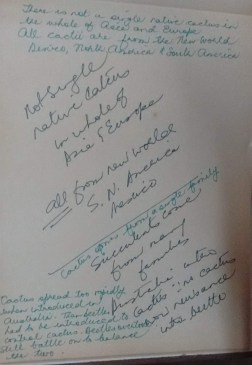
“Look at this one”, he pointed at a plant, “this is Aduso. Its botanical name is Adhatoda vasika which means ‘that which the goat will not touch’. This is what is used for making medicines for cough and cold.” Going just two steps ahead, “You know the cactus, but did you know that there is not a single native cactus in the whole of Asia and Europe? All cactii are from the New World—Mexico, North America and South America.” ”Look at this magnificent neem tree.  Its botanical name Azadirachta indica comes from the Arabic for azad meaning ‘free’ and drakhta meaning ‘tree’. This is thought to be a tree indigenous to India, but there is some doubt if it is originally Indian. It may have originated on the Burma border and come to Bangladesh from there.” “Did you know that Lutyens, when planning the landscaping of Delhi’s roads, planted only native species. Each avenue was planted with one species of fruit tree.” Three steps ahead, we come to the white flower commonly called Chandni. Professor tells us, “Have you noted carefully the arrangement of petals of flowers? Most flower petals are usually in multiples of 3 or 5 (except in the case of the mustard flower).” “Many high school students know this as the shoe flower that they got for dissection in the exams. But why the name shoe flower? Because it is used to polish shoes! Its other name is hibiscus, and is believed to have originated in China.”

IMG_20170822_090553807.jpg

Professor HYM had a fascinating story for every step that we took, drawing attention to the tiniest of flowers that we carelessly trampled underfoot, to the towering culms of bamboo. The path that took us 5-7 minutes to traverse became a magical mystery tour that took close to two hours. Through his eyes the blur of vegetation turned into a veritable treasure trove, with each plant glowing with its own special attributes.

Not long after this visit, Meena and I invited Professor HYM to contribute to a collection of tales of ‘Nature Heroes’ that we were putting together. He graciously agreed, and shared with us some of his journey, experiences and inspirations in a piece titled Reflections of a Botanist.  He writes “I have not pursued any single course. I have done what interests me and not what is in style. I have a deep interest in Indian classical music and photography.”

He concludes the piece with this, “What enlightenment have I received as a student of plant biology? I wish I could be like a tree: deep-rooted and firmly fixed, bearing a lofty bole and a broad canopy, continuously absorbing, synthesizing and renewing, unmindful of stresses and insults, resilient to changes and perpetually giving.”

In the passing away of Professor HY Mohan Ram the world has lost not only a botanist par excellence, but a much loved and respected teacher, researcher, and writer. For us, the Matriarchs, Professor Mohan Ram will always be remembered as a gentle, unassuming guide with a twinkle in his eyes, and a life-long inspiration whose visits to the Centre were like the Open Sesame to a fascinating world of flora.

A page from my notes on the Walk!  (Date 22 August 1998)

IMG_20180620_115125823.jpg


–Mamata

Average is Normal

It is that time of the year again. It is the season of Superlatives. Exam results with Beyond Belief percentages, pictures of the Highest Scorers in the papers, magazines listing the Best Colleges, coaching classes advertising Record-breaking Achievers. So many wonder-kids? Are there no ‘average’ children anymore?

Even several years ago, I remember meeting my children’s classmates’ mothers when we were summoned to meet the teachers after the exam results were given. I heard exchanges about the achievements of the respective prodigy—prizes for painting, dancing, skating, swimming and more. Class toppers, school leaders all. I wondered, if every child is so brilliant, are there any simply ordinary children in the class?

I began to have doubts about my own parenting responsibilities and skills. Well, I did try to get the children to go for swimming coaching, largely because their cousins were going too (50% success—my daughter picked it up, and my son did not), dance lessons (my daughter did last a couple of years, but never made it till an arangetram!), and karate (my daughter made it till the first camp, my son till the white-one belt!).  Neither they, nor I, seemed to have the endurance run the gauntlet and emerge a Winner every time!

As parents who followed a relatively laissez-faire style of parenting, our considerations were mainly that the children were given the space to simply be, and blossom as they will. But as they grew, it became increasingly difficult to cope with the expectations of a competitive system. Still we thought that we were managing ok within the larger environment. We got a jolt one fine morning, when our son was denied readmission into Class 11 in the same school he had studied in for 10 years, because he missed the “cut off” by a couple of marks. Imagine the devastation for a fifteen year old. The experience that followed is a story in itself. One of the outcomes was that we decided that we did not wish our daughter (who was even less equipped to cope with a mindlessly competitive system) to go through this. Despite being told that “this is the system, your children and you will need to learn to swim with the tide, or sink”, we actively explored alternatives….and found them.

The children made it through! Today they are in the ‘system’ as it were, without being sucked into its vortex. They may not meet the generally accepted norms of Mainstream Success. (“Settled” so to speak, with six-figure earnings, car and apartment, designation, the skills to compete ruthlessly …and burn out at 35). They are following somewhat unconventional paths; they continue to explore, and discover new passions, new horizons, and new accomplishments. They are rich in experience, life skills, and relationships. They have the confidence to be themselves, and “not just another brick in the wall”.

Perhaps the greatest freedom we can offer our children is to allow them to think differently, and more importantly, to act differently.  Gunter Pauli

peanuts flaws

From Peanuts by Charles Schulz

Swimming 101

Yes, I am a 101. What is more, I have been at 101 for well over 101 months! And after making close to 101 attempts!
I did try to learn swimming back in the day. If anyone recalls, those of us who did the 11 year ISC (Indian School Certificate), used to have a 7 month break between school and college. Our exams would get over by December, and we could join college only the next July. What a glorious break! While we did our best to do nothing (except read Mills and Boon from the nearby lending libraries), parents were hell bent on sending us here and there, to learn this and that. Not as wide and exotic (and expensive) a menu as today. The staples back in our time were typewriting (yes!!), swimming, a foreign language (usually French), classical music and dance (the last two especially for the Tams). Supplemented by usually-unsuccessful efforts to get us to learn basics of cooking.

Accordingly, I too was shunted to most of the above, including swimming. I showed no talent for physical activities and swimming was no exception. I caught myself a pretty bad infection in a week, and that was the end of that first foray.
I kind of gave up (or did not see a swimming pool) for close on 25 years. But about 15 years ago, when we moved into an apartment block with a pool, the desire to glide like a fish took over. Accordingly, we hunted up a coach and early morning classes started. But the water was cold and Day 4, when I turned my neck in a panic to breathe, it caught. The classes stopped the next day, but the pain persisted for a month!
Next summer, I decided to go to the school down the road which opened up its pool during the vacations for swim lessons. Being in the pool with 15 below-15s did nothing for my ego or my skill. That too ended without much progress.
The year after, using a host of contacts, was able to organize for lessons at the pool of a big club. Slipped and fell on the side. Bruised all limbs and was stiff for a week. End of lessons.
Then we moved to another city and another colony which had a club with a nice pool. Year 1, I did try sincerely and flapped in the water for a month in summer—it was a case of two strokes forward, one stroke back (pun unintended). But next year, there was a dispute between the club management and the residents, and the club closed for the rest of the time we live there.
Then, three years ago, we moved into our permanent home. For the first two years, I just walked around the pool in the society. It was too cold; or there were too many kids; or it was raining; or I was sure I was getting a cold.
Then a week ago, I met a friend on my evening walk. We got to talking of swimming.

‘I can kind of do the back stroke’.
‘Me too’.
‘I can do a few yards of freestyle, but after that, I can’t breathe.’
‘Me neither.’
‘I have tried attending classes many times but the coaches say they can’t teach me anything more. That I know the basics and it’s up to me to practice.’
‘Same here.’

‘Really wish I could swim’.
‘Me too.’
So both of us decided—literally—to take the plunge yesterday.
Dug out our suits (thank god I still fit). And our caps. And towels. And bags.
Landed up at the pool. Showered and were in.
Flapped around a bit. Did a breadth or two of backstroke. Swallowed a lot of water. Felt the chlorine sting our eyes. But did not go too far anywhere.
Got back home. Decided to turn to youtube for a few lessons. Realized I had forgotten to breathe out in the water when I was trying the freestyle.
Now fully charged up. Easy peasy—it looks in the video.
And I have been practicing all day (on land, I have to confess)—blow, blow, blow, breathe in; blow, blow, blow, breathe in.

Today, I shall do it! I shall graduate this time. I shall overcome. I shall glide like a fish.
Do not under-estimate a matriarch.
PS: If I don’t, I won’t be telling you about it!

—Meena