
Hampi. On the list of history-buffs. On the list of backpackers. On the list of pilgrims. On the list of UNESCO World Heritage Sites. It is indeed a ‘listed site’!
This is what UNESCO has to say about it:
‘The austere and grandiose site of Hampi comprise mainly the remnants of the Capital City of Vijayanagara Empire (14th-16th Cent CE), the last great Hindu Kingdom. The property encompasses an area of 4187.24 hectares, located in the Tungabhadra basin in Central Karnataka, Bellary District.
Hampi’s spectacular setting is dominated by river Tungabhadra, craggy hill ranges and open plains, with widespread physical remains. The sophistication of the varied urban, royal and sacred systems is evident from the more than 1600 surviving remains that include forts, riverside features, royal and sacred complexes, temples, shrines, pillared halls, Mandapas, memorial structures, gateways, defence check posts, stables, water structures, etc.’

On a recent visit to Hampi (I know, I know. Who goes there in April???) we were of course awed by the architecture and the sculptures there. At a landscape level (over 4000 hectares as UNESCO says) like Angkor Wat, one can believe that this was the capital-complex of one of the most powerful and rich kingdoms India has ever seen.
So much has been written about this by experts, I don’t think there is much I can add. Of course, we were there only for two brief days, and in fact sight-seeing was not even top of the agenda. But personal impressions are unique, and I shall share them.
- There is no charge to visit any of the sites except a nominal charge to go into the Vithala temple. Pre-Covid, the number of visitors to Hampi was about 7 lakh annually, and is likely to be much higher today. Many of these people go for worship to the temples. But for those purely on the tourist trail, surely it makes sense to charge something? Maybe Rs.100/monument or Rs. 500 for a day pass or something? Surely the case cannot be that our archaeological sites don’t need money for conservation and upkeep? Or that tourists who travel all the way to Hampi and spend on hotels will grudge the small amount for actually seeing what they have come to see? But it felt that the locals see this as a sign of hospitality, with two guides telling us ‘No charge to see anything here. Happy Hampi!’ That is rather nice!
- Another thing was that the guides were not overwhelming or too persistent. Just appropriately persistent! In fact, we did not encounter too many of them, maybe because it was off-season. As well-informed and articulate as any to be met anywhere in India—which means they all told more or less the same stories and the same jokes, but pleasantly.
- There were not enough toilets, and those there were, were not inviting! They were not dirty per se, but definitely yellowing, stained and wet, exhibiting a lack of an active effort to keep them up. This also probably circles back to the point on charging for entrance. If there were more money to spend on toilets, would there be more of them and would they be better kept? (Of course, in the convoluted system of incomes and allocations to such sites, there is little correlation between the two!). The strangest thing was that while the sites open 8.30 a.m., we found the toilets locked on arrival, and informed that they would open at 9.30 a.m. only!
- And Hampi and other sites do have some structures in the name of toilets, we simply do not provide for drinking water. While most of us carry water these days, what about the unfortunates who forget? In a place like Hampi, it is quite possible for someone to come down with a heatstroke, and having access to clean, potable water is an essential that must be provided, not a luxury.
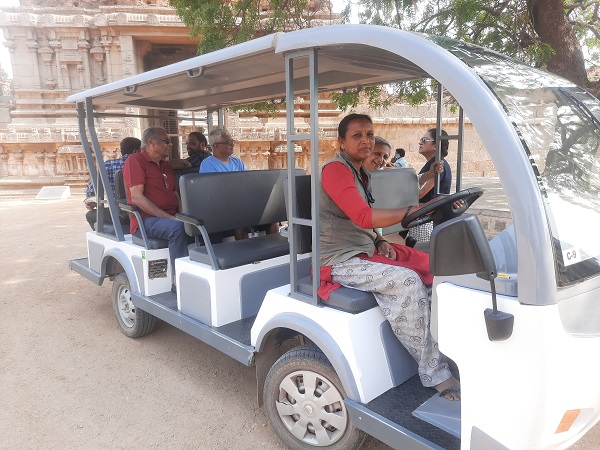
5.A very welcome move by the State Tourism is the introduction of e-vehicles to take the tourists to the various sites. Cars have to be parked at a certain point, and only these electrical vehicles run by the government are allowed beyond that. They charge a nominal amount. And it gets better! All these vehicles are driven by women. Our feisty driver went through a training of 15 days after selection, and confidently drove us around!
Hampi is divided into three core zones–the Sacred Centre, the Royal Centre and the Islamic Quarters. We got to see some parts of the Sacred Centre, so a lot is waiting.
Hampi is happy indeed, but with a little care, could be so much more so.
Here is to Happier Hampi!
–Meena

 Millennial Matriarchs