Serendipity is the Best Travel Guide

Last week, along with dear friends, we had driven to Shimoga to see the Jog Falls, maybe visit the Bhadravathi Sanctuary, and do the other local sights.

Alas, trouble broke out there and we decided to cut short our visit and drive back—fortunately after seeing the Falls. While we were not heart-broken to return a day early, there was an air of slight disappointment in the two cars.

When…

…we suddenly saw a sign ‘Welcome to Amrutapura: City of Ancient Amrutesvara Temple’ (Karnataka has a wonderful practice of labeling its towns, from Chennaptana: Toy Town, to others which are Silk Towns, Arecanut Towns, Coffee Towns etc.).  We recollected that the Hotel Desk had cursorily told us that Amrutapura was a possible place to visit, but we hadn’t really registered it it was a casual mention.

But now that we were here with a day to spare, we decided to explore the possibilities.

And what an experience awaited us!
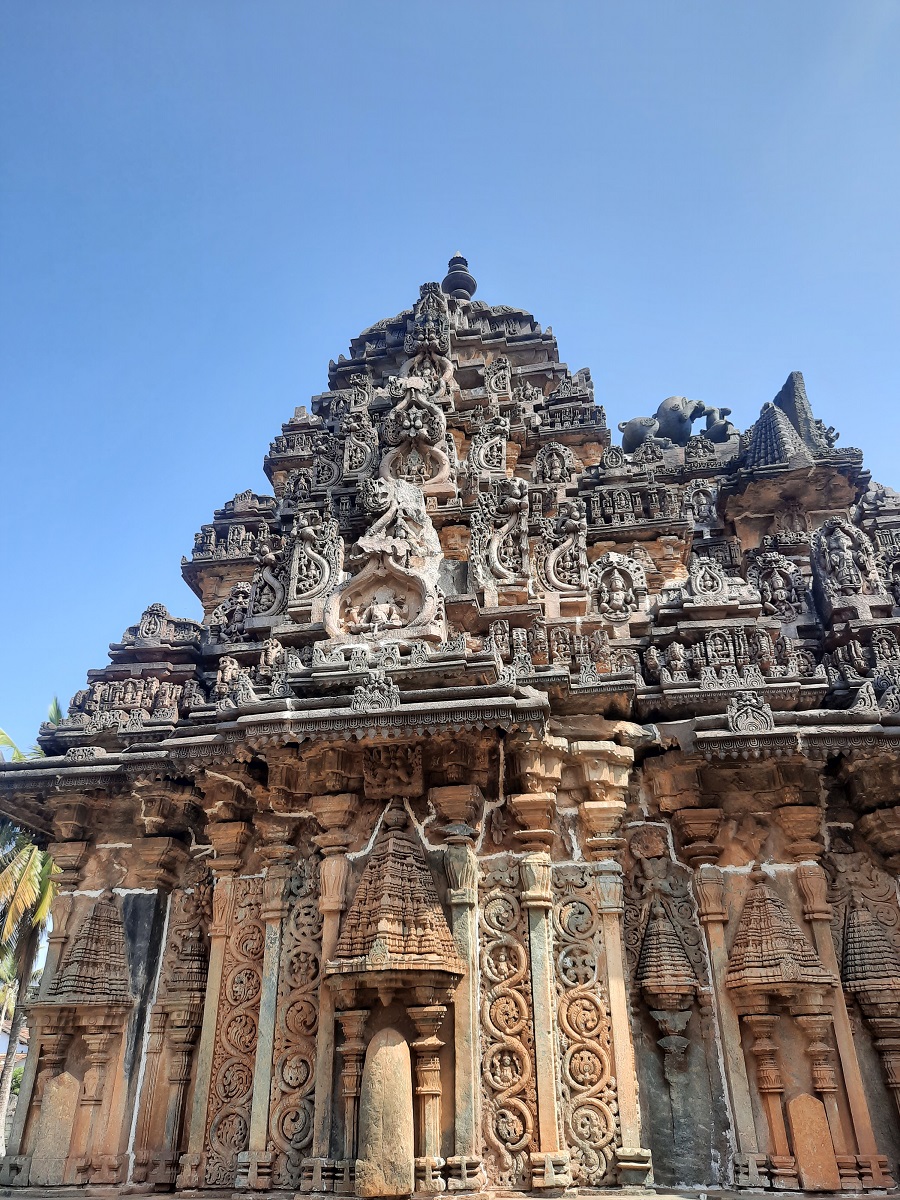
Amruthavarsha Temple, Karnataka
Gopuram of Amruthavarsha Temple, Karnataka

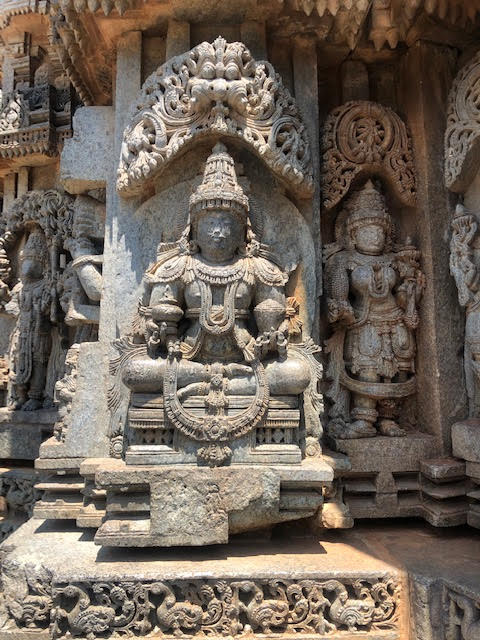
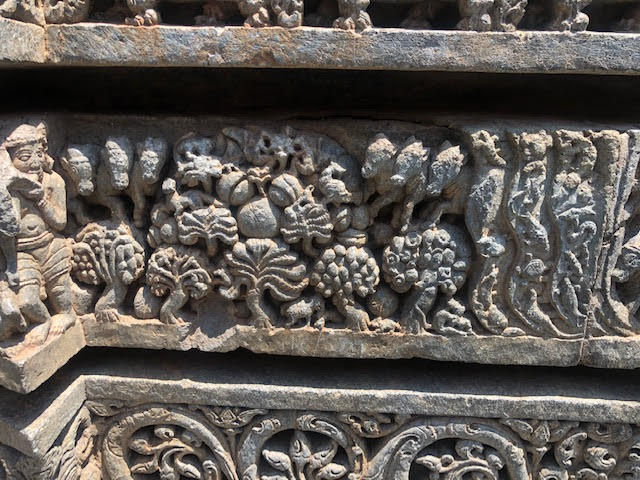
Built in what experts deem the older Hoysala style, this 12thcentury Shiva temple was commissioned by Amrutheshwara Dandanayaka, one of the commanders of Veera Ballala II, the Hoysala King. The beautiful little temple, where worship still happens, is dense with an amazing array of sculptures. Friezes from the Ramayana adorn one side of the structure, while stories of Krishna and tales from the Mahabharatha decorate the other. One tower has a detailed panel of Shiva slaying Gajasura. Another tower showcases the emblem of the Hoysalas, a young man battling a lion. As per folklore, a young man, Sala, saved his Jain guru, Sudatta by striking dead a lion near the temple of the goddess Vasantik. The name of the dynasty itself comes from this incident– ‘Hoy’ meaning strike, and ‘Sala’ for the young man’s name. (I am a little confused about this story, not being able to make out the connection between Sala and the dynasty–did he found it? Was he one of the scions? Obviously, more research is called for on my part. But what really intrigues me is the killing of a tiger to save a Jain muni. Surely the teacher could not have approved of this?). There is also a large stone embedded in the premises, with a poem inscribed on it, which is believed to have been written by Janna, one of the most famous poets of the region and times.
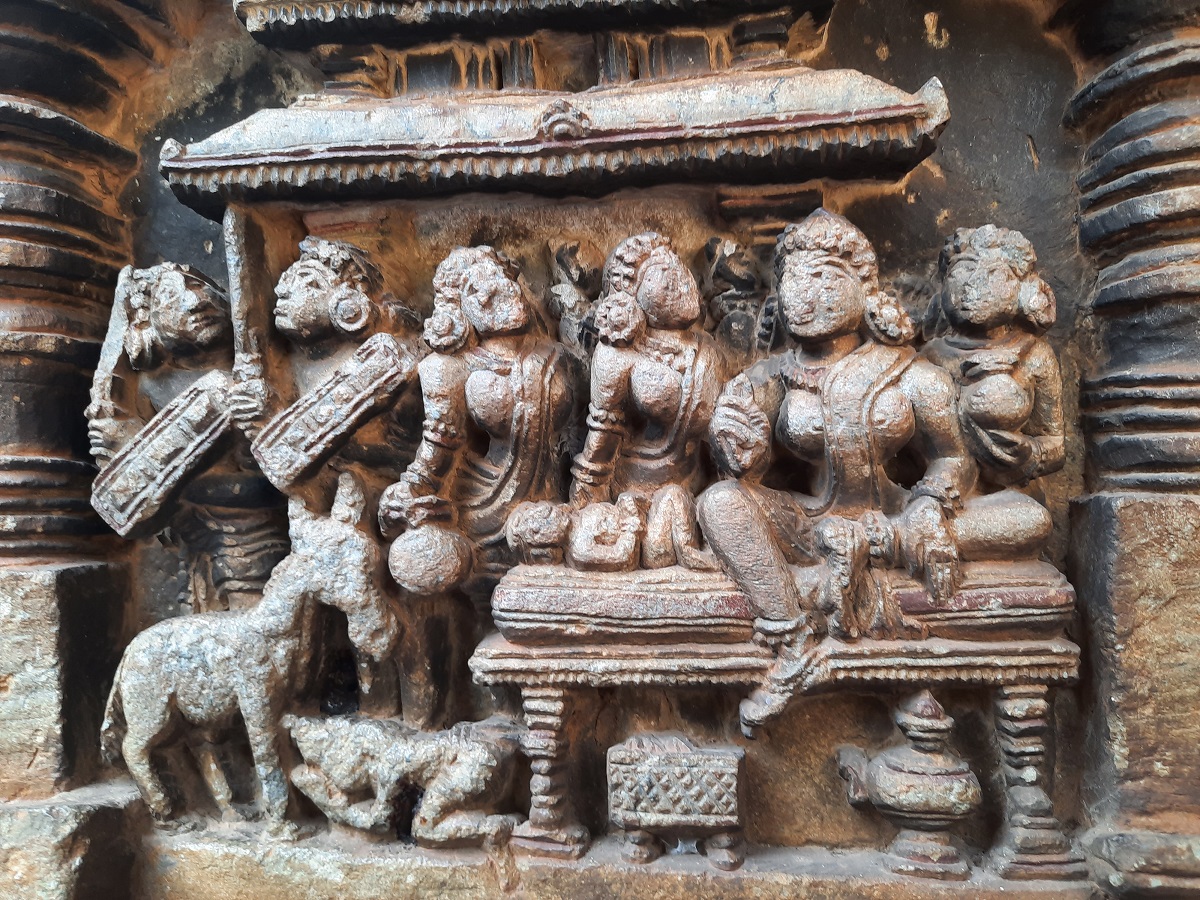
Vasudeva praying to the Donkey, Amruthavarsha Temple, Karnataka
Vasudeva praying to the Donkey

It would seem that a lot of thought had gone into selection of the incidents to be depicted on the friezes. Krishna’s birth, the events subsequent to that, the various attempts of various hideous demons to kill him in his infancy, and his mischievousness as a child form a large part of the display. The most intriguing was of one of a man bowing to a donkey. We could not figure it out, but the temple priest was kind enough to tell us the story. It seems that when Vasudeva was preparing to smuggle Baby Krishna out in a basket on the night he was born, to deliver him to Nand at Mathura to save him from Kamsa, there was a donkey outside the prison gates, all ready to bray aloud and attract the attention of the guards. Vasudeva prostrated himself in front of the donkey, pleading with it not to make a noise. And it finally agreed, thus allowing the clandestine operation to proceed smoothly.
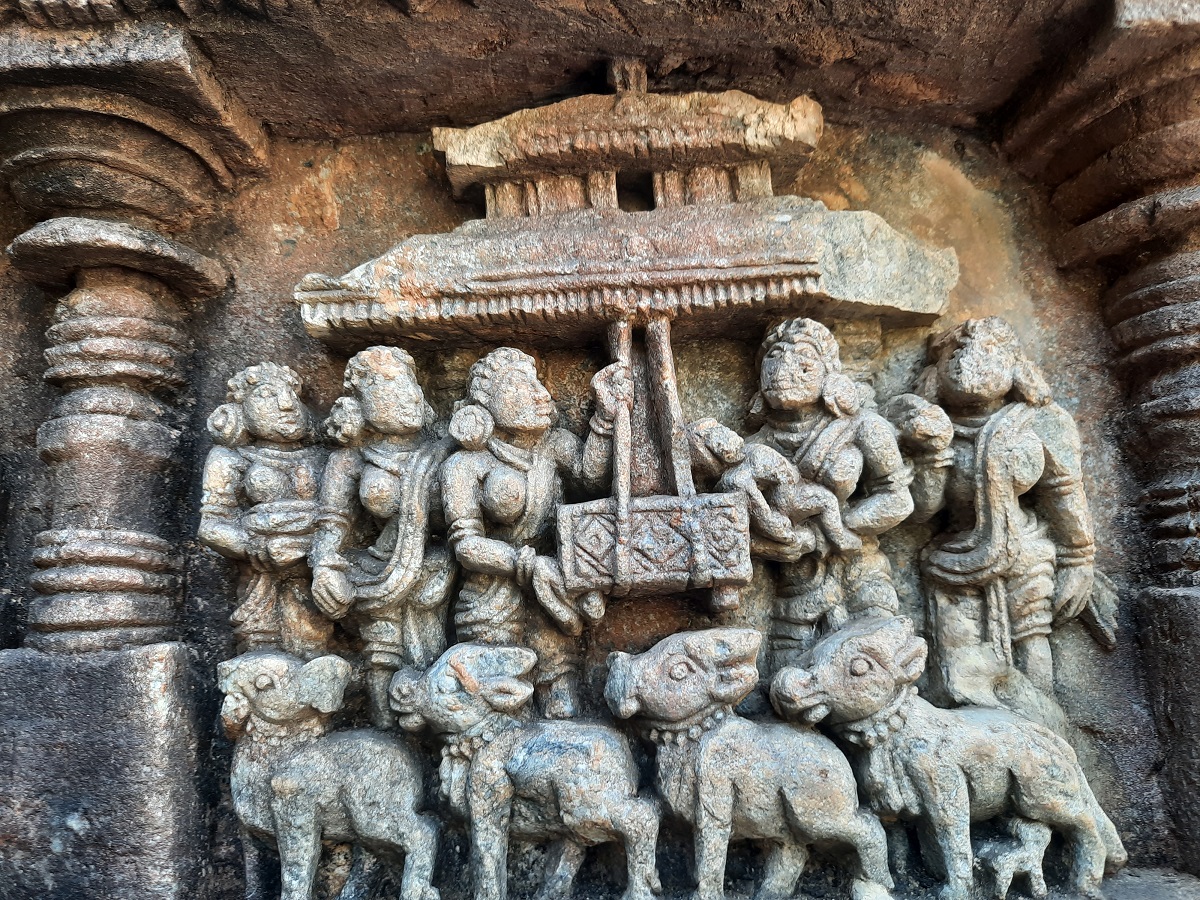
Krishna's Cradle Ceremony, Amruthavarsha Temple, Karnataka
Krishna’s Cradle Ceremony

There is of course the aesthetic beauty of the temple created in ancient times. But at a time when my 7-year old house has leaks and cracks and sundry problems, it is amazing to see how the 12th century structure is still so well maintained and standing so strong. And then, the peaceful and serene ambience of the temple, the spotless cleanliness, the well-maintained greenery. Kudos to the ancient masters, the priests who have taken care of the temple for 900 years+, and now the ASI, which seems to be managing it. But also a small request to ASI: how about a sign somewhere on the temple with its name (no, there was no hint that it was indeed the Amruthavarsha Temple)? How about some information on the temple itself, apart from signs warning of dire consequences of defacing the structure? How about a little more publicity for such a wonder? How about public conveniences built somewhere in the vicinity for travellers who drive many miles to get here?

But no complaints. The temple just blew our minds.  Maybe it is only in India that one would serendipitously happen on a 12th century masterpiece while driving along desultorily. 

–Meena
High-tech Barriers to Heritage

In between the first COVID wave and the second ongoing one, we were tempted to get a little adventurous. We scouted around for sites which we could visit on day-trips.

It is in this process that we got to know about a beautiful Hoysala-style temple situated in Somanathapura, which lies about 130 kms from Bangalore. This is the Chennakeshava Temple built by the Hoysala commander, Somanatha, in 1268 A.D.

And we made our way there with some friends.

It is an astounding structure, made completely of sandstone, with the most intricate carvings, built at the peak of Hoysala architectural excellence.

Chennakeśava means ‘handsome Keshava’, and the temple is dedicated to three forms of Vishu—Keshava, Janardhana and Venugopala. The main temple is on a star-shaped platform with three garbagrahas, each dedicated to one on the three forms. Besides this, there are 64 corridor shrines, set in magnificent pillared corridors. The main temple is surrounded by a pradakshina patha, all along which are carvings from the Ramayana, Mahabharata, Bhagavata Purana etc., which unfold as one undertakes the pradakshina.  The ceilings are decorated with intricate sculptures depicting different stages of the unfolding of a lotus. The massive stone pillars supporting the inner shrine were turned in ancient animal-drawn lathes.

The temple took several decades to build, but was in worship for only 60-70 years before it was sacked by invaders. Since the statues and the structure were defaced and broken, worship could no longer take place there, as per tradition.

It is a wonder that such an old and disused structure still stands in such good shape today—it is nearly 700+ years after it stopped being an active temple. It is in the hands of the Archaeological Survey of India (ASI), and one must appreciate their efforts to have the site in such good shape, standing in such well-maintained grounds. Even the toilets are fairly functional and clean.

But….

And it is a big BUT.

It is plagued by some problems which many of our heritage sites suffer from. For instance, we did not see a single signage anywhere on the roads telling the passers-by of the existence of such an amazing monument close by. Or to direct those who were looking for it.

Within 25 kms of the structure—leave alone on or near the premises—there is not a decent restaurant or even a picnic ground for those who had their own food.

But for the first time we came across a tech-challenge in such a place!

When we reached the gates of the monument and looked around for a ticket window, there was none. Instead there were a few flex posters, informing us of the rates (Rs 20 for online tickets), and a barcode to scan and pay. There were about six groups of tourists, all desperately trying to scan but no one was successful. After about five minutes, the helpful security guard came up to us and told us that it was not working. He suggested we should try to log into the ASI site, pay online and get our tickets. We all tried dutifully. But the signal was at best patchy and the site slow. My friend could get in. The names of each one of the group had to be entered. And the Aadhar or PAN of the person doing the booking. When she tried to pay, it got into a loop which there was no coming out of. We looked around, and many other people were in the same soup. We asked the Guard if he could not just take the money and give us tickets, but he told us that was not allowed. By this time, one person from another group was successful in getting his ticket from the ASI site. So using typical Indian jugaad, we begged him not to exit, but to do our ticketing online, and that we would pay him the Rs. 20/head in cash. He obligingly did this for some of us.

The whole process took us about 20 minutes and was pretty stressful.

And then we went in to visit the monument. Which fortunately was amazing enough to make it all worth while.

But it left us wondering what the point was. Does anyone who wants to visit a heritage site HAVE to have a smartphone? In a country where literacy, let alone digital literacy, is not to be taken for granted, should lack of these prevent a person from such basic access (never mind that it is a barrier even to COVID vaccination!). Is there an inherent age-discrimination–many older people are uncomfortable with all these scan-and-pay modes.  If the wifi does not work at a site, are people to go back the 150 kms they came to visit the monument? And why is the name of every visitor needed for buying entry tickets? Why is Aadhar or PAN information needed? Where does this information go, and what becomes of it?

If the purpose of technology is to make life easier for citizens, then this is surely not the way! The system is good in that it provides a nudge for digital payment (if you scan and pay it is Rs. 20, and if you could buy a physical ticket it is Rs. 25 per ticket). Nudges are good for bringing about behavior change. But taking away options is discriminatory and against basic rights. As is seeking information which is not relevant to anything!

Why does something like a visit to our own heritage sites have to become a battleground about rights?

–Meena