
December 11 is marked as the International Mountain Day. Mountains have always fascinated human beings not only for their sheer scale and majesty, but also as a natural element that offers a challenge, as well as a test of physical and mental strength, and the thrill of scaling the peaks. There are numerous narratives of expeditions that describe these challenges and achievements, most of these by, and about men.
A different perspective, and approach towards mountains reminds us that there is more to mountains than the thrill of conquest.
This was lyrically described by Anna (who called herself Nan) Shepherd, a Scottish poet, writer and explorer of mountains. Nan was born in February 1893, close to Aberdeen on the North East coast of Scotland. When she was one month old, her family moved to nearby Cults and lived in a house with a garden overlooking the hills. Nan continued to live in the same house almost till the end of her life. As a young girl Nan was encouraged by her father, a keen hill walker, to explore the nearby hills, and this planted in her a lifelong love for nature and the mountains. Nan was an equally avid reader, and from her early teens she would fill notebooks with passages that inspired her from the wide spectrum of her reading. After completing her schooling in 1912, Nan joined the University of Aberdeen in the first decades after women were allowed to do so. She was an outstanding student, and graduated in 1915 with an MA in literature. Following this she taught English literature at Aberdeen Training Centre for Teachers, and continued to give enthralling lectures until she was well into her eighties. She was not only an inspiring teacher but also a role model for her students, as an early feminist. She wryly described her role as “the heaven-appointed task of trying to prevent a few of the students who pass through our Institution from conforming altogether to the approved pattern.”
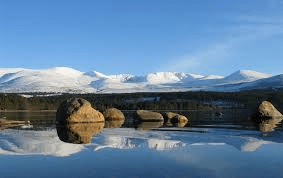
Although she had always enjoyed walking in the hills, Nan Shepherd became deeply engaged with climbing in the period between the two World Wars. She was thirty years old when she began her explorations in the Cairngorms in 1928. This experience was the start of a passion that came to define both her life and her writing. From then on, she sought to escape into the Cairngorms whenever her job would allow. Often she would walk alone, camping out, and wading into hidden lochs. Occasionally she was accompanied by friends and fellow walkers from the local Deeside Field Club, or by students from the university.
By the 1940s Nan had scaled some of the highest peaks in the Cairngorms, among the wildest landscapes in the British Isles. However Nan’s expeditions were not about ‘reaching the top’ but rather a spiritual journey to ‘understand herself and the world’. She became fascinated by what happened to mind and matter on this journey up and down the mountain slopes.
These experiences were reflected in her literary work. The harsh landscape, as well as the people and places she knew well, provided the background to her first three books, published while she was teaching. These novels focussed on the harsh landscape which made for a harsh way of life, and within these, complexities of women struggling with maintaining traditional roles in a dawning age which was opening up new opportunities
But Nan Shepherd never wrote for recognition. She wrote only when she felt she had something worth saying. “I don’t like writing, really. In fact, I very rarely write. No. I never do short stories and articles. I only write when I feel that there’s something that simply must be written.”
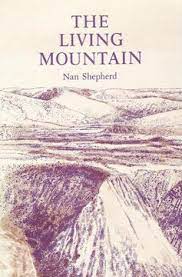
For her teaching was as, if not more, important than her writing. However she continued to document her explorations of the Cairngorms, which came together around the end of the Second World War, under the title The Living Mountain. She combined her knowledge of the mountains, her observations of their rugged beauty, and her literary skills to muse on the philosophical and spiritual offerings from mountains. She wrote of the Cairngorms as “friends” that she “visits”, and with whom her imagination is fired as if “touched by another mind.”
Nan Shepherd completed her book in the summer of 1945, and sent her manuscript to a novelist friend. He cautioned that it may be hard to find a publisher of a book of this nature. Nan put the manuscript away in a drawer where it remained for 30 years. Towards the end of her life, Nan retrieved the manuscript from her drawer and felt that it still resonated in many ways. Given her long association with Aberdeen University, she submitted it to Aberdeen University Press. The Living Mountain was finally published in 1977.
The Living Mountain threaded together, beautifully geography, geology, history and philosophy, along with everything that she herself had experienced in the mountains that she had fallen deeply in love with. For Shepherd, the mountains were living beings, and her book describes how she nurtured her relationship with them by walking. She wholeheartedly believed that only through walking and experiencing could insight be gained. “The more one learns of this intricate interplay of soil, altitude, weather, and the living tissues of plant and insect … the more the mystery deepens.”
The Living Mountain, continues to be timeless, since its publication 30 years after Nan Shephard wrote it. It provides a rare lens into a world that has been viewed mainly through the eyes of male climbers, who focus on the challenges, and the conquests. Nan Shepherd’s lens is that of a naturalist and poet, one of contemplation, reverence, and an exploration of the profound. The book suggests that the summit should not be the organizing principle of a mountain; it urges the practice of not walking “up” a mountain, but rather “into” them, so as to explore not just the physical forms but also ourselves, peering into the nooks and crannies.
Today, mountains across the world are facing their own challenges. Climate change is melting glaciers and distorting landscapes; the surge of climbers are leaving behind manmade mountains of garbage that threaten to bury the real mountains. This is a good time to remember The Living Mountain, and a mountain lover who looked beyond the ascents to the journeys within.
–Mamata Pandya
 Millennial Matriarchs